Thank you for visiting SNEWPapers!
Sign up free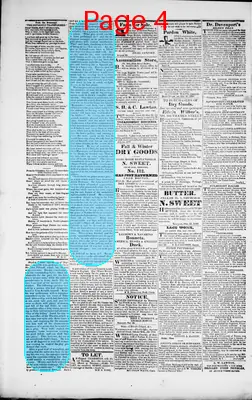
Story
December 9, 1830
The Rhode Island Republican
Newport, Newport County, Rhode Island
What is this article about?
Anecdote of actor Stephen Kemble: A sailor pays 30 guineas to rent a seaside theater for a private performance of Henry IV Part 1 to watch Kemble as Falstaff, cheering wildly and ignoring non-Falstaff scenes before leaving content.
Clipping
OCR Quality
98%
Excellent
Full Text
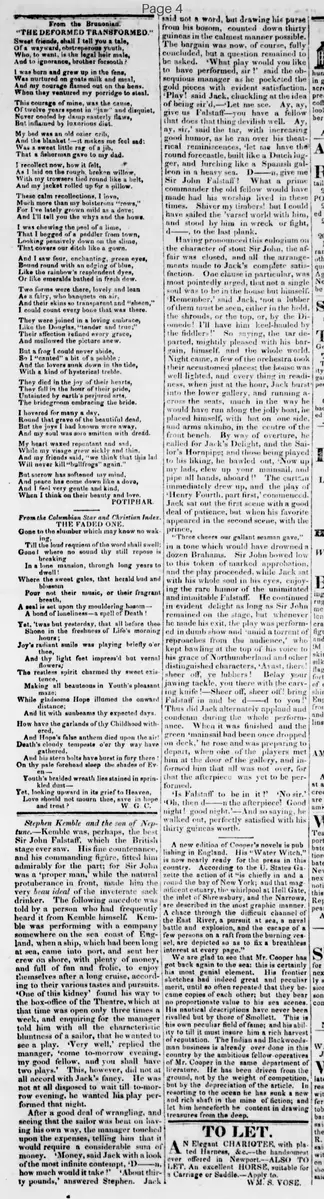
Stephen Kemble and the son of Neptune.—Kemble was, perhaps, the best Sir John Falstaff, which the British stage ever saw. His fine countenance, and his commanding figure, fitted him admirably for the part; for Sir John was a 'proper man,' while the natural protuberance in front, made him the very beau ideal of the inveterate sack drinker. The following anecdote was told by a person who had frequently heard it from Kemble himself. Kemble was performing with a company somewhere on the sea coast of England, when a ship, which had been long at sea, came into port, and sent her crew on shore, with plenty of money, and full of fun and frolic, to enjoy themselves after a long cruise, according to their various tastes and pursuits.
'One of this kidney' found his way to the box-office of the Theatre, which at that time was open only three times a week, and enquiring for the manager told him with all the characteristic bluntness of a sailor, that he wanted to see a play. 'Very well,' replied the manager, 'come to-morrow evening, my good fellow, and you shall have two plays.' This, however, did not at all accord with Jack's fancy. He was not at all disposed to wait till to-morrow evening, he wanted his play performed that night.
After a good deal of wrangling, and seeing that the sailor was bent on having his own way, the manager touched upon the expenses, telling him that it would require a considerable sum of money. 'Money,' said Jack with a look of the most infinite contempt, 'Devil a bit do I care for money—how much would it take?' 'About thirty pounds,' answered Stephen. Jack said not a word, but drawing his purse from his bosom, counted down thirty guineas in the calmest manner possible. The bargain was now, of course, fully concluded, but a question remained to be asked. 'What play would you like to have performed, sir?' said the obsequious manager as he pocketed the gold pieces with evident satisfaction.
'Play!' said Jack, chuckling at the idea of being sir'd,—'Let me see. Ay, ay, give us Falstaff—you have a fellow that does that thing devilish well. Ay, ay, sir,' said the tar, with increasing good humor, as he ran over his theatrical reminiscences, 'let me have the round forecastle, built like a Dutch lugger, and lurching like a Spanish galleon in a heavy sea. D—n, give me Sir John Falstaff? What a prime commander the old fellow would have made had his worship lived in these times. Shiver my timbers! but I could have sailed the 'varsal world with him, and stood by him in wreck or fight, d—n, to the last plank.
Having pronounced this eulogium on the character of stout Sir John, the affair was closed, and all the arrangements made to Jack's complete satisfaction. One clause in particular, was most pointedly urged, that not a single soul was to be in the house but himself. 'Remember,' said Jack, 'not a lubber of them must be seen, either in the hold, the shrouds, or the top, or, by the Diomede! I'll have him keel-hauled by the fiddlers!' So saying, the tar departed, mightily pleased with his bargain, himself, and the whole world.
Night came, a few of the orchestra took their accustomed places; the house was well lighted, and every thing in readiness, when just at the hour, Jack burst into the lower gallery, and running across the seats, much in the way he would have run along the jolly boat, he placed himself, with hat on one side, and arms akimbo, in the centre of the front bench. By way of overture, he called for Jack's Delight, and the Sailor's Hornpipe; and those being played to his liking, he bawled out, 'Now up my lads, clew up your mainsail, and pipe all hands, aboard!' The curtain immediately drew up, and the play of 'Henry Fourth, part first,' commenced.
Jack sat out the first scene with a good deal of patience, but when his favorite appeared in the second scene, with the prince, 'Three cheers our gallant seaman gave,' in a tone which would have drowned a dozen Brahmas. Sir John bowed low to this token of marked approbation, and the play proceeded, while Jack sat with his whole soul in his eyes, enjoying the rare humor of the unimitated and inimitable Falstaff. He continued in evident delight as long as Sir John remained on the stage, but whenever he made his exit, the play was performed in dumb show and 'amid a torrent of reproaches from the audience,' who kept bawling at the top of his voice to his grace of Northumberland and other distinguished characters, 'Avast, there sheer off, ye lubbers! Belay your jawing tackle, you there with the carving knife!—Sheer off, sheer off! bring Falstaff in and be d—d to you!'
Thus did Jack alternately applaud and condemn during the whole performance. When it was finished and the green 'mainsail had been once dropped on deck,' he rose and was preparing to depart, when one of the players met him at the door of the gallery, and informed him that all was not over, for that the afterpiece was yet to be performed.
'Is Falstaff to be in it?' 'No sir.' 'Oh, then d—n the afterpiece! Good night! good night.'—And so saying, he walked out, perfectly satisfied with his thirty guineas worth.
'One of this kidney' found his way to the box-office of the Theatre, which at that time was open only three times a week, and enquiring for the manager told him with all the characteristic bluntness of a sailor, that he wanted to see a play. 'Very well,' replied the manager, 'come to-morrow evening, my good fellow, and you shall have two plays.' This, however, did not at all accord with Jack's fancy. He was not at all disposed to wait till to-morrow evening, he wanted his play performed that night.
After a good deal of wrangling, and seeing that the sailor was bent on having his own way, the manager touched upon the expenses, telling him that it would require a considerable sum of money. 'Money,' said Jack with a look of the most infinite contempt, 'Devil a bit do I care for money—how much would it take?' 'About thirty pounds,' answered Stephen. Jack said not a word, but drawing his purse from his bosom, counted down thirty guineas in the calmest manner possible. The bargain was now, of course, fully concluded, but a question remained to be asked. 'What play would you like to have performed, sir?' said the obsequious manager as he pocketed the gold pieces with evident satisfaction.
'Play!' said Jack, chuckling at the idea of being sir'd,—'Let me see. Ay, ay, give us Falstaff—you have a fellow that does that thing devilish well. Ay, ay, sir,' said the tar, with increasing good humor, as he ran over his theatrical reminiscences, 'let me have the round forecastle, built like a Dutch lugger, and lurching like a Spanish galleon in a heavy sea. D—n, give me Sir John Falstaff? What a prime commander the old fellow would have made had his worship lived in these times. Shiver my timbers! but I could have sailed the 'varsal world with him, and stood by him in wreck or fight, d—n, to the last plank.
Having pronounced this eulogium on the character of stout Sir John, the affair was closed, and all the arrangements made to Jack's complete satisfaction. One clause in particular, was most pointedly urged, that not a single soul was to be in the house but himself. 'Remember,' said Jack, 'not a lubber of them must be seen, either in the hold, the shrouds, or the top, or, by the Diomede! I'll have him keel-hauled by the fiddlers!' So saying, the tar departed, mightily pleased with his bargain, himself, and the whole world.
Night came, a few of the orchestra took their accustomed places; the house was well lighted, and every thing in readiness, when just at the hour, Jack burst into the lower gallery, and running across the seats, much in the way he would have run along the jolly boat, he placed himself, with hat on one side, and arms akimbo, in the centre of the front bench. By way of overture, he called for Jack's Delight, and the Sailor's Hornpipe; and those being played to his liking, he bawled out, 'Now up my lads, clew up your mainsail, and pipe all hands, aboard!' The curtain immediately drew up, and the play of 'Henry Fourth, part first,' commenced.
Jack sat out the first scene with a good deal of patience, but when his favorite appeared in the second scene, with the prince, 'Three cheers our gallant seaman gave,' in a tone which would have drowned a dozen Brahmas. Sir John bowed low to this token of marked approbation, and the play proceeded, while Jack sat with his whole soul in his eyes, enjoying the rare humor of the unimitated and inimitable Falstaff. He continued in evident delight as long as Sir John remained on the stage, but whenever he made his exit, the play was performed in dumb show and 'amid a torrent of reproaches from the audience,' who kept bawling at the top of his voice to his grace of Northumberland and other distinguished characters, 'Avast, there sheer off, ye lubbers! Belay your jawing tackle, you there with the carving knife!—Sheer off, sheer off! bring Falstaff in and be d—d to you!'
Thus did Jack alternately applaud and condemn during the whole performance. When it was finished and the green 'mainsail had been once dropped on deck,' he rose and was preparing to depart, when one of the players met him at the door of the gallery, and informed him that all was not over, for that the afterpiece was yet to be performed.
'Is Falstaff to be in it?' 'No sir.' 'Oh, then d—n the afterpiece! Good night! good night.'—And so saying, he walked out, perfectly satisfied with his thirty guineas worth.
What sub-type of article is it?
Biography
Curiosity
What themes does it cover?
Triumph
Social Manners
What keywords are associated?
Stephen Kemble
Falstaff
Sailor
Theater Hire
Henry Iv
Anecdote
What entities or persons were involved?
Stephen Kemble
Jack
Where did it happen?
Sea Coast Of England
Story Details
Key Persons
Stephen Kemble
Jack
Location
Sea Coast Of England
Story Details
A sailor hires the theater manager Stephen Kemble for 30 guineas to perform Henry IV Part 1 that night just for himself, specifically to see Kemble as Falstaff. He enjoys the performance enthusiastically, cheering for Falstaff and criticizing other scenes, then leaves satisfied after refusing the afterpiece.