Thank you for visiting SNEWPapers!
Sign up free
Staunton Spectator
Staunton, Virginia
What is this article about?
The British House of Lords is hearing an appeal in the Thellusson case, involving the 1796 will of merchant Peter Thellusson, who left £3,000,000 to accumulate for his descendants until the last of nine offspring died in February 1856. The fortune, now diminished by legal fees, is to be divided among eldest male lineal descendants, with disputes over entitlement ongoing.
Clipping
OCR Quality
Full Text
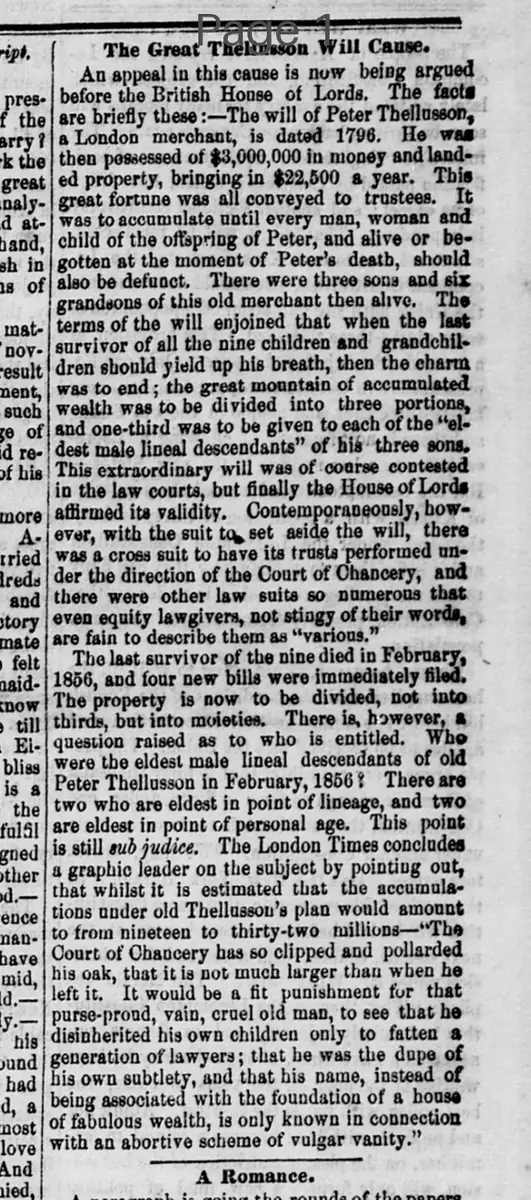
An appeal in this cause is now being argued before the British House of Lords. The facts are briefly these: The will of Peter Thellusson, a London merchant, is dated 1796. He was then possessed of £3,000,000 in money and landed property, bringing in £22,500 a year. This great fortune was all conveyed to trustees. It was to accumulate until every man, woman and child of the offspring of Peter, and alive or begotten at the moment of Peter's death, should also be defunct. There were three sons and six grandsons of this old merchant then alive. The terms of the will enjoined that when the last survivor of all the nine children and grandchildren should yield up his breath, then the charm was to end; the great mountain of accumulated wealth was to be divided into three portions, and one-third was to be given to each of the "eldest male lineal descendants" of his three sons.
This extraordinary will was of course contested in the law courts, but finally the House of Lords affirmed its validity. Contemporaneously, however, with the suit to set aside the will, there was a cross suit to have its trusts performed under the direction of the Court of Chancery, and there were other law suits so numerous that even equity lawgivers, not stingy of their words, are fain to describe them as "various."
The last survivor of the nine died in February, 1856, and four new bills were immediately filed. The property is now to be divided, not into thirds, but into moieties. There is, however, a question raised as to who is entitled. Who were the eldest male lineal descendants of old Peter Thellusson in February, 1856? There are two who are eldest in point of lineage, and two are eldest in point of personal age. This point is still sub judice. The London Times concludes a graphic leader on the subject by pointing out, that whilst it is estimated that the accumulations under old Thellusson's plan would amount to from nineteen to thirty-two millions—"The Court of Chancery has so clipped and pollarded his oak, that it is not much larger than when he left it. It would be a fit punishment for that purse-proud, vain, cruel old man, to see that he disinherited his own children only to fatten a generation of lawyers; that he was the dupe of his own subtlety, and that his name, instead of being associated with the foundation of a house of fabulous wealth, is only known in connection with an abortive scheme of vulgar vanity."
What sub-type of article is it?
What keywords are associated?
What entities or persons were involved?
Where did it happen?
Foreign News Details
Primary Location
London
Event Date
February 1856
Key Persons
Outcome
property to be divided into moieties among eldest male lineal descendants; accumulations estimated at 19-32 millions but diminished by court of chancery fees to near original size; entitlement dispute sub judice.
Event Details
Appeal argued before House of Lords on 1796 will of London merchant Peter Thellusson, leaving £3,000,000 to accumulate until death of last of nine offspring in February 1856. Will contested but upheld; numerous lawsuits followed. Division now into moieties, with question of eldest male lineal descendants unresolved.