Thank you for visiting SNEWPapers!
Sign up free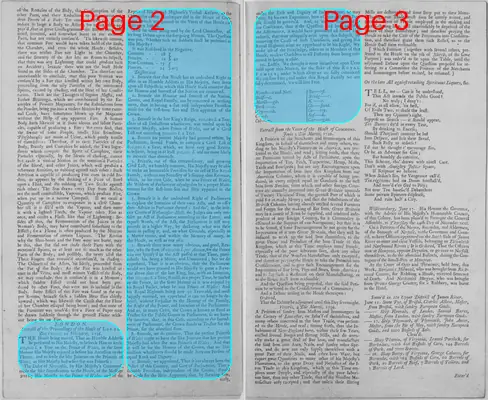
The Virginia Gazette
Richmond, Williamsburg, Richmond County, Virginia
What is this article about?
On February 25, 1736, the House of Lords debated and rejected a motion to address King George II for settling £100,000 annually on the Prince of Wales and a jointure on the Princess, mirroring prior royal provisions. Vote: 40 contents, 103 non-contents. Several lords dissented with detailed reasons.
Merged-components note: Continuation of the foreign news extract from House of Lords proceedings across pages; merged as sequential reading order and text continuity.
Clippings
1 of 2
OCR Quality
Full Text
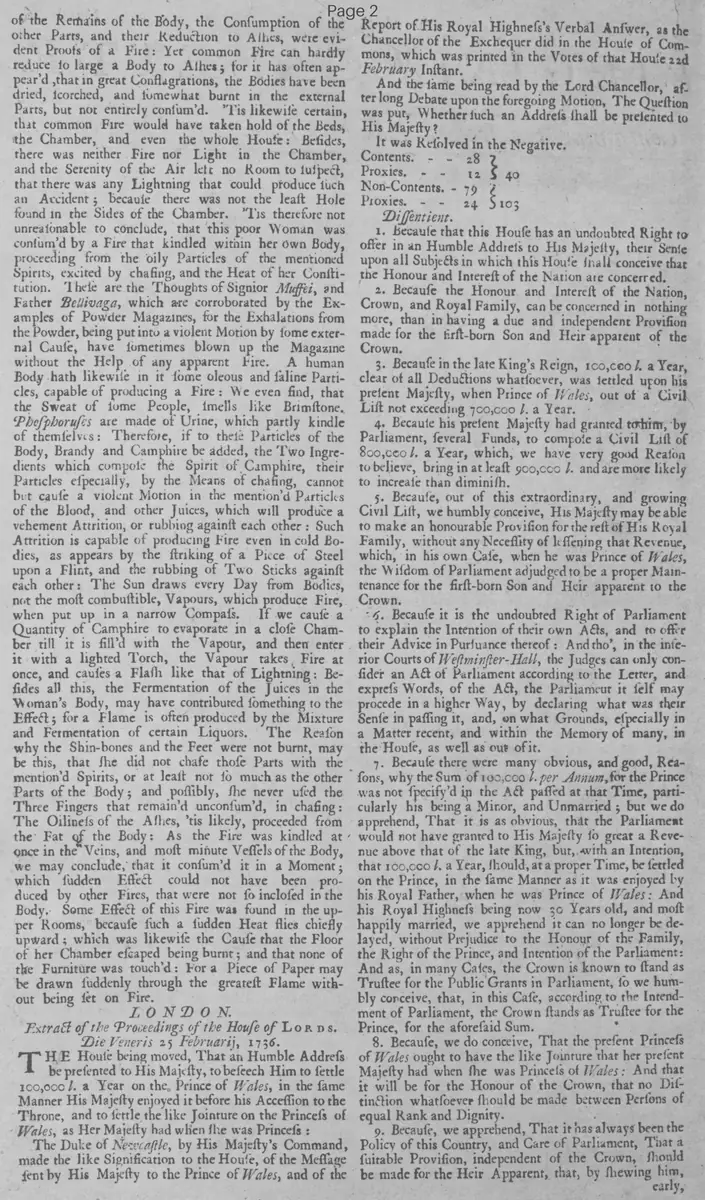
Extract of the Proceedings of the House of Lords.
Die Veneris 25 Februarij, 1736.
THE House being moved, That an Humble Address be presented to His Majesty, to beseech Him to settle 100,000 l. a Year on the Prince of Wales, in the same Manner His Majesty enjoyed it before his Accession to the Throne, and to settle the like Jointure on the Princess of Wales, as Her Majesty had when she was Princess: The Duke of Newcastle, by His Majesty's Command, made the like Signification to the House, of the Message Sent by His Majesty to the Prince of Wales, and of the Report of His Royal Highness's Verbal Answer, as the Chancellor of the Exchequer did in the House of Commons, which was printed in the Votes of that House 22d February Instant. And the same being read by the Lord Chancellor, after long Debate upon the foregoing Motion, The Question was put, Whether such an Address shall be presented to His Majesty? It was Resolved in the Negative.
Contents. 28
Proxies. 12
40
Non-Contents. 79
Proxies. 24
103
Dissentient.
1. Because that this House has an undoubted Right to offer in an Humble Address to His Majesty, their Sense upon all Subjects in which this House Shall conceive that the Honour and Interest of the Nation are concerned.
2. Because the Honour and Interest of the Nation, Crown, and Royal Family, can be concerned in nothing more, than in having a due and independent Provision made for the first-born Son and Heir apparent of the Crown.
3. Because in the late King's Reign, 100,000 l. a Year, clear of all Deductions whatsoever, was settled upon his present Majesty, when Prince of Wales, out of a Civil List not exceeding 700,000 l. a Year.
4. Because his present Majesty had granted to him, by Parliament, several Funds, to compose a Civil List of 800,000 l. a Year, which, we have very good Reason to believe, bring in at least 900,000 l. and are more likely to increase than diminish.
5. Because, out of this extraordinary, and growing Civil List, we humbly conceive, His Majesty may be able to make an honourable Provision for the rest of His Royal Family, without any Necessity of lessening that Revenue, which, in his own Case, when he was Prince of Wales, the Wisdom of Parliament adjudged to be a proper Maintenance for the first-born Son and Heir apparent to the Crown.
6. Because it is the undoubted Right of Parliament to explain the Intention of their own Acts, and to offer their Advice in Pursuance thereof: And tho', in the inferior Courts of Westminster-Hall, the Judges can only consider an Act of Parliament according to the Letter, and express Words, of the Act, the Parliament it self may proceed in a higher Way, by declaring what was their Sense in passing it, and, on what Grounds, especially in a Matter recent, and within the Memory of many, in the House, as well as out of it.
7. Because there were many obvious, and good, Reasons, why the Sum of 100,000 l. per Annum, for the Prince was not specify'd in the Act pass'd at that Time, particularly his being a Minor, and Unmarried; but we do apprehend, That it is as obvious, that the Parliament would not have granted to His Majesty so great a Revenue above that of the late King, but, with an Intention, that 100,000 l. a Year, should, at a proper Time, be settled on the Prince, in the same Manner as it was enjoyed by his Royal Father, when he was Prince of Wales: And his Royal Highness being now 30 Years old, and most happily married, we apprehend it can no longer be delay'd, without Prejudice to the Honour of the Family, the Right of the Prince, and Intention of the Parliament: And as, in many Cases, the Crown is known to stand as Trustee for the Public Grants in Parliament; so we humbly conceive, that, in this Case, according to the Intentment of Parliament, the Crown stands as Trustee for the Prince, for the aforesaid Sum.
8. Because, we do conceive, That the present Princess of Wales ought to have the like Jointure that her present Majesty had when he was Princess of Wales: And that it will be for the Honour of the Crown, that no Distinction whatsoever should be made between Persons of equal Rank and Dignity.
9. Because, we apprehend, That it has always been the Policy of this Country, and Care of Parliament, That a suitable Provision, independent of the Crown, Should be made for the Heir Apparent, that, by Shewing him,early, the Ease and Dignity of Independence, he may learn, by his own Experience, how a Great and Free People should be govern'd. And, as we are convinced in our Conscience, that if the Question had been pass'd in the Affirmative, it would have prevented all future Uneasiness, that may unhappily arise upon this Subject, by removing the Cause of such Uneasiness, and giving His Royal Highness what we apprehend to be his Right, We make use of the Privilege, inherent in Members of this House, to clear Ourselves to all Posterity from being concerned in laying it aside.
10. Lastly,
We thought it more incumbent upon Us to insist upon this Motion, for the Sake of this ROYAL FAMILY; under Which alone we are fully convinced We can live Free; and under this Royal Family we are fully determined, We will live Free.
Winch--a and Nott.
Ba----rt.
Bedf-d.
Brilg----r
Marlb--gh
K-...-r.
Berk.---ye.
Ch----feild.
If'ey----th.
Co-:---try.
C-----t..
S!!f.--.-k.
Coj----m.
Car-.---gan::
What sub-type of article is it?
What keywords are associated?
What entities or persons were involved?
Where did it happen?
Foreign News Details
Primary Location
London
Event Date
1736 02 25
Key Persons
Outcome
motion resolved in the negative; contents: 40 (28 + 12 proxies); non-contents: 103 (79 + 24 proxies). several lords dissented with 10 reasons listed.
Event Details
The House of Lords debated a motion for an humble address to His Majesty to settle £100,000 a year on the Prince of Wales as previously enjoyed by the King before accession, and a like jointure on the Princess of Wales. The Duke of Newcastle relayed the King's message and the Prince's response. After debate, the question was put and resolved negatively.