Thank you for visiting SNEWPapers!
Sign up free
Literary
April 8, 1891
Barbour County Index
Medicine Lodge, Barber County, Kansas
What is this article about?
An overview of Tibetan literature, primarily Buddhist religious texts, including translations from Sanskrit and Chinese, native compositions, and the Bon religion's works. Emphasizes its religious foundation and importance in portraying Buddhist philosophy.
Clipping
OCR Quality
95%
Excellent
Full Text
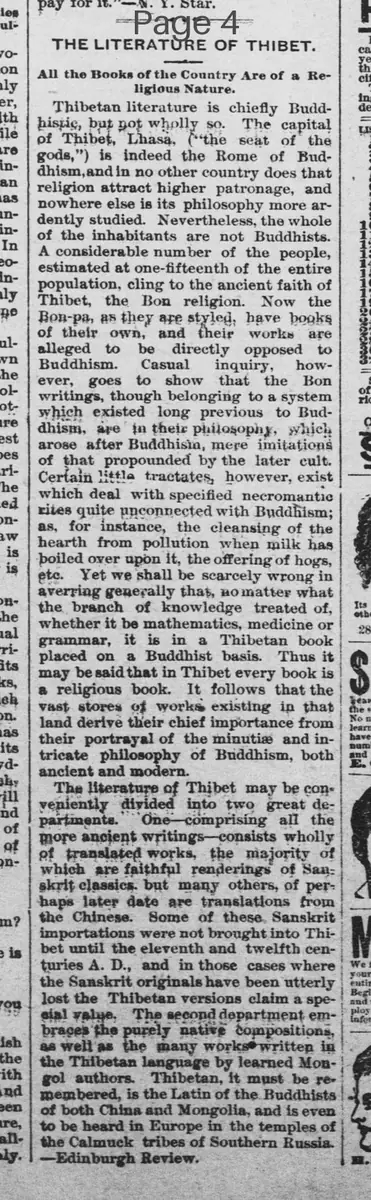
THE LITERATURE OF THIBET.
All the Books of the Country Are of a Religious Nature.
Thibetan literature is chiefly Buddhistic, but not wholly so. The capital of Thibet, Lhasa, (the seat of the gods,) is indeed the Rome of Buddhism, and in no other country does that religion attract higher patronage, and nowhere else is its philosophy more ardently studied. Nevertheless, the whole of the inhabitants are not Buddhists. A considerable number of the people, estimated at one-fifteenth of the entire population, cling to the ancient faith of Thibet, the Bon religion. Now the Bon-pa, as they are styled, have books of their own, and their works are alleged to be directly opposed to Buddhism. Casual inquiry, however, goes to show that the Bon writings, though belonging to a system which existed long previous to Buddhism, are in their philosophy, which arose after Buddhism, mere imitations of that propounded by the latter cult. Certain little tractates, however, exist which deal with specified necromantic rites quite unconnected with Buddhism; as, for instance, the cleansing of the hearth from pollution when milk has boiled over upon it, the offering of hogs, etc. Yet we shall be scarcely wrong in averring generally that, no matter what the branch of knowledge treated of, whether it be mathematics, medicine or grammar, it is in a Thibetan book placed on a Buddhist basis. Thus it may be said that in Thibet every book is a religious book. It follows that the vast stores of works existing in that land derive their chief importance from their portrayal of the minutiae and intricate philosophy of Buddhism, both ancient and modern.
The literature of Thibet may be conveniently divided into two great departments. One-comprising all the more ancient writings-consists wholly of translated works, the majority of which are faithful renderings of Sanskrit classics, but many others, of perhaps later date are translations from the Chinese. Some of these Sanskrit importations were not brought into Thibet until the eleventh and twelfth centuries A. D., and in those cases where the Sanskrit originals have been utterly lost the Thibetan versions claim a special value. The second department embraces the purely native compositions, as well as the many works written in the Thibetan language by learned Mongol authors. Thibetan, it must be remembered, is the Latin of the Buddhists of both China and Mongolia, and is even to be heard in Europe in the temples of the Calmuck tribes of Southern Russia.
-Edinburgh Review.
All the Books of the Country Are of a Religious Nature.
Thibetan literature is chiefly Buddhistic, but not wholly so. The capital of Thibet, Lhasa, (the seat of the gods,) is indeed the Rome of Buddhism, and in no other country does that religion attract higher patronage, and nowhere else is its philosophy more ardently studied. Nevertheless, the whole of the inhabitants are not Buddhists. A considerable number of the people, estimated at one-fifteenth of the entire population, cling to the ancient faith of Thibet, the Bon religion. Now the Bon-pa, as they are styled, have books of their own, and their works are alleged to be directly opposed to Buddhism. Casual inquiry, however, goes to show that the Bon writings, though belonging to a system which existed long previous to Buddhism, are in their philosophy, which arose after Buddhism, mere imitations of that propounded by the latter cult. Certain little tractates, however, exist which deal with specified necromantic rites quite unconnected with Buddhism; as, for instance, the cleansing of the hearth from pollution when milk has boiled over upon it, the offering of hogs, etc. Yet we shall be scarcely wrong in averring generally that, no matter what the branch of knowledge treated of, whether it be mathematics, medicine or grammar, it is in a Thibetan book placed on a Buddhist basis. Thus it may be said that in Thibet every book is a religious book. It follows that the vast stores of works existing in that land derive their chief importance from their portrayal of the minutiae and intricate philosophy of Buddhism, both ancient and modern.
The literature of Thibet may be conveniently divided into two great departments. One-comprising all the more ancient writings-consists wholly of translated works, the majority of which are faithful renderings of Sanskrit classics, but many others, of perhaps later date are translations from the Chinese. Some of these Sanskrit importations were not brought into Thibet until the eleventh and twelfth centuries A. D., and in those cases where the Sanskrit originals have been utterly lost the Thibetan versions claim a special value. The second department embraces the purely native compositions, as well as the many works written in the Thibetan language by learned Mongol authors. Thibetan, it must be remembered, is the Latin of the Buddhists of both China and Mongolia, and is even to be heard in Europe in the temples of the Calmuck tribes of Southern Russia.
-Edinburgh Review.
What sub-type of article is it?
Essay
What themes does it cover?
Religious
What keywords are associated?
Thibetan Literature
Buddhism
Bon Religion
Sanskrit Translations
Religious Texts
What entities or persons were involved?
Edinburgh Review
Literary Details
Title
The Literature Of Thibet.
Author
Edinburgh Review
Subject
All The Books Of The Country Are Of A Religious Nature.