Thank you for visiting SNEWPapers!
Sign up free
Editorial
May 11, 1937
The Bismarck Tribune
Bismarck, Mandan, Burleigh County, Morton County, North Dakota
What is this article about?
Editorial criticizes steel industry's monopolistic pricing leading to excessive profits, agrees with Roosevelt on avoiding government price bolstering, blames combinations for price issues, and calls for real competition to aid economy.
Clipping
OCR Quality
98%
Excellent
Full Text
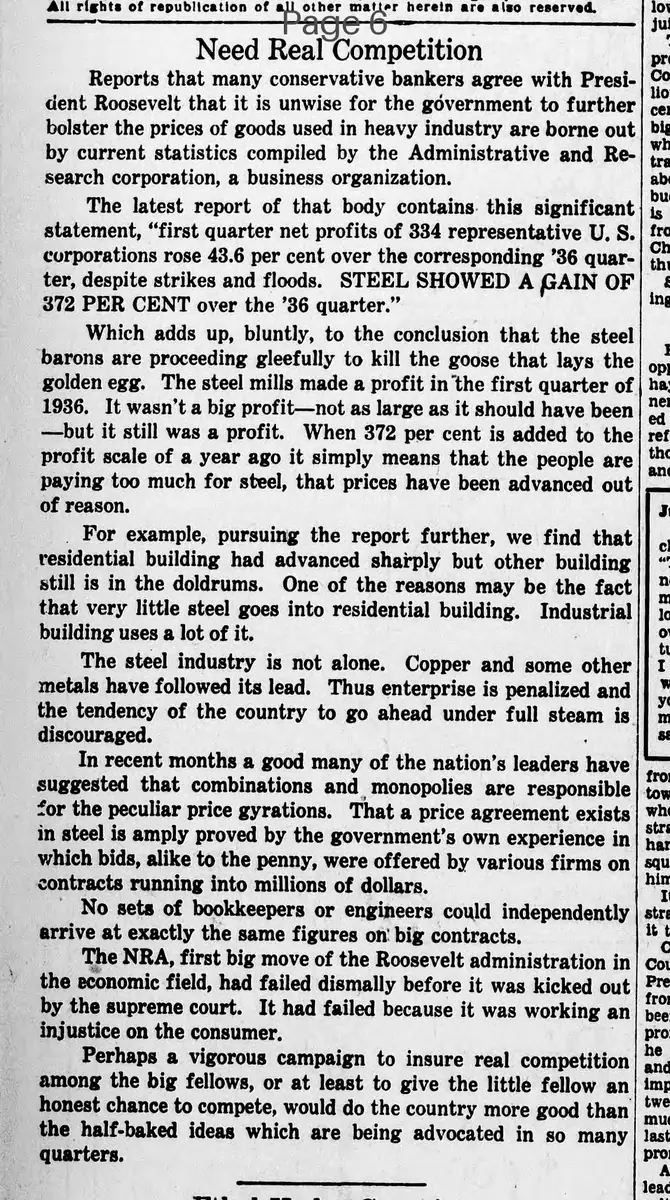
Need Real Competition
Reports that many conservative bankers agree with President Roosevelt that it is unwise for the government to further bolster the prices of goods used in heavy industry are borne out by current statistics compiled by the Administrative and Research corporation, a business organization.
The latest report of that body contains this significant statement, "first quarter net profits of 334 representative U. S. corporations rose 43.6 per cent over the corresponding '36 quarter, despite strikes and floods. STEEL SHOWED A GAIN OF 372 PER CENT over the '36 quarter."
Which adds up, bluntly, to the conclusion that the steel barons are proceeding gleefully to kill the goose that lays the golden egg. The steel mills made a profit in the first quarter of 1936. It wasn't a big profit—not as large as it should have been—but it still was a profit. When 372 per cent is added to the profit scale of a year ago it simply means that the people are paying too much for steel, that prices have been advanced out of reason.
For example, pursuing the report further, we find that residential building had advanced sharply but other building still is in the doldrums. One of the reasons may be the fact that very little steel goes into residential building. Industrial building uses a lot of it.
The steel industry is not alone. Copper and some other metals have followed its lead. Thus enterprise is penalized and the tendency of the country to go ahead under full steam is discouraged.
In recent months a good many of the nation's leaders have suggested that combinations and monopolies are responsible for the peculiar price gyrations. That a price agreement exists in steel is amply proved by the government's own experience in which bids, alike to the penny, were offered by various firms on contracts running into millions of dollars.
No sets of bookkeepers or engineers could independently arrive at exactly the same figures on big contracts.
The NRA, first big move of the Roosevelt administration in the economic field, had failed dismally before it was kicked out by the supreme court. It had failed because it was working an injustice on the consumer.
Perhaps a vigorous campaign to insure real competition among the big fellows, or at least to give the little fellow an honest chance to compete, would do the country more good than the half-baked ideas which are being advocated in so many quarters.
Reports that many conservative bankers agree with President Roosevelt that it is unwise for the government to further bolster the prices of goods used in heavy industry are borne out by current statistics compiled by the Administrative and Research corporation, a business organization.
The latest report of that body contains this significant statement, "first quarter net profits of 334 representative U. S. corporations rose 43.6 per cent over the corresponding '36 quarter, despite strikes and floods. STEEL SHOWED A GAIN OF 372 PER CENT over the '36 quarter."
Which adds up, bluntly, to the conclusion that the steel barons are proceeding gleefully to kill the goose that lays the golden egg. The steel mills made a profit in the first quarter of 1936. It wasn't a big profit—not as large as it should have been—but it still was a profit. When 372 per cent is added to the profit scale of a year ago it simply means that the people are paying too much for steel, that prices have been advanced out of reason.
For example, pursuing the report further, we find that residential building had advanced sharply but other building still is in the doldrums. One of the reasons may be the fact that very little steel goes into residential building. Industrial building uses a lot of it.
The steel industry is not alone. Copper and some other metals have followed its lead. Thus enterprise is penalized and the tendency of the country to go ahead under full steam is discouraged.
In recent months a good many of the nation's leaders have suggested that combinations and monopolies are responsible for the peculiar price gyrations. That a price agreement exists in steel is amply proved by the government's own experience in which bids, alike to the penny, were offered by various firms on contracts running into millions of dollars.
No sets of bookkeepers or engineers could independently arrive at exactly the same figures on big contracts.
The NRA, first big move of the Roosevelt administration in the economic field, had failed dismally before it was kicked out by the supreme court. It had failed because it was working an injustice on the consumer.
Perhaps a vigorous campaign to insure real competition among the big fellows, or at least to give the little fellow an honest chance to compete, would do the country more good than the half-baked ideas which are being advocated in so many quarters.
What sub-type of article is it?
Economic Policy
Trade Or Commerce
What keywords are associated?
Steel Prices
Monopolies
Economic Competition
Industry Profits
Nra Failure
What entities or persons were involved?
President Roosevelt
Steel Barons
Administrative And Research Corporation
Nra
Supreme Court
Editorial Details
Primary Topic
Criticism Of Monopolistic Pricing In Steel And Metals Industries
Stance / Tone
Critical Of Big Business Monopolies And Supportive Of Real Competition
Key Figures
President Roosevelt
Steel Barons
Administrative And Research Corporation
Nra
Supreme Court
Key Arguments
Conservative Bankers Agree With Roosevelt That Government Should Not Bolster Heavy Industry Prices
Steel Corporations' Profits Rose 372% In First Quarter 1937 Over 1936, Indicating Excessive Pricing
High Steel Prices Penalize Enterprise And Discourage Economic Progress
Price Agreements In Steel Proven By Identical Bids On Government Contracts
Nra Failed Due To Injustice On Consumers
Vigorous Campaign For Real Competition Needed Over Half Baked Ideas