Thank you for visiting SNEWPapers!
Sign up free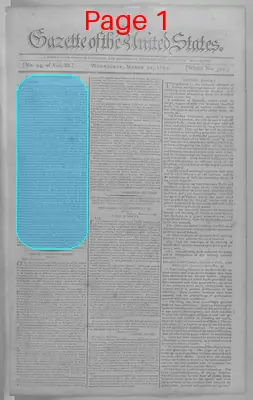
Letter to Editor
March 21, 1792
Gazette Of The United States
New York, New York County, New York
What is this article about?
Satirical letter to Mr. Fenno mocking opponents of the federal funding system by absurdly applying their anti-republican arguments to private debts and speculators' rights, advocating for exceptions to property protections and aid for widows and orphans without funding.
Clipping
OCR Quality
95%
Excellent
Full Text
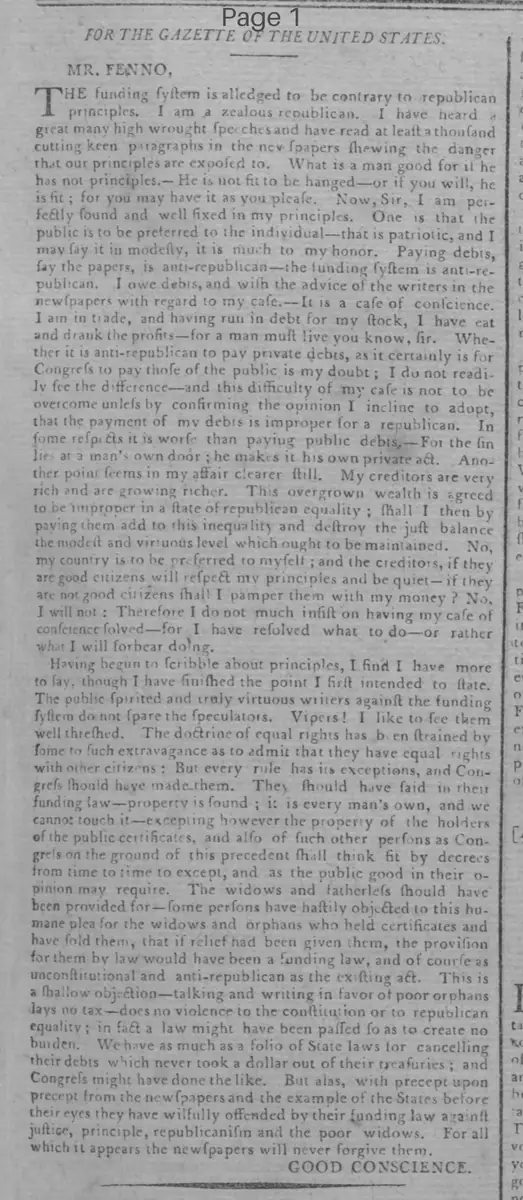
FOR THE GAZETTE OF THE UNITED STATES.
MR. FENNO.
The funding system is alleged to be contrary to republican principles. I am a zealous republican. I have heard great many high wrought speeches and have read at least a thousand cutting keen paragraphs in the newspapers showing the danger that our principles are exposed to. What is a man good for if he has not principles.—He is not fit to be hanged—or if you will, he is fit; for you may have it as you please. Now, Sir, I am perfectly sound and well fixed in my principles. One is that the public is to be preferred to the individual—that is patriotic, and I may say it in modesty, it is much to my honor. Paying debts, say the papers, is anti-republican—the funding system is anti-republican. I owe debts, and with the advice of the writers in the newspapers with regard to my case.—It is a case of conscience. I am in trade, and having run in debt for my stock, I have eat and drank the profits—for a man must live you know, sir. Whether it is anti-republican to pay private debts, as it certainly is for Congress to pay those of the public is my doubt; I do not readily see the difference—and this difficulty of my case is not to be overcome unless by confirming the opinion I incline to adopt, that the payment of my debts is improper for a republican. In some respects it is worse than paying public debts.—For the sin lies at a man's own door; he makes it his own private act. Another point seems in my affair clearer still. My creditors are very rich and are growing richer. This overgrown wealth is agreed to be improper in a state of republican equality; shall I then by paying them add to this inequality and destroy the just balance the modest and virtuous level which ought to be maintained. No, my country is to be preferred to myself; and the creditors, if they are good citizens will respect my principles and be quiet—if they are not good citizens shall I pamper them with my money? No, I will not: Therefore I do not much insist on having my case of conscience solved—for I have resolved what to do—or rather what I will forbear doing.
Having begun to scribble about principles, I find I have more to say, though I have finished the point I first intended to state. The public spirited and truly virtuous writers against the funding system do not spare the speculators. Vipers! I like to see them well threshed. The doctrine of equal rights has been strained by some to such extravagance as to admit that they have equal rights with other citizens: But every rule has its exceptions, and Congress should have made them. They should have said in the funding law—property is sacred; it is every man's own, and we cannot touch it—excepting however the property of the holders of the public certificates, and also of such other persons as Congress on the ground of this precedent shall think fit by decrees from time to time to except, and as the public good in their opinion may require. The widows and fatherless should have been provided for—some persons have hastily objected to this humane plea for the widows and orphans who held certificates and have sold them, that if relief had been given them, the provision for them by law would have been a Funding law. and of course as unconstitutional and anti-republican as the existing act. This is a shallow objection—talking and writing in favor of poor orphans lays no tax—does no violence to the constitution or to republican equality; in fact a law might have been passed so as to create no burden, We have as much as a folio of State laws for cancelling their debts which never took a dollar out of their treasuries; and Congress might have done the like. But alas, with precept upon precept from the newspapers and the example of the States before their eyes they have wilfully offended by their funding law against justice, principle, republicanism and the poor widows. For all which it appears the newspapers will never forgive them.
GOOD CONSCIENCE.
MR. FENNO.
The funding system is alleged to be contrary to republican principles. I am a zealous republican. I have heard great many high wrought speeches and have read at least a thousand cutting keen paragraphs in the newspapers showing the danger that our principles are exposed to. What is a man good for if he has not principles.—He is not fit to be hanged—or if you will, he is fit; for you may have it as you please. Now, Sir, I am perfectly sound and well fixed in my principles. One is that the public is to be preferred to the individual—that is patriotic, and I may say it in modesty, it is much to my honor. Paying debts, say the papers, is anti-republican—the funding system is anti-republican. I owe debts, and with the advice of the writers in the newspapers with regard to my case.—It is a case of conscience. I am in trade, and having run in debt for my stock, I have eat and drank the profits—for a man must live you know, sir. Whether it is anti-republican to pay private debts, as it certainly is for Congress to pay those of the public is my doubt; I do not readily see the difference—and this difficulty of my case is not to be overcome unless by confirming the opinion I incline to adopt, that the payment of my debts is improper for a republican. In some respects it is worse than paying public debts.—For the sin lies at a man's own door; he makes it his own private act. Another point seems in my affair clearer still. My creditors are very rich and are growing richer. This overgrown wealth is agreed to be improper in a state of republican equality; shall I then by paying them add to this inequality and destroy the just balance the modest and virtuous level which ought to be maintained. No, my country is to be preferred to myself; and the creditors, if they are good citizens will respect my principles and be quiet—if they are not good citizens shall I pamper them with my money? No, I will not: Therefore I do not much insist on having my case of conscience solved—for I have resolved what to do—or rather what I will forbear doing.
Having begun to scribble about principles, I find I have more to say, though I have finished the point I first intended to state. The public spirited and truly virtuous writers against the funding system do not spare the speculators. Vipers! I like to see them well threshed. The doctrine of equal rights has been strained by some to such extravagance as to admit that they have equal rights with other citizens: But every rule has its exceptions, and Congress should have made them. They should have said in the funding law—property is sacred; it is every man's own, and we cannot touch it—excepting however the property of the holders of the public certificates, and also of such other persons as Congress on the ground of this precedent shall think fit by decrees from time to time to except, and as the public good in their opinion may require. The widows and fatherless should have been provided for—some persons have hastily objected to this humane plea for the widows and orphans who held certificates and have sold them, that if relief had been given them, the provision for them by law would have been a Funding law. and of course as unconstitutional and anti-republican as the existing act. This is a shallow objection—talking and writing in favor of poor orphans lays no tax—does no violence to the constitution or to republican equality; in fact a law might have been passed so as to create no burden, We have as much as a folio of State laws for cancelling their debts which never took a dollar out of their treasuries; and Congress might have done the like. But alas, with precept upon precept from the newspapers and the example of the States before their eyes they have wilfully offended by their funding law against justice, principle, republicanism and the poor widows. For all which it appears the newspapers will never forgive them.
GOOD CONSCIENCE.
What sub-type of article is it?
Satirical
Persuasive
Political
What themes does it cover?
Economic Policy
Politics
Morality
What keywords are associated?
Funding System
Republican Principles
Public Debt
Speculators
Widows Orphans
Economic Policy
Satire
What entities or persons were involved?
Good Conscience.
Mr. Fenno.
Letter to Editor Details
Author
Good Conscience.
Recipient
Mr. Fenno.
Main Argument
satirically defends the funding system by absurdly extending critics' logic to justify not paying private debts and excepting speculators' property from equal rights, while mocking calls for aid to widows and orphans without actual funding.
Notable Details
Mocks Anti Funding Newspaper Rhetoric
Calls Speculators 'Vipers'
References State Laws Cancelling Debts Without Cost