Thank you for visiting SNEWPapers!
Sign up free
Fowle's New Hampshire Gazette And General Advertiser
Portsmouth, Rockingham County, New Hampshire
What is this article about?
A letter to the New-Hampshire Gazette submits a pamphlet by Brian Edwards critiquing British trade restrictions with the post-independence United States, particularly affecting West India commerce, and advocating for liberal policies to restore mutual benefits. Includes the pamphlet's title, advertisement, and partial text discussing proclamations of July 2 and December 26, 1783.
Clipping
OCR Quality
Full Text
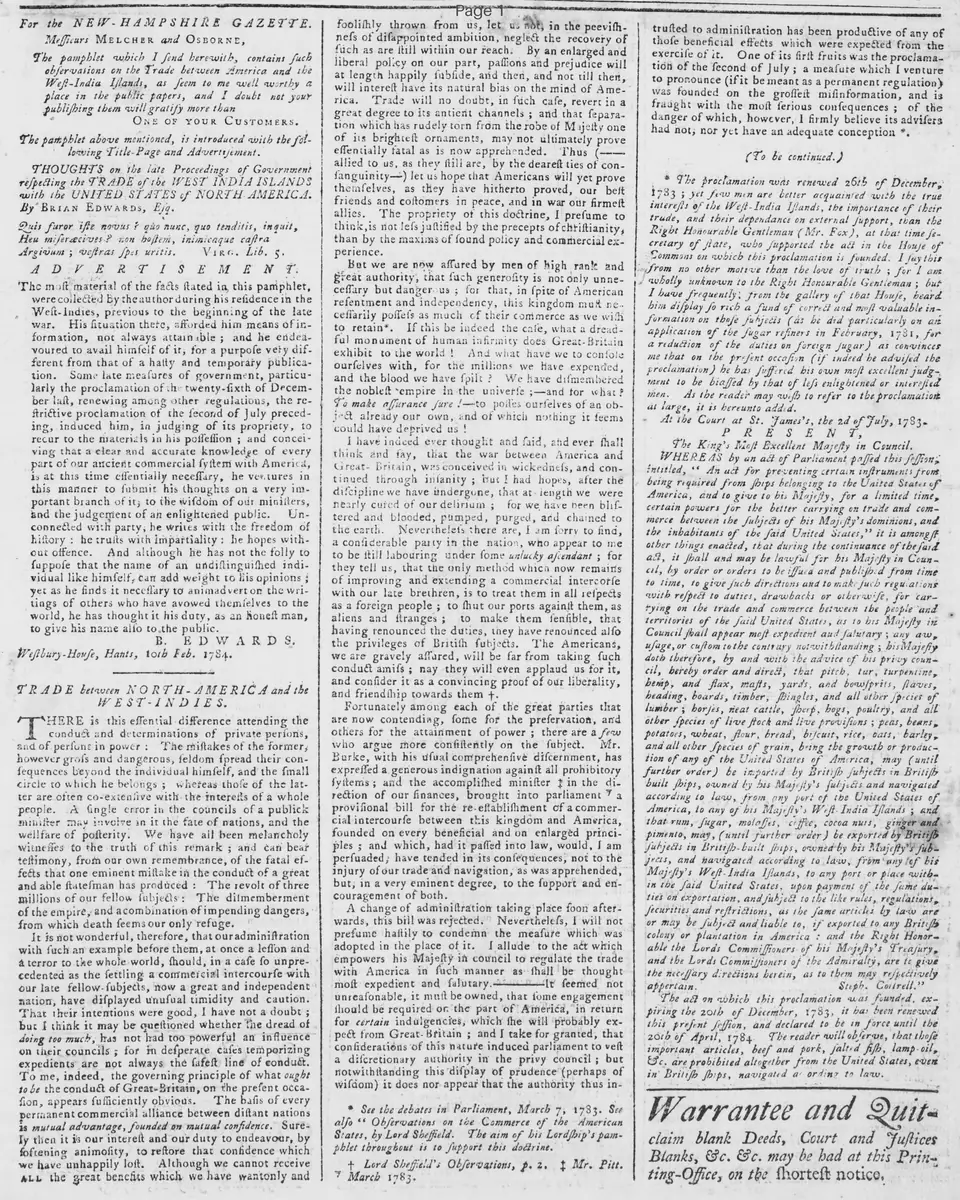
Messieurs Melcher and Osborne,
The pamphlet which I send herewith, contains such observations on the trade between America and the West-India Islands, as seem to me well worthy a place in the public papers, and I doubt not your publishing them will gratify more than
One Of Your Customers.
The pamphlet above mentioned, is introduced with the following Title-Page and Advertisement.
THOUGHTS on the late Proceedings
of Government
respecting the TRADE of the WEST INDIA ISLANDS
with the UNITED STATES of NORTH-AMERICA.
By Brian Edwards, Esq.
Quis furor iste novus? quo nunc, quo tenditis, inquit,
Heu miserecordes? non hostem, inimicaque castra
Arguite; vestras Spes uritis. VIRG. Lib. 5.
ADVERTISEMENT.
The most material of the facts stated in this pamphlet were collected by the author during his residence in the West-Indies, previous to the beginning of the late war. His situation there afforded him means of information, not always attainable; and he endeavoured to avail himself of it, for a purpose very different from that of a hasty and temporary publication. Some late measures of government, particularly the proclamation of the twenty-sixth of December last, renewing among other regulations, the restrictive proclamation of the second of July preceding, induced him, in judging of its propriety, to recur to the materials in his possession: and conceiving that a clear and accurate knowledge of every part of our ancient commercial system with America, is at this time essentially necessary, he ventures in this manner to submit his thoughts on a very important branch of it; to the wisdom of our ministers, and the judgement of an enlightened public. Unconnected with party, he writes with the freedom of history: he trusts with impartiality: he hopes without offence. And although he has not the folly to suppose that the name of an undistinguished individual like himself, can add weight to his opinions; yet as he finds it necessary to animadvert on the writings of others who have avowed themselves to the world, he has thought it his duty, as an honest man, to give his name also to the public.
B. EDWARDS.
Westbury-House, Hants, 10th Feb. 1784.
TRADE between NORTH-AMERICA and the
WEST-INDIES.
THERE is this essential difference attending the conduct and determinations of private persons, and of persons in power: The mistakes of the former, however gross and dangerous, seldom spread their consequences beyond the individual himself, and the small circle to which he belongs; whereas those of the latter are often co-extensive with the interests of a whole people. A single error in the councils of a public minister may involve in it the fate of nations, and the welfare of posterity. We have all been melancholy witnesses to the truth of this remark; and can bear testimony, from our own remembrance, of the fatal effects that one eminent mistake in the conduct of a great and able statesman has produced: The revolt of three millions of our fellow subjects: The dismemberment of the empire, and a combination of impending dangers, from which death seems our only refuge.
It is not wonderful, therefore, that our administration with such an example before them, at once a lesson and a terror to the whole world, should, in a case so unprecedented as the settling a commercial intercourse with our late fellow-subjects, now a great and independent nation, have displayed unusual timidity and caution. That their intentions were good, I have not a doubt; but I think it may be questioned whether the dread of doing too much, has not had too powerful an influence on their councils; for in desperate cases temporizing expedients are not always the safest line of conduct.
To me, indeed, the governing principle of what ought to be the conduct of Great-Britain, on the present occasion, appears sufficiently obvious. The basis of every permanent commercial alliance between distant nations is mutual advantage, founded on mutual confidence. Surely then it is our interest and our duty to endeavour, by softening animosity, to restore that confidence which we have unhappily lost. Although we cannot receive all the great benefits which we have wantonly and foolishly thrown from us, let us not, in the peevishness of disappointed ambition, neglect the recovery of such as are still within our reach. By an enlarged and liberal policy on our part, passions and prejudice will at length happily subside, and then, and not till then, will interest have its natural bias on the mind of America. Trade will no doubt, in such case, revert in a great degree to its ancient channels; and that separation which has rudely torn from the robe of Majesty one of its brightest ornaments, may not ultimately prove essentially fatal as is now apprehended. Thus allied to us, as they still are, by the dearest ties of consanguinity—let us hope that Americans will yet prove themselves, as they have hitherto proved, our best friends and customers in peace, and in war our firmest allies. The propriety of this doctrine, I presume to think, is not less justified by the precepts of christianity, than by the maxims of sound policy and commercial experience.
But we are now assured by men of high rank and great authority, that such generosity is not only unnecessary but dangerous; for that, in spite of American resentment and independency, this kingdom must necessarily possess as much of their commerce as we wish to retain. If this be indeed the case, what a dreadful monument of human infirmity does Great-Britain exhibit to the world! And what have we to console ourselves with, for the millions we have expended, and the blood we have spilt? We have dismembered the noblest empire in the universe;—and for what? To make assurance sure!—to possess ourselves of an object already our own, and of which nothing it seems could have deprived us!
I have indeed ever thought and said, and ever shall think and say, that the war between America and Great-Britain, was conceived in wickedness, and continued through insanity; but I had hopes, after the discipline we have undergone, that at length we were nearly cured of our delirium; for we have been blistered and blooded, pumped, purged, and chained to the earth. Nevertheless there are, I am sorry to find, a considerable party in the nation, who appear to me to be still labouring under some unlucky ascendant; for they tell us, that the only method which now remains of improving and extending a commercial intercourse with our late brethren, is to treat them in all respects as a foreign people; to shut our ports against them, as aliens and strangers; to make them sensible, that having renounced the duties, they have renounced also the privileges of British Subjects. The Americans, we are gravely assured, will be far from taking such conduct amiss; nay they will even applaud us for it, and consider it as a convincing proof of our liberality, and friendship towards them.
Fortunately among each of the great parties that are now contending, some for the preservation, and others for the attainment of power; there are a few who argue more consistently on the subject. Mr. Burke, with his usual comprehensive discernment, has expressed a generous indignation against all prohibitory systems; and the accomplished minister in the direction of our finances, brought into parliament a provisional bill for the re-establishment of a commercial intercourse between this kingdom and America, founded on every beneficial and on enlarged principles; and which, had it passed into law, would, I am persuaded, have tended in its consequences, not to the injury of our trade and navigation, as was apprehended, but, in a very eminent degree, to the support and encouragement of both.
A change of administration taking place soon afterwards, this bill was rejected. Nevertheless, I will not presume hastily to condemn the measure which was adopted in the place of it. I allude to the act which empowers his Majesty in council to regulate the trade with America in such manner as shall be thought most expedient and salutary. It seemed not unreasonable, it must be owned, that some engagement should be required on the part of America, in return for certain indulgencies, which he will probably expect from Great-Britain; and I take for granted, that considerations of this nature induced parliament to vest a discretionary authority in the privy council; but notwithstanding this display of prudence (perhaps of wisdom) it does not appear that the authority thus intrusted to administration has been productive of any of those beneficial effects which were expected from the exercise of it. One of its first fruits was the proclamation of the second of July; a measure which I venture to pronounce (if it be meant as a permanent regulation) was founded on the grossest misinformation, and is fraught with the most serious consequences; of the danger of which, however, I firmly believe its advisers had not; nor yet have an adequate conception.
(To be continued.)
The proclamation was renewed 26th of December, 1783; yet few men are better acquainted with the true interests of the West-India Islands, the importance of their trade, and their dependence on external support, than the Right Honourable Gentleman (Mr. Fox), at that time secretary of state, who supported the act in the House of Commons on which this proclamation is founded. I say this from no other motive than the love of truth; for I am wholly unknown to the Right Honourable Gentleman; but I have frequently, from the gallery of that House, heard him display so rich a fund of correct and most valuable information on those subjects (as he did particularly on an application of the sugar refiners in February, 1781, for a reduction of the duties on foreign sugar) as convinces me that on the present occasion (if indeed he advised the proclamation) he has suffered his own most excellent judgement to be biassed by that of less enlightened or interested men. As the reader may wish to refer to the proclamation at large, it is hereunto added.
At the Court at St. James's, the 2d of July, 1783.
PRESENT,
The King's Most Excellent Majesty in Council.
WHEREAS by an act of Parliament passed this session, intitled, "An act for preventing certain instruments from being required from ships belonging to the United States of America, and to give to his Majesty, for a limited time, certain powers for the better carrying on trade and commerce between the Subjects of his Majesty's dominions, and the inhabitants of the said United States," it is amongst other things enacted, that during the continuance of the said act, it shall and may be lawful for his Majesty in Council, by order or orders to be issued and published from time to time, to give such directions and to make such regulations with respect to duties, drawbacks or otherwise, for carrying on the trade and commerce between the people and territories of the said United States, as to his Majesty in Council shall appear most expedient and salutary; any law, usage, or custom to the contrary notwithstanding; his Majesty doth therefore, by and with the advice of his privy council, hereby order and direct, that pitch, tar, turpentine, hemp, and flax, masts, yards, and bowsprits, staves, heading, boards, timber, shingles, and all other species of lumber; horses, neat cattle, sheep, hogs, poultry, and all other species of live stock and live provisions; peas, beans, potatoes, wheat, flour, bread, biscuit, rice, oats, barley, and all other species of grain, being the growth or production of any of the United States of America, may (until further order) be imported by British subjects in British built ships, owned by his Majesty's subjects and navigated according to law, from any port of the United States of America, to any of his Majesty's West-India Islands; and that rum, sugar, molasses, coffee, cocoa nuts, ginger and pimento, may, (until further order) be exported by British subjects in British-built ships, owned by his Majesty's subjects, and navigated according to law, from any of his Majesty's West-India Islands, to any port or place within the said United States, upon payment of the same duties on exportation, and subject to the like rules, regulations, securities and restrictions, as the same articles by law are or may be subject and liable to, if exported to any British colony or plantation in America: and the Right Honourable the Lords Commissioners of his Majesty's Treasury, and the Lords Commissioners of the Admiralty, are to give the necessary directions herein, as to them may respectively appertain.
Steph. Cottrell.
The act on which this proclamation was founded, expiring the 20th of December, 1783, it has been renewed this present session, and declared to be in force until the 20th of April, 1784. The reader will observe, that those important articles, beef and pork, salted fish, lamp-oil, &c. are prohibited altogether from the United States, even in British ships, navigated according to law.
What sub-type of article is it?
What themes does it cover?
What keywords are associated?
What entities or persons were involved?
Letter to Editor Details
Author
One Of Your Customers (Submitting Pamphlet By Brian Edwards, Esq.)
Recipient
Messieurs Melcher And Osborne
Main Argument
british government should adopt a liberal trade policy with the independent united states to restore mutual confidence and commerce, rather than restrictive proclamations that harm west india trade and overall interests.
Notable Details