Thank you for visiting SNEWPapers!
Sign up free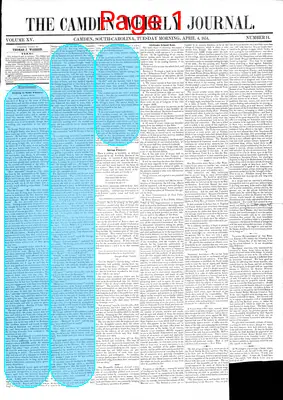
Literary
April 4, 1854
The Camden Weekly Journal
Camden, Kershaw County, South Carolina
What is this article about?
Sir George Tindel, a young baronet ruined by gambling, flees to Boulogne with his uncle's inheritance to evade creditors. He falls for the Baroness d'Estival, who lures him back to England on her yacht, reveals herself as his cousin Anne Fulton, pays his debts, and they marry happily.
Clipping
OCR Quality
95%
Excellent
Full Text
Miscellaneous.
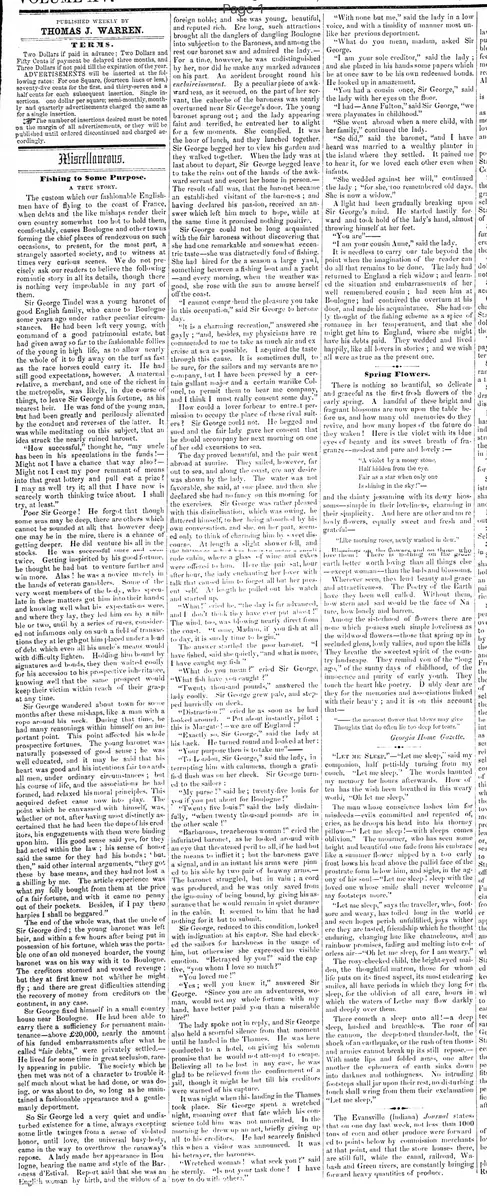
Fishing to Some Purpose.
A TRUE STORY.
The custom which our fashionable English men have of flying to the coast of France, when debts and the like mishaps render their own country somewhat too hot to hold them, comfortably, causes Boulogne and other towns forming the chief places of rendezvous on such occasions, to present, for the most part, a strangely assorted society, and to witness at times very curious scenes. We do not precisely ask our readers to believe the following romantic story in all its details, though there is nothing very improbable in any part of them.
Sir George Tindel was a young baronet of good English family, who came to Boulogne some years ago under rather peculiar circumstances. He had been left very young, with command of a good patrimonial estate, but had given way so far to the fashionable follies of the young in high life, as to allow nearly the whole of it to fly away on the turf as fast as the race horses could carry it. He had still good expectations, however. A maternal relative, a merchant, and one of the richest in the metropolis, was likely, in due course of things, to leave Sir George his fortune, as his nearest heir. He was fond of the young man, but had been greatly and perilously alienated by the conduct and reverses of the latter. It was while meditating on this subject, that an idea struck the nearly ruined baronet.
"How successful," thought he, "my uncle has been in his speculations in the funds!— Might not I have a chance that way also?— Might not I cast my poor remnant of means into that great lottery and pull out a prize? I may as well try it; all that I have now is scarcely worth thinking twice about. I shall try, at least."
Poor Sir George! He forgot that though some seas may be deep, there are others which cannot be sounded at all; that however deep one may be in the mire, there is a chance of getting deeper. He did venture his all in the stocks. He was successful once and twice. Getting inspirited by his good fortune, he thought he had but to venture further and win more. Alas! he was a novice merely in the hands of veteran gamblers. Some of the very worst members of the 'bound,' who speculate in these matters got him into their hands and knowing well what his expectations were, and where they lay, they led him on by a nibble or two, until by a series of ruses, considered not infamous only on such a field of transactions they at length got him placed under a load of debt which even all his uncle's means would with difficulty lighten. Holding him bound by signatures and bonds, they then waited coolly for his accession to his prospective inheritance, knowing well that the same prospect would keep their victim within reach of their grasp at any time.
Months after these mishaps, like a man with a rope around his neck. Sir George wandered about town for some time, had many reasonings within himself on an important point. This point affected his whole prospective fortunes. The young baronet was naturally possessed of good sense; he was well educated, and it may be said that his heart was good and his intentions fair towards all men, under ordinary circumstances; but his course of life, and the associations he had formed, had relaxed his moral principles. This point which he canvassed with himself, was, whether or not, after having most distinctly ascertained that he had been the dupe of his creditors, his engagements with them were binding upon him. His good sense said yes, for they had acted within the law; his sense of honor said the same for they had his bonds; 'but,' said other internal arguments, 'they got these by base means, and they had not lost a shilling by me. The article experience was what my folly bought from them at the price of a fair fortune, and with it came no penny out of their pockets. Besides, if I pay these harpies I shall be beggared.'
The end of the whole was, that the uncle of Sir George died; the young baronet was left heir, and within a few hours after being put in possession of his fortune, which was the portable one of an old moneyed hoarder, the young baronet was on his way with it to Boulogne. The creditors stormed and vowed revenge; but they at first knew not whither he might fly; and there are great difficulties attending the recovery of money from creditors on the continent, in any case.
Sir George fixed himself in a small country house near Boulogne. He had been able to carry there a sufficiency for permanent maintenance—above £20,000, nearly the amount of his funded embarrassments after what he called "fair debts," were privately settled.— He lived for some time in great seclusion, rarely appearing in public. The society which he then met was not of a character to trouble himself much about what he had done, or was doing, or was about to do, so long as he maintained a fashionable appearance and a gentlemanly deportment.
So Sir George led a very quiet and undisturbed existence for a time, always excepting some little twinges from a sense of violated honor, until love, the universal busy-body came in the way to overthrow the runaway's repose. A lady made her appearance in Boulogne, bearing the name and style of the Baroness d'Estival. Report said that she was an English woman by birth, and the widow of a foreign noble; and she was young, beautiful, and reputed rich. Ere long, such attractions brought all the danglers of dangling Boulogne into subjection to the Baroness, and among the rest our baronet saw and admired the lady.- For a time, however, he was undistinguished by her, nor did he make any marked advances on his part. An accident brought round his enclaircissement. By a peculiar piece of awkwardness, as it seemed, on the part of her servant, the caleche of the baroness was nearly overturned near Sir George's door. The young baronet sprung out; and the lady appearing faint and terrified, he entreated her to alight for a few moments. She complied. It was the hour of lunch, and they lunched together. Sir George begged her to view his garden and they walked together. When the lady was at last about to depart, Sir George begged leave to take the rein out of the hands of the awkward servant and escort her home in person.- The result of all was, that the baronet became an established visitant of the baroness; and having declared his passion, received an answer which left him much to hope, while at the same time it promised nothing positive.
Sir George could not be long acquainted with the fair baroness without discovering that she had one remarkable and somewhat eccentric taste—she was distractedly fond of fishing. She had hired for the season a large yawl, something between a fishing boat and a yacht —and every morning, when the weather was good, she rose with the sun to amuse herself off the coast.
"I cannot comprehend the pleasure you take in this occupation," said Sir George to her one day.
"It is a charming recreation," answered she gayly; "and, besides, my physicians have recommended to me to take as much air and exercise at sea as possible. I acquired the taste through this cause. It is sometimes dull, to be sure, for the sailors and my servants are no company, but I have been pressed by a certain gallant major and a certain warlike Colonel, to permit them to bear me company, and I think I must really consent some day."
How could a lover forbear to entreat permission to occupy the place of these rival suitors? Sir George could not. He begged and sued and the fair lady gave her consent that he should accompany her next morning on one of her odd excursions to sea.
The day proved beautiful, and the pair went abroad at sunrise. They sailed, however, far out to sea, and along the coast, ere any desire was shown by the lady. The water was not favorable, she said, at one place, and then she declared she had no fancy on this morning for the exercise. Sir George was rather pleased with this disinclination, which was owing, he flattered himself, to her being absorbed by his own conversation, and she, on her part, seemed only to think of charming him by sweet discourse. At length a slight shower fell, and they took shelter in the rude cabin, where a glass of wine and cakes were offered to him. There the pair sat, hour after hour, the lady enchanting her lover with talk that caused him to forget all but her present self. At length he pulled out his watch and started up.
"What!" cried he, "the day is far advanced, and I don't think they have ever put about!"
The wind, too, was blowing nearly direct from the coast. "Come, Madam, if you fish at all to-day, it is surely time to begin."
The answer startled the poor baronet. "I have fished," said she quietly, "and what is more, I have caught my fish."
"What do you mean?" cried Sir George.
"What fish have I caught?"
"Twenty thousand pounds," answered the lady coolly. Sir George grew pale, and stepped hurriedly on deck.
"Distraction!" cried he as soon as he had looked around. "Put about instantly, pilot: this is Margate!—we are off England!"
"Exactly so, Sir George," said the lady at his back. He turned round and looked at her:
"Your purpose then is to take me"
"To London, Sir George," said the lady, in interrupting him with calmness, though a gratified flush was on her cheek. Sir George turned to the sailors:
"My purse!" said he; "twenty-five louis for you if you put about for Boulogne!"
"Twenty five louis!" said the lady disdainfully, "when twenty thousand pounds are in the other scale!"
"Barbarous, treacherous woman!" cried the infuriated baronet, as he looked around with an eye that threatened peril to all, if he had but the means to inflict it; but the baroness gave a signal, and in an instant his arms were pinned to his side by two pair of brawny arms.- The baronet struggled, but in vain; a cord was produced, and he was only saved from the ignominy of being bound, by giving his assurance that he would remain in quiet durance in the cabin. It seemed to him that he had nothing for it but to submit.
Sir George, reduced to this condition, looked with indignation at his captor. She had checked the sailors for harshness in the usage of him, but otherwise she expressed no visible emotion. "Betrayed by you!" said the captive, "you whom I love so much?"
"You loved me!"
"Yes; well you knew it," answered Sir George. "Since you are an adventuress, woman, would not my whole fortune with my hand, have better paid you than a miserable hire?"
The lady spoke not in reply, and Sir George also held a scornful silence from that moment until he landed in the Thames. He was here conducted to a hotel, on giving his solemn promise that he would not attempt to escape. Believing all to be lost in any case, he was glad to be relieved from the confinement of a jail, though it might be but till his creditors were warned of his capture.
It was night when this landing in the Thames took place. Sir George spent a wretched night, moaning over that fate which his conscience told him was not unmerited. In the morning he drew up an act, briefly giving up all to his creditors. He had scarcely finished this when a visitor was announced. It was his betrayer, the baroness.
"Wretched woman! what seek you?" said he sternly. "Is not your task done? I have now to do with others."
"With none but me," said the lady in a low voice, and with a timidity of manner most unlike her previous deportment.
"What do you mean, madam?" asked Sir George.
"I am your sole creditor," said the lady; and she placed in his hands some papers which he at once saw to be his own redeemed bonds. He looked up in amazement.
"You had a cousin once, Sir George," said the lady with her eyes on the floor.
"I had—Anne Fulton," said Sir George, "we were playmates in childhood."
"She went abroad when a mere child, with her family," continued the lady.
"She did," said the baronet, "and I have heard was married to a wealthy planter in the island where they settled. It pained me to hear it, for we loved each other even when infants."
"She wedded against her will," continued the lady; "for she, too remembered old days. She is now a widow."
A light had been gradually breaking upon Sir George's mind. He started hastily forward and took hold of the lady's hand, almost throwing himself at her feet.
"You are"
"I am your cousin Anne," said the lady.
It is needless to carry our tale beyond the point when the imagination of the reader can do all that remains to be done. The lady had returned to England a rich widow; and learning the situation and embarrassments of her well remembered cousin; had seen him at Boulogne; had contrived the overturn at his door, and made his acquaintance. She had only thought of the fishing scheme as a spice of romance in her temperament, and that she might get him to England, where she might have his debts paid. They wedded and lived happily, like all lovers in stories; and we wish all were as true as the present one.
Fishing to Some Purpose.
A TRUE STORY.
The custom which our fashionable English men have of flying to the coast of France, when debts and the like mishaps render their own country somewhat too hot to hold them, comfortably, causes Boulogne and other towns forming the chief places of rendezvous on such occasions, to present, for the most part, a strangely assorted society, and to witness at times very curious scenes. We do not precisely ask our readers to believe the following romantic story in all its details, though there is nothing very improbable in any part of them.
Sir George Tindel was a young baronet of good English family, who came to Boulogne some years ago under rather peculiar circumstances. He had been left very young, with command of a good patrimonial estate, but had given way so far to the fashionable follies of the young in high life, as to allow nearly the whole of it to fly away on the turf as fast as the race horses could carry it. He had still good expectations, however. A maternal relative, a merchant, and one of the richest in the metropolis, was likely, in due course of things, to leave Sir George his fortune, as his nearest heir. He was fond of the young man, but had been greatly and perilously alienated by the conduct and reverses of the latter. It was while meditating on this subject, that an idea struck the nearly ruined baronet.
"How successful," thought he, "my uncle has been in his speculations in the funds!— Might not I have a chance that way also?— Might not I cast my poor remnant of means into that great lottery and pull out a prize? I may as well try it; all that I have now is scarcely worth thinking twice about. I shall try, at least."
Poor Sir George! He forgot that though some seas may be deep, there are others which cannot be sounded at all; that however deep one may be in the mire, there is a chance of getting deeper. He did venture his all in the stocks. He was successful once and twice. Getting inspirited by his good fortune, he thought he had but to venture further and win more. Alas! he was a novice merely in the hands of veteran gamblers. Some of the very worst members of the 'bound,' who speculate in these matters got him into their hands and knowing well what his expectations were, and where they lay, they led him on by a nibble or two, until by a series of ruses, considered not infamous only on such a field of transactions they at length got him placed under a load of debt which even all his uncle's means would with difficulty lighten. Holding him bound by signatures and bonds, they then waited coolly for his accession to his prospective inheritance, knowing well that the same prospect would keep their victim within reach of their grasp at any time.
Months after these mishaps, like a man with a rope around his neck. Sir George wandered about town for some time, had many reasonings within himself on an important point. This point affected his whole prospective fortunes. The young baronet was naturally possessed of good sense; he was well educated, and it may be said that his heart was good and his intentions fair towards all men, under ordinary circumstances; but his course of life, and the associations he had formed, had relaxed his moral principles. This point which he canvassed with himself, was, whether or not, after having most distinctly ascertained that he had been the dupe of his creditors, his engagements with them were binding upon him. His good sense said yes, for they had acted within the law; his sense of honor said the same for they had his bonds; 'but,' said other internal arguments, 'they got these by base means, and they had not lost a shilling by me. The article experience was what my folly bought from them at the price of a fair fortune, and with it came no penny out of their pockets. Besides, if I pay these harpies I shall be beggared.'
The end of the whole was, that the uncle of Sir George died; the young baronet was left heir, and within a few hours after being put in possession of his fortune, which was the portable one of an old moneyed hoarder, the young baronet was on his way with it to Boulogne. The creditors stormed and vowed revenge; but they at first knew not whither he might fly; and there are great difficulties attending the recovery of money from creditors on the continent, in any case.
Sir George fixed himself in a small country house near Boulogne. He had been able to carry there a sufficiency for permanent maintenance—above £20,000, nearly the amount of his funded embarrassments after what he called "fair debts," were privately settled.— He lived for some time in great seclusion, rarely appearing in public. The society which he then met was not of a character to trouble himself much about what he had done, or was doing, or was about to do, so long as he maintained a fashionable appearance and a gentlemanly deportment.
So Sir George led a very quiet and undisturbed existence for a time, always excepting some little twinges from a sense of violated honor, until love, the universal busy-body came in the way to overthrow the runaway's repose. A lady made her appearance in Boulogne, bearing the name and style of the Baroness d'Estival. Report said that she was an English woman by birth, and the widow of a foreign noble; and she was young, beautiful, and reputed rich. Ere long, such attractions brought all the danglers of dangling Boulogne into subjection to the Baroness, and among the rest our baronet saw and admired the lady.- For a time, however, he was undistinguished by her, nor did he make any marked advances on his part. An accident brought round his enclaircissement. By a peculiar piece of awkwardness, as it seemed, on the part of her servant, the caleche of the baroness was nearly overturned near Sir George's door. The young baronet sprung out; and the lady appearing faint and terrified, he entreated her to alight for a few moments. She complied. It was the hour of lunch, and they lunched together. Sir George begged her to view his garden and they walked together. When the lady was at last about to depart, Sir George begged leave to take the rein out of the hands of the awkward servant and escort her home in person.- The result of all was, that the baronet became an established visitant of the baroness; and having declared his passion, received an answer which left him much to hope, while at the same time it promised nothing positive.
Sir George could not be long acquainted with the fair baroness without discovering that she had one remarkable and somewhat eccentric taste—she was distractedly fond of fishing. She had hired for the season a large yawl, something between a fishing boat and a yacht —and every morning, when the weather was good, she rose with the sun to amuse herself off the coast.
"I cannot comprehend the pleasure you take in this occupation," said Sir George to her one day.
"It is a charming recreation," answered she gayly; "and, besides, my physicians have recommended to me to take as much air and exercise at sea as possible. I acquired the taste through this cause. It is sometimes dull, to be sure, for the sailors and my servants are no company, but I have been pressed by a certain gallant major and a certain warlike Colonel, to permit them to bear me company, and I think I must really consent some day."
How could a lover forbear to entreat permission to occupy the place of these rival suitors? Sir George could not. He begged and sued and the fair lady gave her consent that he should accompany her next morning on one of her odd excursions to sea.
The day proved beautiful, and the pair went abroad at sunrise. They sailed, however, far out to sea, and along the coast, ere any desire was shown by the lady. The water was not favorable, she said, at one place, and then she declared she had no fancy on this morning for the exercise. Sir George was rather pleased with this disinclination, which was owing, he flattered himself, to her being absorbed by his own conversation, and she, on her part, seemed only to think of charming him by sweet discourse. At length a slight shower fell, and they took shelter in the rude cabin, where a glass of wine and cakes were offered to him. There the pair sat, hour after hour, the lady enchanting her lover with talk that caused him to forget all but her present self. At length he pulled out his watch and started up.
"What!" cried he, "the day is far advanced, and I don't think they have ever put about!"
The wind, too, was blowing nearly direct from the coast. "Come, Madam, if you fish at all to-day, it is surely time to begin."
The answer startled the poor baronet. "I have fished," said she quietly, "and what is more, I have caught my fish."
"What do you mean?" cried Sir George.
"What fish have I caught?"
"Twenty thousand pounds," answered the lady coolly. Sir George grew pale, and stepped hurriedly on deck.
"Distraction!" cried he as soon as he had looked around. "Put about instantly, pilot: this is Margate!—we are off England!"
"Exactly so, Sir George," said the lady at his back. He turned round and looked at her:
"Your purpose then is to take me"
"To London, Sir George," said the lady, in interrupting him with calmness, though a gratified flush was on her cheek. Sir George turned to the sailors:
"My purse!" said he; "twenty-five louis for you if you put about for Boulogne!"
"Twenty five louis!" said the lady disdainfully, "when twenty thousand pounds are in the other scale!"
"Barbarous, treacherous woman!" cried the infuriated baronet, as he looked around with an eye that threatened peril to all, if he had but the means to inflict it; but the baroness gave a signal, and in an instant his arms were pinned to his side by two pair of brawny arms.- The baronet struggled, but in vain; a cord was produced, and he was only saved from the ignominy of being bound, by giving his assurance that he would remain in quiet durance in the cabin. It seemed to him that he had nothing for it but to submit.
Sir George, reduced to this condition, looked with indignation at his captor. She had checked the sailors for harshness in the usage of him, but otherwise she expressed no visible emotion. "Betrayed by you!" said the captive, "you whom I love so much?"
"You loved me!"
"Yes; well you knew it," answered Sir George. "Since you are an adventuress, woman, would not my whole fortune with my hand, have better paid you than a miserable hire?"
The lady spoke not in reply, and Sir George also held a scornful silence from that moment until he landed in the Thames. He was here conducted to a hotel, on giving his solemn promise that he would not attempt to escape. Believing all to be lost in any case, he was glad to be relieved from the confinement of a jail, though it might be but till his creditors were warned of his capture.
It was night when this landing in the Thames took place. Sir George spent a wretched night, moaning over that fate which his conscience told him was not unmerited. In the morning he drew up an act, briefly giving up all to his creditors. He had scarcely finished this when a visitor was announced. It was his betrayer, the baroness.
"Wretched woman! what seek you?" said he sternly. "Is not your task done? I have now to do with others."
"With none but me," said the lady in a low voice, and with a timidity of manner most unlike her previous deportment.
"What do you mean, madam?" asked Sir George.
"I am your sole creditor," said the lady; and she placed in his hands some papers which he at once saw to be his own redeemed bonds. He looked up in amazement.
"You had a cousin once, Sir George," said the lady with her eyes on the floor.
"I had—Anne Fulton," said Sir George, "we were playmates in childhood."
"She went abroad when a mere child, with her family," continued the lady.
"She did," said the baronet, "and I have heard was married to a wealthy planter in the island where they settled. It pained me to hear it, for we loved each other even when infants."
"She wedded against her will," continued the lady; "for she, too remembered old days. She is now a widow."
A light had been gradually breaking upon Sir George's mind. He started hastily forward and took hold of the lady's hand, almost throwing himself at her feet.
"You are"
"I am your cousin Anne," said the lady.
It is needless to carry our tale beyond the point when the imagination of the reader can do all that remains to be done. The lady had returned to England a rich widow; and learning the situation and embarrassments of her well remembered cousin; had seen him at Boulogne; had contrived the overturn at his door, and made his acquaintance. She had only thought of the fishing scheme as a spice of romance in her temperament, and that she might get him to England, where she might have his debts paid. They wedded and lived happily, like all lovers in stories; and we wish all were as true as the present one.
What sub-type of article is it?
Prose Fiction
Satire
What themes does it cover?
Love Romance
Moral Virtue
Commerce Trade
What keywords are associated?
Gambling Folly
Debt Evasion
Romantic Reunion
Fishing Metaphor
Baronet Adventure
Literary Details
Title
Fishing To Some Purpose.
Key Lines
"Twenty Thousand Pounds," Answered The Lady Coolly.
"I Am Your Sole Creditor," Said The Lady;
"I Am Your Cousin Anne," Said The Lady.
They Wedded And Lived Happily, Like All Lovers In Stories; And We Wish All Were As True As The Present One.