Thank you for visiting SNEWPapers!
Sign up free
The New Hampshire Gazette And Historical Chronicle
Portsmouth, Greenland, Rockingham County, New Hampshire
What is this article about?
British and East India Company forces under Major Hector Munro decisively defeated the combined army of Shah Alam II and Shuja-ud-Daula at the Battle of Buxar on October 23, 1764, capturing 130-150 cannons and inflicting heavy enemy losses of about 6,000 killed.
Clipping
OCR Quality
Full Text
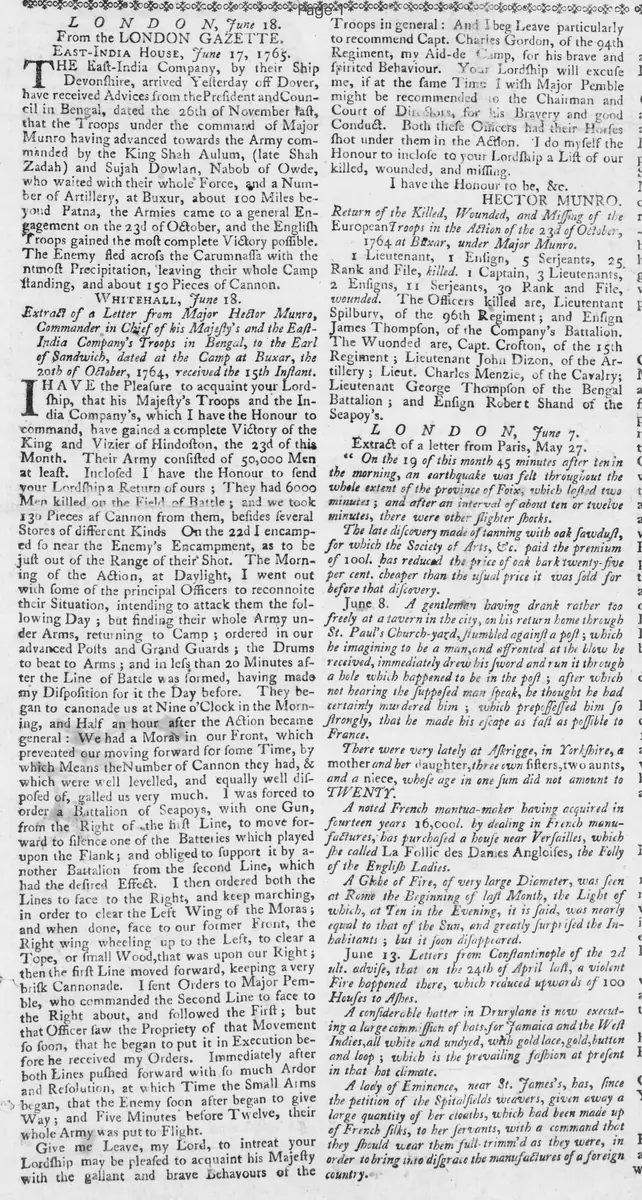
WHITEHALL, June 18.
Extract of a Letter from Major Hector Munro, Commander in Chief of his Majesty's and the East-India Company's Troops in Bengal, to the Earl of Sandwich, dated at the Camp at Buxar, the 20th of October, 1764, received the 15th Instant.
HAVE the Pleasure to acquaint your Lordship, that his Majesty's Troops and the India Company's, which I have the Honour to command, have gained a complete Victory over the King and Vizier of Hindostan, the 23d of this Month. Their Army consisted of 50,000 Men at least. Enclosed I have the Honour to send your Lordship a Return of ours : They had 6000 Men killed on the Field of Battle : and we took 130 Pieces of Cannon from them, besides several Stores of different Kinds. On the 22d I encamped so near the Enemy's Encampment, as to be just out of the Range of their Shot. The Morning of the Action, at Daylight, I went out with some of the principal Officers to reconnoitre their Situation, intending to attack them the following Day : but finding their whole Army under Arms, returning to Camp ; ordered in our advanced Posts and Grand Guards ; the Drums to beat to Arms : and in less than 20 Minutes after the Line of Battle was formed, having made my Disposition for it the Day before. They began to canonade us at Nine o'Clock in the Morning, and Half an hour after the Action became general: We had a Morass in our Front, which prevented our moving forward for some Time, by which Means the Number of Cannon they had, & which were well levelled, and equally well disposed of, galled us very much. I was forced to order a Battalion of Sepoys, with one Gun, from the Right of the first Line, to move forward to silence one of the Batteries which played upon the Flank: and obliged to support it by another Battalion from the second Line, which had the desired Effect. I then ordered both the Lines to face to the Right, and keep marching, in order to clear the Left Wing of the Morass; and when done, face to our former Front, the Right wing wheeling up to the Left, to clear a Tope, or small Wood,that was upon our Right; then the first Line moved forward, keeping a very brisk Cannonade. I sent Orders to Major Pemble, who commanded the Second Line to face to the Right about, and followed the First; but that Officer saw the Propriety of that Movement before he received my Orders. Immediately after noon, that he began to put it in Execution before he received my Orders. and both Lines pushed forward with so much Ardor and Resolution, at which Time the Small Arms began, that the Enemy soon after began to give Way; and Five Minutes before Twelve, their whole Army was put to Flight.
Give me Leave, my Lord, to intreat your Lordship may be pleased to acquaint his Majesty with the gallant and brave Behaviours of the Troops in general : And I beg Leave particularly to recommend Capt. Charles Gordon, of the 94th Regiment, my Aid-de Camp, for his brave and spirited Behaviour. Your Lordship will excuse me, if at the same Time I wish Major Pemble might be recommended to the Chairman and Court of Directors, for his Bravery and good Conduct. Both these Officers had their Horses shot under them in the Action. I do myself the Honour to enclose to your Lordship a List of our killed, wounded, and missing.
I have the Honour to be, &c.
HECTOR MUNRO.
Return of the Killed, Wounded, and Missing of the European Troops in the Action of the 23d of October, 1764 at Buxar, under Major Munro.
1 Lieutenant, 1 Ensign, 5 Serjeants, 25 Rank and File, killed. 1 Captain, 3 Lieutenants, 2 Ensigns, 11 Serjeants, 30 Rank and File, wounded. The Officers killed are, Lieutenant Spilbury, of the 84th Regiment; and Ensign James Thompson, of the Company's Battalion. The Wounded are, Capt. Crofton, of the 15th Regiment : Lieutenant John Dixon, of the Artillery ; Lieut. Charles Menzie, of the Cavalry; Lieutenant George Thompson of the Bengal Battalion ; and Ensign Robert Shand of the Sepoys.
What sub-type of article is it?
What keywords are associated?
What entities or persons were involved?
Where did it happen?
Foreign News Details
Primary Location
Buxar
Event Date
23d Of October, 1764
Key Persons
Outcome
english complete victory; enemy 6000 killed, 130-150 pieces of cannon captured, whole camp left standing; english casualties: 1 lieutenant, 1 ensign, 5 serjeants, 25 rank and file killed; 1 captain, 3 lieutenants, 2 ensigns, 11 serjeants, 30 rank and file wounded.
Event Details
Troops under Major Munro advanced towards the army of Shah Aulum and Sujah Dowlan at Buxar. On October 23, 1764, the armies engaged; English formed line of battle quickly, faced cannonade, maneuvered around morass and wood, advanced with ardor, causing enemy flight by noon.