Thank you for visiting SNEWPapers!
Sign up free
Letter to Editor
July 26, 1920
The Nonpartisan Leader
Fargo, Cass County, North Dakota
What is this article about?
Charles Ferm criticizes changes to Kansas's property assessment system, arguing that appointing assessors by a governor-selected board has shifted power from democratic townships to autocratic state control, contrary to the Lincoln and Grant era. He references historical precedents and a 1911 Supreme Court decision affirming state rights.
Clipping
OCR Quality
95%
Excellent
Full Text
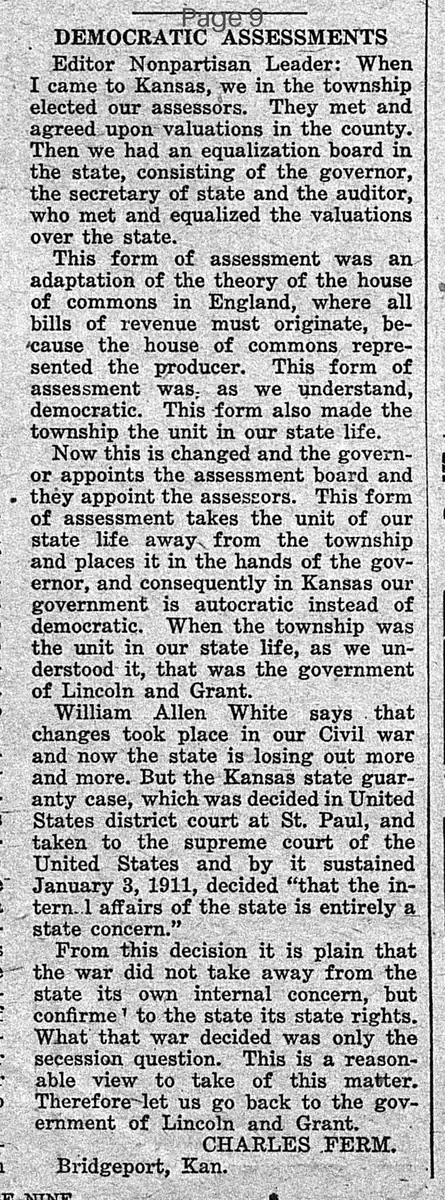
DEMOCRATIC ASSESSMENTS
Editor Nonpartisan Leader: When I came to Kansas, we in the township elected our assessors. They met and agreed upon valuations in the county. Then we had an equalization board in the state, consisting of the governor, the secretary of state and the auditor, who met and equalized the valuations over the state.
This form of assessment was an adaptation of the theory of the house of commons in England, where all bills of revenue must originate, because the house of commons represented the producer. This form of assessment was, as we understand, democratic. This form also made the township the unit in our state life.
Now this is changed and the governor appoints the assessment board and they appoint the assessors. This form of assessment takes the unit of our state life away from the township and places it in the hands of the governor, and consequently in Kansas our government is autocratic instead of democratic. When the township was the unit in our state life, as we understood it, that was the government of Lincoln and Grant.
William Allen White says that changes took place in our Civil war and now the state is losing out more and more. But the Kansas state guaranty case, which was decided in United States district court at St. Paul, and taken to the supreme court of the United States and by it sustained January 3, 1911, decided "that the internal affairs of the state is entirely a state concern."
From this decision it is plain that the war did not take away from the state its own internal concern, but confirmed to the state its state rights. What that war decided was only the secession question. This is a reasonable view to take of this matter.
Therefore let us go back to the government of Lincoln and Grant.
CHARLES FERM
Bridgeport, Kan.
Editor Nonpartisan Leader: When I came to Kansas, we in the township elected our assessors. They met and agreed upon valuations in the county. Then we had an equalization board in the state, consisting of the governor, the secretary of state and the auditor, who met and equalized the valuations over the state.
This form of assessment was an adaptation of the theory of the house of commons in England, where all bills of revenue must originate, because the house of commons represented the producer. This form of assessment was, as we understand, democratic. This form also made the township the unit in our state life.
Now this is changed and the governor appoints the assessment board and they appoint the assessors. This form of assessment takes the unit of our state life away from the township and places it in the hands of the governor, and consequently in Kansas our government is autocratic instead of democratic. When the township was the unit in our state life, as we understood it, that was the government of Lincoln and Grant.
William Allen White says that changes took place in our Civil war and now the state is losing out more and more. But the Kansas state guaranty case, which was decided in United States district court at St. Paul, and taken to the supreme court of the United States and by it sustained January 3, 1911, decided "that the internal affairs of the state is entirely a state concern."
From this decision it is plain that the war did not take away from the state its own internal concern, but confirmed to the state its state rights. What that war decided was only the secession question. This is a reasonable view to take of this matter.
Therefore let us go back to the government of Lincoln and Grant.
CHARLES FERM
Bridgeport, Kan.
What sub-type of article is it?
Persuasive
Political
Reflective
What themes does it cover?
Politics
Economic Policy
Constitutional Rights
What keywords are associated?
Kansas Assessment
Democratic Government
Autocratic State
Lincoln Grant
Civil War
State Rights
Property Valuation
What entities or persons were involved?
Charles Ferm
Editor Nonpartisan Leader
Letter to Editor Details
Author
Charles Ferm
Recipient
Editor Nonpartisan Leader
Main Argument
the shift from elected township assessors to governor-appointed boards has made kansas government autocratic rather than democratic, removing the township as the unit of state life; revert to the original system of lincoln and grant.
Notable Details
Adaptation Of English House Of Commons Theory
Reference To Government Of Lincoln And Grant
Kansas State Guaranty Case Decided January 3, 1911
Civil War Confirmed State Rights On Internal Affairs