Thank you for visiting SNEWPapers!
Sign up free
The New Hampshire Gazette
Portsmouth, Rockingham County, New Hampshire
What is this article about?
A newspaper editorial praises President Jackson's annual message for its able explanation of U.S.-Britain trade, foreign relations, vetoes on bills, fair tariff views, and humane Indian removal policy. It notes a healthy treasury surplus of $4.8M by Jan. 1, 1831, and positive reports from Postmaster General and Navy Secretary showing departmental reforms and savings.
Clipping
OCR Quality
Full Text
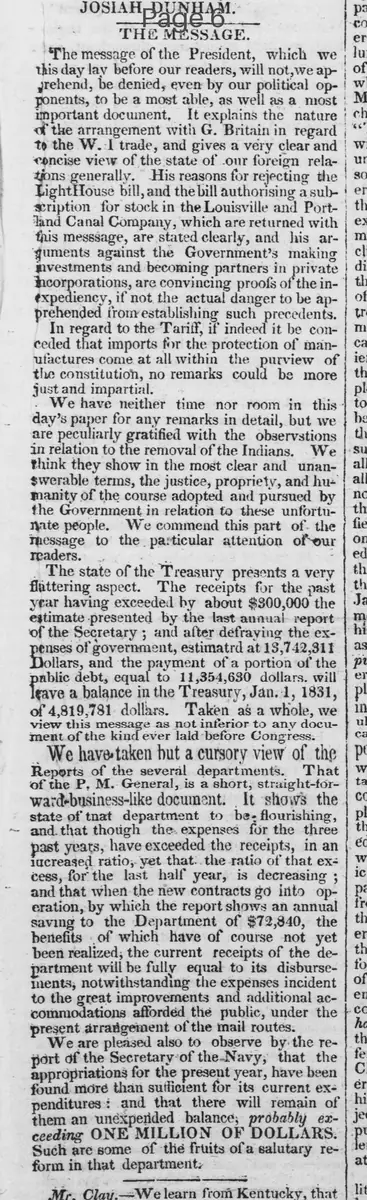
The message of the President, which we this day lay before our readers, will not, we apprehend, be denied, even by our political opponents, to be a most able, as well as a most important document. It explains the nature of the arrangement with G. Britain in regard to the W. I trade, and gives a very clear and concise view of the state of our foreign relations generally. His reasons for rejecting the Light-House bill, and the bill authorising a subscription for stock in the Louisville and Portland Canal Company, which are returned with this message, are stated clearly, and his arguments against the Government's making investments and becoming partners in private incorporations, are convincing proofs of the inexpediency, if not the actual danger to be apprehended from establishing such precedents.
In regard to the Tariff, if indeed it be conceded that imports for the protection of manufactures come at all within the purview of the constitution, no remarks could be more just and impartial.
We have neither time nor room in this day's paper for any remarks in detail, but we are peculiarly gratified with the observations in relation to the removal of the Indians. We think they show in the most clear and unanswerable terms, the justice, propriety, and humanity of the course adopted and pursued by the Government in relation to these unfortunate people. We commend this part of the message to the particular attention of our readers.
The state of the Treasury presents a very flattering aspect. The receipts for the past year having exceeded by about $500,000 the estimate presented by the last annual report of the Secretary; and after defraying the expenses of government, estimated at 15,742,311 Dollars, and the payment of a portion of the public debt, equal to 11,354,630 dollars. will leave a balance in the Treasury, Jan. 1, 1831, of 4,819,781 dollars. Taken as a whole, we view this message as not inferior to any document of the kind ever laid before Congress.
We have taken but a cursory view of the Reports of the several departments, That of the P. M. General, is a short, straight-forward-business-like document. It shows the state of that department to be flourishing, and that though the expenses for the three past years, have exceeded the receipts, in an increased ratio, yet that the ratio of that excess, or the last half year, is decreasing; and that when the new contracts go into operation, by which the report shows an annual saving to the Department of $72,840, the benefits of which have of course not yet been realized; the current receipts of the department will be fully equal to its disbursements, notwithstanding the expenses incident to the great improvements and additional accommodations afforded the public, under the present arrangement of the mail routes.
We are pleased also to observe by the report of the Secretary of the Navy, that the appropriations for the present year, have been found more than sufficient for its current expenditures: and that there will remain of them an unexpended balance; probably exceeding ONE MILLION OF DOLLARS.
Such are some of the fruits of a salutary reform in that department:
What sub-type of article is it?
What themes does it cover?
What keywords are associated?
What entities or persons were involved?
Where did it happen?
Story Details
Key Persons
Location
United States
Event Date
January 1, 1831
Story Details
The editorial lauds the President's message for clarifying U.S.-Britain West Indies trade, foreign relations, vetoes on lighthouse and canal bills, constitutional tariff views, and justifying humane Indian removal. It highlights treasury surplus after expenses and debt payments, flourishing postal service with upcoming savings, and Navy's unexpended appropriations from reforms.