Thank you for visiting SNEWPapers!
Sign up free
The Providence Journal, And Town And Country Advertiser
Providence, Providence County, Rhode Island
What is this article about?
Eyewitness account by Mr. Petit of the Battle of Marengo's aftermath, detailing the exhaustion, wounded soldiers, prisoners, and eventual armistice between French and Austrian forces, portraying the human cost of the French victory.
Merged-components note: These components continue the account of the Battle of Marengo, a foreign military event; relabeled to foreign_news as it fits international war reporting better than 'story'.
Clippings
1 of 2
OCR Quality
Full Text
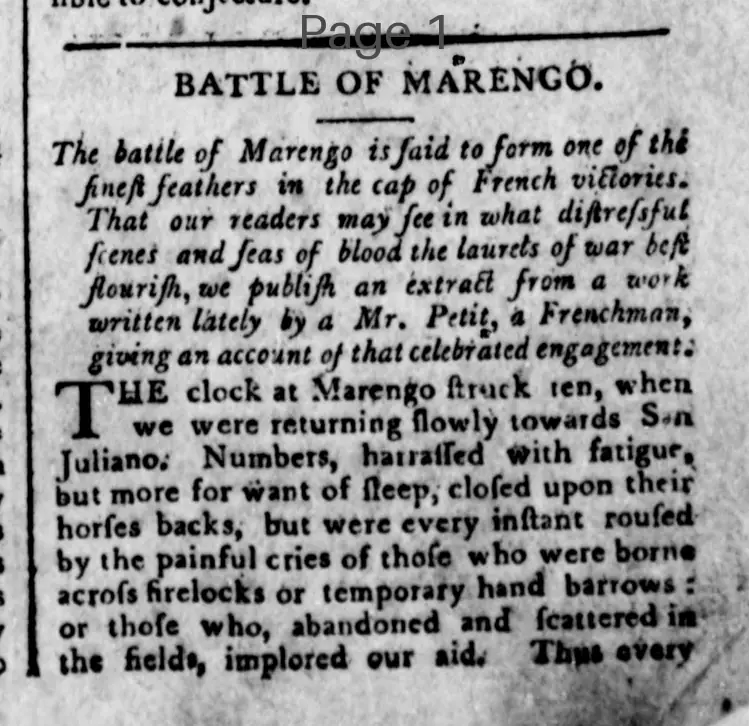
The battle of Marengo is said to form one of the finest feathers in the cap of French victories. That our readers may see in what distressful scenes and seas of blood the laurels of war best flourish, we publish an extract from a work written lately by a Mr. Petit, a Frenchman, giving an account of that celebrated engagement:
The clock at Marengo struck ten, when we were returning slowly towards San Juliano: Numbers, harassed with fatigue, but more for want of sleep, dozed upon their horses backs; but were every instant roused by the painful cries of those who were borne across firelocks or temporary hand barrows: or those who, abandoned and scattered in the fields, implored our aid. Thus every
Humane and sensitive heart was penetrated with that melancholy to which the true soldier is no stranger, and which does him so much honour.
Horses limping here and there, upon three legs, calling to our own by their instinctive neighings; at every step too it was necessary to turn out of our way, so as to avoid treading upon the wounded. The ditches and the road often presented the scene of caissons, and other carriages, as well as cannon, overturned. Further off we beheld houses devoured by the flames, and tumbling upon the heads of the wretched owners, half dead by the fears which had driven them to the expedient of hiding themselves in the cellars and other subterranean places. The total darkness which surrounded us, made the picture additionally frightful. Prisoners, not knowing where to go, but with the hope of escaping, wandered at random. If they were met by the French soldiers, bending under the weight of their comrades, they were forced to turn back, and bear on their shoulders those respectable burdens.
At length arrived at head-quarters, which served as the ambulance to the army, every one showed himself, as he could, among the dying and the dead, without the piercing cries of the former being able any longer to surmount the violence of sleep. The next morning, hunger taking its turn to prevail, I, in a melancholy condition, entered the great court to look for something for myself and horse to eat. I was there struck with a sight so horrible, that I shuddered all over. More than three thousand Frenchmen and Austrians, heaped one upon another in the yard, in the granaries, in the stables and outhouses, even in the very cellars and vaults, were uttering the most lamentable cries, blended with the severest curses against the surgeons, there being too few to dress all their wounds at once. Everywhere I heard the languishing voices of comrades, and one of my particular friends, who begged of me something to eat or drink. All that I could do was to fetch them some water. In truth, forgetting my own wants, and those of my horse, I staid more than two hours, running back wards and forwards, performing by turns the part of a surgeon and an hospital attendant.
Prisoners were brought in from every part, which increased the number of the famished. In short, this was a day that appeared of an insupportable length to all of us. However, an event which gave birth to a great many conjectures, moderated in some degree, our endless inquietudes. An Austrian officer came to hold a parley, and a French aid-de-camp set out immediately to Alexandria. No one knew anything of this business, and yet everyone made a gazette of it, after his own manner. Berthier went off to that place about noon, leaving us all in the greatest expectation, for no one dared to hope for that which we learnt the next day to have been obtained. We were early in the morning informed of the news of the armistice, which filled the French army with a joy never before experienced; while that of the Austrian, storming with rage, fled off the next and succeeding days before us, on the field of battle, till reeking with their and our blood, and where the dead carcases began to taint the air with their putrid exhalations.
And now a supply of subsistence and other necessaries began to arrive, as well as carriages for the conveyance of the sick. A rational partition of these comforts was made among all the victims of that bloody day. Without any inquietude or jealousy, the Austrian was seen with the Frenchman, who two days before would have cut one another's throats. They were seen to receive from the same hands, under the same roof, in the same chamber, the required help, and the urgent care of succouring humanity.
What sub-type of article is it?
What keywords are associated?
What entities or persons were involved?
Where did it happen?
Foreign News Details
Primary Location
Marengo
Key Persons
Outcome
more than three thousand frenchmen and austrians wounded; armistice agreed upon; austrian army fled; supplies arrived for the sick and wounded.
Event Details
After the Battle of Marengo, French troops returned exhausted to San Juliano amid cries of the wounded and scenes of destruction. At headquarters, thousands of wounded French and Austrian soldiers overwhelmed medical care. Prisoners assisted in carrying the injured. Negotiations led to an armistice, bringing joy to the French and rage to the Austrians, who retreated. Supplies were shared humanely between former enemies.