Thank you for visiting SNEWPapers!
Sign up free
Editorial
May 20, 1845
The Daily Union
Washington, District Of Columbia
What is this article about?
The Daily Union editorial defends against New York Herald accusations of opposing John C. Calhoun's potential diplomatic role, reaffirms commitment to Democratic Party unity without proscribing individuals, denies involvement in rumors about missions to England involving Calhoun, Van Buren, and Elmore, and emphasizes support for the administration and republican principles ahead of future elections.
Clipping
OCR Quality
95%
Excellent
Full Text
THE DAILY UNION.
THE UNION:
CITY OF WASHINGTON.
TUESDAY NIGHT, MAY 20, 1845.
ONCE MORE.
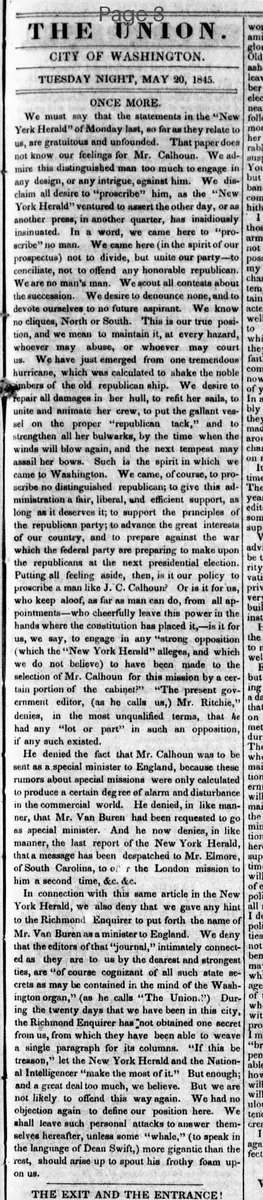
We must say that the statements in the "New York Herald" of Monday last, so far as they relate to us, are gratuitous and unfounded. That paper does not know our feelings for Mr. Calhoun. We admire this distinguished man too much to engage in any design, or any intrigue, against him. We disclaim all desire to "proscribe" him, as the "New York Herald" ventured to assert the other day, or as another press, in another quarter, has insidiously insinuated. In a word, we came here to "proscribe" no man. We came here (in the spirit of our prospectus) not to divide, but unite our party—to conciliate, not to offend any honorable republican. We are no man's man. We scout all contests about succession. We desire to discountenance none, and to devote ourselves to no future aspirant. We know no cliques, North or South. This is our true position, and we mean to maintain it, at every hazard, whoever may abuse, or whoever may court us. We have just emerged from one tremendous hurricane, which was calculated to shake the noble timbers of the old republican ship. We desire to repair all damages in her hull, to refit her sails, to unite and animate her crew, to put the gallant vessel on the proper "republican tack," and to strengthen all her bulwarks, by the time when the winds will blow again, and the next tempest may assail her bows. Such is the spirit in which we came to Washington. We came, of course, to proscribe no distinguished republican; to give this administration a fair, liberal, and efficient support, as long as it deserves it; to support the principles of the republican party; to advance the great interests of our country, and to prepare against the war which the federal party are preparing to make upon the republicans at the next presidential election. Putting all feeling aside, then, is it our policy to proscribe a man like J. C. Calhoun? Or is it for us, who keep aloof, as far as man can do, from all appointments—who cheerfully leave this power in the hands where the constitution has placed it,—is it for us, we say, to engage in any "strong opposition (which the "New York Herald" alleges, and which we do not believe) to have been made to the selection of Mr. Calhoun for this mission by a certain portion of the cabinet?" "The present government editor, (as he calls us,) Mr. Ritchie," denies, in the most unqualified terms, that he had any "lot or part" in such an opposition, if any such existed. He denied the fact that Mr. Calhoun was to be sent as a special minister to England, because these rumors about special missions were only calculated to produce a certain degree of alarm and disturbance in the commercial world. He denied, in like manner, that Mr. Van Buren had been requested to go as special minister. And he now denies, in like manner, the last report of the New York Herald, that a message has been despatched to Mr. Elmore, of South Carolina, to offer the London mission to him a second time, &c. &c. In connection with this same article in the New York Herald, we also deny that we gave any hint to the Richmond Enquirer to put forth the name of Mr. Van Buren as a minister to England. We deny that the editors of that "journal," intimately connected as they are to us by the dearest and strongest ties, are "of course cognizant of all such state secrets as may be contained in the mind of the Washington organ," (as he calls "The Union.") During the twenty days that we have been in this city, the Richmond Enquirer has "not obtained one secret from us, from which they have been able to weave a single paragraph for its columns." "If this be treason," let the New York Herald and the National Intelligencer "make the most of it." But enough; and a great deal too much, we believe. But we are not likely to offend this way again. We had no objection again to define our position here. We shall leave such personal attacks to answer themselves hereafter, unless some "whale," (to speak in the language of Dean Swift,) more gigantic than the rest, should arise up to spout his frothy foam upon us.
THE UNION:
CITY OF WASHINGTON.
TUESDAY NIGHT, MAY 20, 1845.
ONCE MORE.
We must say that the statements in the "New York Herald" of Monday last, so far as they relate to us, are gratuitous and unfounded. That paper does not know our feelings for Mr. Calhoun. We admire this distinguished man too much to engage in any design, or any intrigue, against him. We disclaim all desire to "proscribe" him, as the "New York Herald" ventured to assert the other day, or as another press, in another quarter, has insidiously insinuated. In a word, we came here to "proscribe" no man. We came here (in the spirit of our prospectus) not to divide, but unite our party—to conciliate, not to offend any honorable republican. We are no man's man. We scout all contests about succession. We desire to discountenance none, and to devote ourselves to no future aspirant. We know no cliques, North or South. This is our true position, and we mean to maintain it, at every hazard, whoever may abuse, or whoever may court us. We have just emerged from one tremendous hurricane, which was calculated to shake the noble timbers of the old republican ship. We desire to repair all damages in her hull, to refit her sails, to unite and animate her crew, to put the gallant vessel on the proper "republican tack," and to strengthen all her bulwarks, by the time when the winds will blow again, and the next tempest may assail her bows. Such is the spirit in which we came to Washington. We came, of course, to proscribe no distinguished republican; to give this administration a fair, liberal, and efficient support, as long as it deserves it; to support the principles of the republican party; to advance the great interests of our country, and to prepare against the war which the federal party are preparing to make upon the republicans at the next presidential election. Putting all feeling aside, then, is it our policy to proscribe a man like J. C. Calhoun? Or is it for us, who keep aloof, as far as man can do, from all appointments—who cheerfully leave this power in the hands where the constitution has placed it,—is it for us, we say, to engage in any "strong opposition (which the "New York Herald" alleges, and which we do not believe) to have been made to the selection of Mr. Calhoun for this mission by a certain portion of the cabinet?" "The present government editor, (as he calls us,) Mr. Ritchie," denies, in the most unqualified terms, that he had any "lot or part" in such an opposition, if any such existed. He denied the fact that Mr. Calhoun was to be sent as a special minister to England, because these rumors about special missions were only calculated to produce a certain degree of alarm and disturbance in the commercial world. He denied, in like manner, that Mr. Van Buren had been requested to go as special minister. And he now denies, in like manner, the last report of the New York Herald, that a message has been despatched to Mr. Elmore, of South Carolina, to offer the London mission to him a second time, &c. &c. In connection with this same article in the New York Herald, we also deny that we gave any hint to the Richmond Enquirer to put forth the name of Mr. Van Buren as a minister to England. We deny that the editors of that "journal," intimately connected as they are to us by the dearest and strongest ties, are "of course cognizant of all such state secrets as may be contained in the mind of the Washington organ," (as he calls "The Union.") During the twenty days that we have been in this city, the Richmond Enquirer has "not obtained one secret from us, from which they have been able to weave a single paragraph for its columns." "If this be treason," let the New York Herald and the National Intelligencer "make the most of it." But enough; and a great deal too much, we believe. But we are not likely to offend this way again. We had no objection again to define our position here. We shall leave such personal attacks to answer themselves hereafter, unless some "whale," (to speak in the language of Dean Swift,) more gigantic than the rest, should arise up to spout his frothy foam upon us.
What sub-type of article is it?
Partisan Politics
What keywords are associated?
Calhoun
Party Unity
New York Herald
Political Intrigue
Diplomatic Missions
Republican Party
What entities or persons were involved?
Mr. Calhoun
New York Herald
Mr. Ritchie
Richmond Enquirer
Mr. Van Buren
Mr. Elmore
National Intelligencer
Editorial Details
Primary Topic
Defense Against Accusations Of Opposing Calhoun And Party Intrigue
Stance / Tone
Defensive And Unifying
Key Figures
Mr. Calhoun
New York Herald
Mr. Ritchie
Richmond Enquirer
Mr. Van Buren
Mr. Elmore
National Intelligencer
Key Arguments
Statements In New York Herald About Us Are Unfounded
We Admire Calhoun And Do Not Proscribe Him
Our Mission Is To Unite The Party, Not Divide It
We Deny Opposition To Calhoun's Selection For Mission
We Deny Giving Hints To Richmond Enquirer About Van Buren
We Support The Administration And Republican Principles