Thank you for visiting SNEWPapers!
Sign up free
The Hillsdale Standard
Hillsdale, Hillsdale County, Michigan
What is this article about?
A reflective essay on Ireland's devastating decade from 1841-1851, marked by famine, population decline of 20%, mass emigration, evictions, and failed political agitations for repeal and independence, contrasting with global progress and calling for renewed action to prevent extermination.
Merged-components note: Continuation of foreign news article on Ireland's demographic and social changes from 1841-1851, across sequential reading order and adjacent bboxes.
Clipping
OCR Quality
Full Text
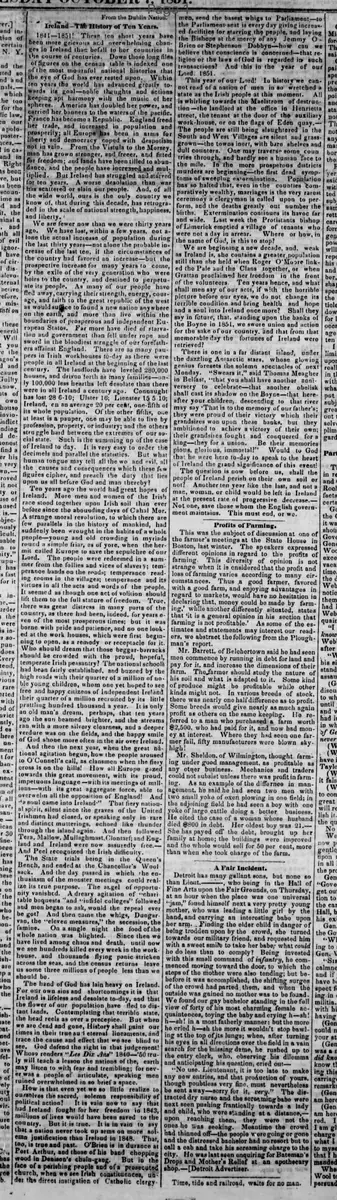
Within ten years the world has advanced greatly towards its goal—noble thoughts and actions keeping apt harmony with the music of her spheres. America has doubled her power, and carried her banners to the waters of the pacific. France has become a Republic. England freed her trade, and increased in population and prosperity; all Europe has been in arms or liberties and democracy coped with despotism not in vain. From the Vistula to the Moselle. man has grown stronger, and freer, and fitted for freedom: and lands have been tilled to abundance, and the people have increased and multiplied. But Ireland has struggled and starved for ten years. A worse desolation than war has scattered or slain our people. And, of all the wide world, ours is the only country we know of, that during this decade, has retrograded in the scale of national strength, happiness, and liberty.
We are fewer now than we were thirty years ago. We have lost, within a few years, not alone the actual increase of population during the last thirty years—not alone the probable increase of the last ten, if the circumstances of the country had favored an increase—but the prospective increase for many years to come, by the exile of the very generation who were heirs to the country, and destined to perpetuate its people. As many of our people have fled away, carrying their strength, energy, courage, and faith to the great republic of the west as would suffice to found a new nation anywhere on the earth, and more than live within the boundaries of prosperous and independent European States. Far more have died of starvation and government than fell under rope and sword in the bloodiest struggle of our forefathers against England. There are as many paupers in Irish workhouses to-day as there were people in all Ireland at the beginning of the last century. The landlords have leveled 280,000 houses, and driven forth as many families—only 100,000 less hearths left desolate than there were in all Ireland a century ago. Connaught has lost 28 6-10; Ulster 16; Leinster 15 5-10; Ireland, on an average 20 per cent, one-fifth of its whole population. Of the other fifths, one at least is a pauper, one may be able to live by profession, property, or industry; and the others struggle hard between the extremes of our social state. Such is the summing up of the case of Ireland to day. It is very easy to order the decimals and parallel the statistics. But what human tongue may tell all the woe and evil, all the causes and consequences which these few figures cipher, and preach the duty that lies upon us all before God and man thereby?
Ten years ago the world had great hopes of Ireland. More men and women of the Irish race stood together upon Irish soil than ever before since the abounding days of Cahal Mor. A strange moral revolution, to which there are few parallels in the history of mankind, had suddenly been wrought in the habits of a whole people—young and old crowding in myriads round a simple friar, as of yore, when the hermit called Europe to save the sepulchre of our Lord. The people were redeemed in a summer from the oldies and vices of slavery; temperance bands on the roads; temperance reading rooms in the villages; temperance and its virtues in all the acts and words of the people. It seemed as though one act of volition should lift them to the full stature of freedom. True, there was great distress in many parts of the country, as there had been, indeed, for years even of the most prosperous times; but it was borne with pride and patience, and no one looked at the work houses, which were first beginning to open, as a remedy or receptacle for it. Who should dream that those beggar-barracks should be crowded with the proud, hopeful, temperate Irish peasantry? The national schools had been fairly established, and buzzed by the high roads with their quarter of a million of noble young children, whom one yet hoped to see free and happy citizens of Independent Ireland their quarter of a million recruited by its little prattling hundred thousand a year. It is only an old man's dream, perhaps, that ten years ago the sun beamed brighter, and the streams ran with a more silvery clearness, and a deeper verdure was on the fields, and the happy smile of God shone more often in the air over Ireland.
And then the next year, when the great national agitation begun, how the people aroused to O'Connell's call, as clansmen when the fiery cross is on the hills! How all Europe gazed towards this great movement, with its proud, impetuous language—with its meetings of millions—with its great aggregate force, able to overwhelm all the opposition of England! And "a soul came into Ireland." That fiery national spirit, silent since the graves of the United Irishmen had closed, or speaking only in rare and distinct mutterings, echoed like thunder through the island again. And then followed Tara, Mallow, Mullaghmast, Clontarf; and England and Ireland were now assuredly free. And Peel recognized the Irish difficulty. The State trials being in the Queen's Bench, and ended at the Chancellor's Wool sack. And the day passed in which the enthusiasm of the monster meetings could realize its true purpose. The angel of opportunity vanished. A dreary agitation of "charitable bequests" and "infidel colleges" followed and men began to ask, would the repeal ever be got? And then came the whigs, Dungarvan, the "eleven measures," the secession, the famine. On a single night the food of the whole nation was blighted. Since then we have lived among chaos and death, until now we see hundreds killed every week in the workhouse, and thousands flying panic-stricken across the seas, and the census returns leave us some three millions of people less than we should be.
The hand of God has lain heavy on Ireland. For our own sins and shortcomings it is that Ireland is lifeless and desolate to-day, and that the flower of our population, have fled to distant lands. Contemplating that terrible state, the head reels as over a precipice. But when we are dead and gone, History shall paint our times in their true and eternal lineaments, and trace the cause and effect that we are blind to see, God defend the right in that judgement!
Whose readers "Les Dix Ans" 1840-'50 truly will teach a lesson the nations of the earth may listen to with fear and trembling; for never was a people of articulate, speaking men ruined overwhelmed in so brief a space.
How is that even yet we so little realize to ourselves the sacred, solemn responsibility of political action? It is vain now to say that had Ireland fought for her freedom in 1843, millions of lives would have been saved to the country. But it is true. It is in vain to say that a nation never took up arms on more solemn justification than Ireland in 1848. That, too, is true and past. O'Brien is in durance at Port Arthur, and those of his band chopping wood in Denison's chain-gang. But in the face of a perishing people and of a prosecuted church, when we see Irish constituencies, under the direct instigation of Catholic clergy-men, send the basest whigs to Parliament—to the Parliament—seat is every day giving increased facilities for starving the people, and leaving the Bishops at the mercy of any Jemmy O-Brien or Stephenson Dobbyn—how can we believe that conscience is concerned—that religion or the laws of God is regarded in such transactions? And this in the year of our Lord, 1851.
This year of our Lord! In history we cannot read of a nation of men in so wretched a state as the Irish people at this moment. All is whirling towards the Maelstrom of destruction—the landlord at the office in Henrietta street, the tenant at the door of the auxiliary work-house, or on the flags of Eden quay. The people are still being slaughtered in the South and West Villages are silent and grass-grown—the towns inert, with bare shelves and dull counters. One may traverse some countries through, and hardly see a human face to the mile. In the more prosperous districts murders are beginning—the first dead symptoms of sweeping extermination. Population has so halted that, even in the counties comparatively wealthy, marriage is the very rarest ceremony a clergyman is called upon to perform, and the deaths greatly outnumber the births. Extermination continues its havoc far and wide. Last week the Protestant bishop of Limerick emptied a village of tenants who were not a day in arrear. Where or how, in the name of God, is this to stop?
We are beginning a new decade, and, weak as Ireland is, she contains a greater population still than she held when Roger O'Moore linked the Pale and the Clans together, or when Grattan proclaimed her freedom in the front of the volunteers. Ten years hence, and what shall men say of our acts, if with the horrible picture before our eyes, we do not change its terrible condition and bring health and hope and a soul into Ireland once more? Shall they say in future, that, standing upon the banks of the Boyne in 1851, we swore union and action for the sake of our country, and that from that memorable day the fortunes of Ireland were retrieved?
There is one in a far distant island, under the dazzling Antarctic stars, whose glowing genius foresees the solemn spectacles of next Monday. "Swear it," said Thomas Meagher in Belfast, "that you shall have another anniversary to celebrate—that another obelisk shall cast its shadow on the Boyne—that hereafter your children, descending to that river may say That is to the memory of our fathers; they were proud of their victory which their grandsires won upon these banks, but they ambitioned to achieve a victory of their own; their grandsires fought and conquered for a king—they for a union. Be their memories pious, glorious, immortal?" Would to God that he were here to-day to speak to the heart of Ireland the grand significance of this event!
The question is now before us, shall the people of Ireland perish on their own soil or not? Another ten year like the last, and not a man, woman, or child would be left in Ireland at the present rate of progressive decrease. Not one, save those whom the English government maintains. This must end, or we.
What sub-type of article is it?
What keywords are associated?
What entities or persons were involved?
Where did it happen?
Foreign News Details
Primary Location
Ireland
Event Date
1841 1851
Key Persons
Outcome
population loss of 20% (one-fifth), 280,000 houses leveled, mass emigration to america, deaths from starvation exceeding historical battles, thousands of paupers, ongoing extermination and evictions.
Event Details
Over the decade 1841-1851, Ireland suffered famine, blighted crops, political agitations for repeal led by O'Connell failing, 1848 uprising suppressed with leaders exiled, mass evictions by landlords, workhouses filled with starving peasantry, contrasting with global progress; calls for renewed union and action at the Boyne in 1851 to reverse decline.