Thank you for visiting SNEWPapers!
Sign up free
Letter to Editor
August 30, 1832
Herald Of The Times
Newport, Newport County, Rhode Island
What is this article about?
A letter from East Greenwich defends the characters of Senator Asher Robbins and Representative Tristam Burges against an anonymous slanderous account in the Herald of a political meeting, corrects misstatements about farmer attendance, praises Burges' speech criticizing the Jackson administration, and attacks Jackson supporters including Updike and Potter.
Clipping
OCR Quality
95%
Excellent
Full Text
From the Providence Journal of Monday last.
East Greenwich, Aug. 25.
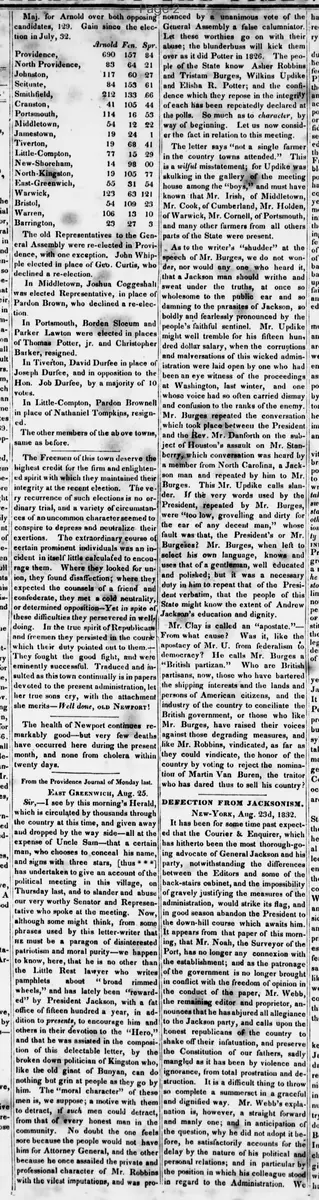
Sir,—I see by this morning's Herald, which is circulated by thousands through the country at this time, and given away and dropped by the way side—all at the expense of Uncle Sam—that a certain man, who chooses to conceal his name, and signs with three stars, [thus * * *] has undertaken to give an account of the political meeting in this village, on Thursday last, and to slander and abuse our very worthy Senator and Representative who spoke at the meeting. Now, although some might think, from some phrases used by this letter-writer that HE must be a paragon of disinterested patriotism and moral purity—we happen to know, here, that he is no other than the Little Rest lawyer who writes pamphlets about "broadrimmed wheels," and has lately been "rewarded" by President Jackson, with a fat office of fifteen hundred a year, in addition to presents, to encourage him and others in their devotion to the "Hero," and that he was assisted in the composition of this delectable letter, by the broken down politician of Kingston who, like the old giant of Bunyan, can do nothing but grin at people as they go by him. The "moral character" of these men is, we suppose, a motive with them to detract, if such men could detract, from that of every honest man in the community. No doubt the one feels sore because the people would not have him for Attorney General, and the other because he once assailed the private and professional character of Mr. Robbins with the vilest imputations, and was pronounced by a unanimous vote of the General Assembly a false calumniator.
Let these worthies go on with their abuse; the blunderbuss will kick them over as it did Potter in 1826. The people of the State know Asher Robbins and Tristam Burges, Wilkins Updike and Elisha R. Potter; and the confidence which they repose in the integrity of each has been repeatedly declared at the polls. So much as to character, by way of beginning. Let us now consider the fact in relation to this meeting. The letter says "not a single farmer in the country towns attended." This is a wilful misstatement; for Updike was skulking in the gallery of the meeting house among the "boys," and must have known that Mr. Irish, of Middletown, Mr. Cook, of Cumberland, Mr. Holden, of Warwick, Mr. Cornell, of Portsmouth, and many other farmers from all other parts of the State were present.
As to the writer's "shudder" at the speech of Mr. Burges, we do not wonder, nor would any one who heard it. That a Jackson man should writhe and sweat under the truths, at once so wholesome to the public ear and so damning to the parasites of Jackson, so boldly and fearlessly pronounced by the people's faithful sentinel. Mr. Updike might well tremble for his fifteen hundred dollar salary, when the corruptions and malversations of this wicked administration were laid open by one who had been an eye witness of the proceedings at Washington, last winter, and one whose voice had so often carried dismay and confusion to the ranks of the enemy.
Mr. Burges repeated the conversation which took place between the President and the Rev. Mr. Danforth on the subject of Houston's assault on Mr. Stanberry, which conversation was heard by a member from North Carolina, a Jackson man and repeated by him to Mr. Burges. This Mr. Updike calls slander. If the very words used by the President, repeated by Mr. Burges, were "too low, grovelling and dirty for the ear of any decent man," whose fault was that, the President's or Mr. Burges's? Mr. Burges, when left to select his own language, knows and uses that of a gentleman, well educated and polished; but it was a necessary duty in him to repeat that of the President verbatim, that the people of this State might know the extent of Andrew Jackson's education and dignity.
Mr. Clay is called an "apostate." From what cause? Was it, like the apostacy of Mr. U. from federalism to democracy? He calls Mr. Burges a "British partizan." Who are British partisans, now, those who have bartered the shipping interests and the lands and persons of American citizens, and the industry of the country to conciliate the British government, or those who like Mr. Burges, have raised their voices against those degrading measures, and like Mr. Robbins, vindicated, as far as they could vindicate, the honor of the country by voting to reject the nomination of Martin Van Buren, the traitor who has dared thus to sell his country?
East Greenwich, Aug. 25.
Sir,—I see by this morning's Herald, which is circulated by thousands through the country at this time, and given away and dropped by the way side—all at the expense of Uncle Sam—that a certain man, who chooses to conceal his name, and signs with three stars, [thus * * *] has undertaken to give an account of the political meeting in this village, on Thursday last, and to slander and abuse our very worthy Senator and Representative who spoke at the meeting. Now, although some might think, from some phrases used by this letter-writer that HE must be a paragon of disinterested patriotism and moral purity—we happen to know, here, that he is no other than the Little Rest lawyer who writes pamphlets about "broadrimmed wheels," and has lately been "rewarded" by President Jackson, with a fat office of fifteen hundred a year, in addition to presents, to encourage him and others in their devotion to the "Hero," and that he was assisted in the composition of this delectable letter, by the broken down politician of Kingston who, like the old giant of Bunyan, can do nothing but grin at people as they go by him. The "moral character" of these men is, we suppose, a motive with them to detract, if such men could detract, from that of every honest man in the community. No doubt the one feels sore because the people would not have him for Attorney General, and the other because he once assailed the private and professional character of Mr. Robbins with the vilest imputations, and was pronounced by a unanimous vote of the General Assembly a false calumniator.
Let these worthies go on with their abuse; the blunderbuss will kick them over as it did Potter in 1826. The people of the State know Asher Robbins and Tristam Burges, Wilkins Updike and Elisha R. Potter; and the confidence which they repose in the integrity of each has been repeatedly declared at the polls. So much as to character, by way of beginning. Let us now consider the fact in relation to this meeting. The letter says "not a single farmer in the country towns attended." This is a wilful misstatement; for Updike was skulking in the gallery of the meeting house among the "boys," and must have known that Mr. Irish, of Middletown, Mr. Cook, of Cumberland, Mr. Holden, of Warwick, Mr. Cornell, of Portsmouth, and many other farmers from all other parts of the State were present.
As to the writer's "shudder" at the speech of Mr. Burges, we do not wonder, nor would any one who heard it. That a Jackson man should writhe and sweat under the truths, at once so wholesome to the public ear and so damning to the parasites of Jackson, so boldly and fearlessly pronounced by the people's faithful sentinel. Mr. Updike might well tremble for his fifteen hundred dollar salary, when the corruptions and malversations of this wicked administration were laid open by one who had been an eye witness of the proceedings at Washington, last winter, and one whose voice had so often carried dismay and confusion to the ranks of the enemy.
Mr. Burges repeated the conversation which took place between the President and the Rev. Mr. Danforth on the subject of Houston's assault on Mr. Stanberry, which conversation was heard by a member from North Carolina, a Jackson man and repeated by him to Mr. Burges. This Mr. Updike calls slander. If the very words used by the President, repeated by Mr. Burges, were "too low, grovelling and dirty for the ear of any decent man," whose fault was that, the President's or Mr. Burges's? Mr. Burges, when left to select his own language, knows and uses that of a gentleman, well educated and polished; but it was a necessary duty in him to repeat that of the President verbatim, that the people of this State might know the extent of Andrew Jackson's education and dignity.
Mr. Clay is called an "apostate." From what cause? Was it, like the apostacy of Mr. U. from federalism to democracy? He calls Mr. Burges a "British partizan." Who are British partisans, now, those who have bartered the shipping interests and the lands and persons of American citizens, and the industry of the country to conciliate the British government, or those who like Mr. Burges, have raised their voices against those degrading measures, and like Mr. Robbins, vindicated, as far as they could vindicate, the honor of the country by voting to reject the nomination of Martin Van Buren, the traitor who has dared thus to sell his country?
What sub-type of article is it?
Persuasive
Political
Provocative
What themes does it cover?
Politics
What keywords are associated?
Political Meeting
Jackson Administration
Slander
Asher Robbins
Tristam Burges
Wilkins Updike
Elisha Potter
East Greenwich
Van Buren Nomination
What entities or persons were involved?
Sir
Letter to Editor Details
Recipient
Sir
Main Argument
the letter defends the integrity of asher robbins and tristam burges against slander by jackson supporters, corrects falsehoods about a political meeting's attendance, and condemns the jackson administration's corruptions and policies favoring british interests.
Notable Details
Identifies Anonymous Writer As Little Rest Lawyer Rewarded By Jackson
Assisted By Broken Down Politician Of Kingston
References Updike's Office And Potter's Past Calumny
Details Farmers Present: Mr. Irish Of Middletown, Mr. Cook Of Cumberland, Mr. Holden Of Warwick, Mr. Cornell Of Portsmouth
Burges Repeats Jackson Danforth Conversation On Houston's Assault On Stanberry
Criticizes Rejection Of Van Buren Nomination
Alludes To Potter Incident In 1826