Thank you for visiting SNEWPapers!
Sign up free
Alexandria Gazette
Alexandria, Alexandria County, District Of Columbia
What is this article about?
At a public dinner in Albemarle, Mr. Rives gave a two-hour speech defending his congressional actions against Administration critics, decrying party discipline on the sub-Treasury scheme, quoting Hugh S. Legare on constitutional subversion, comparing the Van Buren administration unfavorably to Jefferson's, and warning of executive overreach threatening republicanism.
Clipping
OCR Quality
Full Text
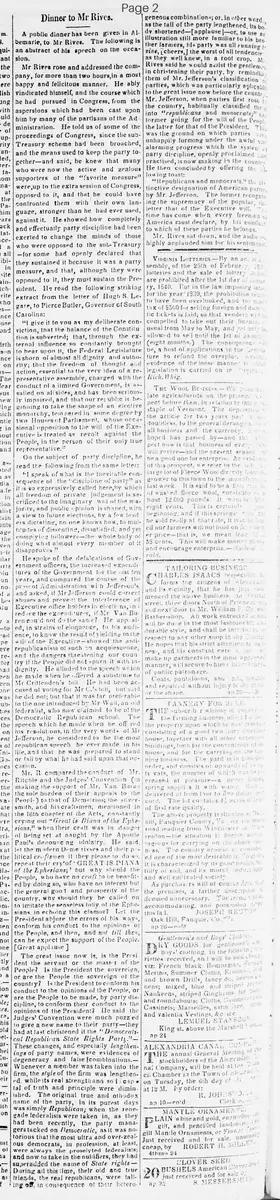
A public dinner has been given in Albemarle, to Mr. Rives. The following is an abstract of his speech on the occasion.
Mr. Rives rose and addressed the company, for more than two hours, in a most happy and felicitous manner.
He ably vindicated himself, and the course which he had pursued in Congress, from the aspersions which had been cast upon him by many of the partisans of the Administration. He told us of some of the proceedings of Congress, since the sub-Treasury scheme had been broached, and the means used to keep the party together—and said, he knew that many who were now the active and zealous supporters of the "favorite measure" were, up to the extra session of Congress, opposed to it, and that he could have confronted them with their own language, stronger than he had ever used against it. He showed how completely and effectually party discipline had been exerted to change the minds of those who were opposed to the sub-Treasury—for some had openly declared that they sustained it because it was a party measure, and that, although they were opposed to it, they must sustain the President. He read the following striking extract from the letter of Hugh S. Legare, to Pierce Butler, Governor of South Carolina:
"I give it to you as my deliberate conviction, that the balance of the Constitution is subverted; that, through the external influence so constantly brought to bear upon it, the Federal Legislature is shorn of almost all dignity and authority; that the freedom of thought and action, essential to the very idea of a representative assembly, charged with the conduct of a limited Government, is assailed on all sides, and has been seriously impaired, and that our republic is beginning to take the shape of an elective monarchy, tempered in some degree by two Houses of Parliament, whose occasional opposition to the will of the Executive is treated as revolt against the People, in the person of their only true representative."
On the subject of party discipline, he read the following from the same letter:
"I speak of what is the inevitable consequence of the "discipline of party" as it is so expressively called here, by which all freedom of private judgement is sacrificed to the imaginary will of the majority, and public opinion is shaped, with a view to future elections, by a few leaders dictating, no one knows how, to multitudes of dissenting, dissatisfied, and even complaining followers—the whole body of doing what almost every member of it disapproves."
He spoke of the defalcations of Government officers, the increased expenditures of the Government for the last ten years, and compared the course of the present Administration with Jefferson's, and asked, if Mr. Jefferson could correct abuses and prevent the interference of Executive office holders in elections, and reduce the expenditures, if Mr. Van Buren could not do the same? He appealed, in strains of eloquence, to his audience, to know the result of yielding to the will of the Executive—showed the anti-republicanism of such an acquiescence, and the dangers threatening our country if the People did not spurn it with indignation. He alluded to the speech which he made when he offered a substitute to Mr. Crittenden's bill. He had been accused of voting for Mr. C.'s bill, but said he did not: but that it was far preferable to the one introduced by Mr. Wall, an old federalist, who now claimed to be of the Democratic Republican school. The speech which he made when he offered his resolutions, in the very words of Mr. Jefferson, he considered to be the most republican speech he ever made in his life, and that he was prepared to stand or fall by what he had said upon that occasion.
Mr. R. compared the conduct of Mr. Ritchie and the Judges' Convention (in making the support of Mr. Van Buren the sole burden of their appeals to the People) to that of Demetrius, the silver-smith, and his craftsmen, mentioned in the 19th chapter of the Acts, constantly crying out "Great is Diana of the Ephesians," when their craft was in danger of being set at naught by the Apostle Paul's denouncing idolatry. He said, let the modern Demetriuses and their political craftsmen, if they please to do so, repeat their cry of "GREAT IS DIANA of the Ephesians;" but why should the People, who have no craft to be benefited by doing so, who have no interest but the general good and prosperity of the country, why should they be called on to imitate the senseless folly of the Ephesians, in echoing this clamor? Let the President abjure the errors of his ways, conform his conduct to the opinions of the People, and then, and not till then, can he expect the support of the People. [Great applause.]
The great issue now is, is the President the servant or the master of the People? Is the President the sovereign, or are the People the sovereign of the country? Is the President to conform his conduct to the opinions of the People, or are the People to be made, by party discipline, to conform their conduct to the opinions of the President? He said the Judges' Convention were much puzzled to give a new name to their party—they had at last christened it the "Democratic Republican State Rights Party." These changes, and especially lengthenings of party names, were evidences of degeneracy and false combinations. Whenever a member was taken into the firm, the style of the firm was lengthened, while its real strength and stock of truth and principle were diminished. The original true and orthodox name of the party, in its purest days was simply Republican; when the renegade federalists were taken in, as they had been recently, the party managers tacked on Democratic, as it was notorious that the most ultra and over-zealous democrats, in profession, at least, were always the proselyted federalists; and now to take in the nullifiers, they had superadded the name of State rights. During all this time, their old and true friends, the real republicans, were falling off, in consequence of their heterogeneous combinations; or, in other words, as the tail of the party lengthened, its body shortened—[applause]—or, to use an illustration still more familiar to his brother formers, his party was all running to vine, [great cheers,] the worst of all tendencies, as they well knew, in a root crop. Mr. Rives said he would assist the gentlemen in christening their party, by reminding them of Mr. Jefferson's classification of parties, which was particularly applicable to the great issue now before the country. Mr. Jefferson, when parties first rose in the country, habitually classified them into "republicans and monarchists;" the former going for the will of the People, the latter for that of the Executive will. This was the ground on which parties were unhappily forming under the awful and alarming progress which the system of party discipline, openly proclaimed and practised, is now making in the country. He then concluded by offering the following toast:
"Republicans and monarchists," the distinctive designation of American parties by Mr. Jefferson. The former recognizing the supremacy of the popular, in preference to that of the Executive will. The time has come when every freeman in America must declare, by his conduct, to which of these parties he belongs.
Mr. Rives sat down, and the audience, highly applauded him for his sentiments.
What sub-type of article is it?
What themes does it cover?
What keywords are associated?
What entities or persons were involved?
Where did it happen?
Story Details
Key Persons
Location
Albemarle
Story Details
Mr. Rives delivers a speech at a public dinner, vindicating his congressional course against Administration aspersions, exposing party discipline's role in supporting the sub-Treasury scheme despite opposition, quoting Legare on constitutional subversion and party discipline, contrasting Van Buren with Jefferson on expenditures and executive interference, warning of republican dangers from yielding to executive will, defending his votes and resolutions, analogizing party supporters to biblical idolaters, critiquing party name changes as degeneracy, and toasting Jefferson's republican vs. monarchist classification.