Thank you for visiting SNEWPapers!
Sign up free
Alexandria Daily Gazette, Commercial & Political
Alexandria, Virginia
What is this article about?
On January 20, in the House of Representatives, Mr. Bacon concludes his speech in a debate on an extra session, arguing against a permanent embargo, referencing the 1794 precautionary and coercive embargo under Washington, defending government intentions for peace and defense, and criticizing opponents for discouraging national spirit.
Clipping
OCR Quality
Full Text
HOUSE OF REPRESENTATIVES.
Friday, January 20.
DEBATE ON EXTRA SESSION.
[CONTINUED.]
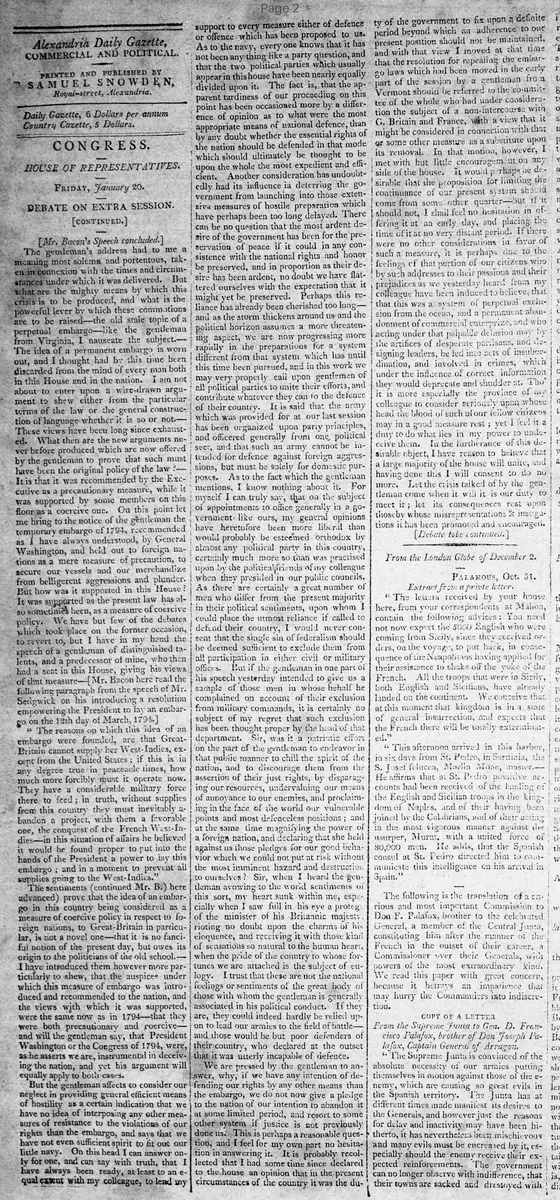
Mr. Bacon's Speech concluded.
The gentleman's address had to me a meaning most solemn and portentous, taken in connexion with the times and circumstances under which it was delivered. But what are the mighty means by which this crisis is to be produced, and what is the powerful lever by which these commotions are to be raised--the old stale topic of a perpetual embargo-like the gentleman from Virginia, I nauseate the subject.--
The idea of a permanent embargo is worn out, and I thought had by this time been discarded from the mind of every man both in this House and in the nation. I am not about to enter upon a wire-drawn argument to shew either from the particular terms of the law or the general construction of language whether it is so or not.--
These views have been long since exhausted. What then are the new arguments never before produced which are now offered by the gentleman to prove that such must have been the original policy of the law ?---
It is that it was recommended by the Executive as a precautionary measure, while it was supported by some members on this floor as a coercive one. On this point let me bring to the notice of the gentleman the temporary embargo of 1794, recommended as I have always understood, by General Washington, and held out to foreign nations as a mere measure of precaution, to secure our vessels and our merchandise from belligerent aggressions and plunder.
But how was it supported in this House ?
It was supported as the present law has also sometimes been, as a measure of coercive policy.. We have but few of the debates which took place on the former occasion, to revert to, but I have in my hand the speech of a gentleman of distinguished talents, and a predecessor of mine, who then had a seat in this House, giving his views of that measure-[Mr. Bacon here read the following paragraph from the speech of Mr. Sedgwick on his introducing a resolution empowering the President to lay an embargo on the 12th day of March, 1794.]
" The reasons on which this idea of an embargo were founded, are that Great-Britain cannot supply her West-Indies, except from the United States ; if this is in any degree true in peaceable times, how much more forcibly must it operate now.
They have a considerable military force there to feed ; in truth, without supplies from this country they must inevitably abandon a project, with them a favorable one, the conquest of the French West-Indies--in this situation of affairs he believed it would be found proper to put into the hands of the President a power to lay this embargo ; and in a moment to prevent all supplies going to the West-Indies."
The sentiments (continued Mr. B.) here advanced) prove that the idea of an embargo in this country being considered as a measure of coercive policy in respect to foreign nations, to Great-Britain in particular, is not a novel one--that it is no fanciful notion of the present day, but owes its origin to the politicians of the old school.--
I have introduced them however more particularly to shew, that. the auspices under which this measure of embargo was introduced and recommended to the nation, and the views with which it was supported. were the same now as in 1794--that they were both precautionary and coercive-
and will the gentleman say, that President Washington or the Congress of 1794, were, as he asserts we are, instrumental in deceiving the nation, and yet his argument will equally apply to both cases.
But the gentleman affects to consider our neglect in providing general efficient means of hostility as a certain indication that we have no idea of interposing any other measures of resistance to the violations of our rights than the embargo, and says that we have not even sufficient spirit to fit out our little navy. On this head I can answer only for one, and can say with truth, that I have always been ready, at least to an equal extent with my colleague, to lend my support to every measure either of defence or offence which has been proposed to us.
As to the navy, every one knows that it has not been any thing like a party question, and that the two political parties which usually appear in this house have been nearly equally divided upon it. The fact is, that the apparent tardiness of our proceeding on this point has been occasioned more by a difference of opinion as to what were the most appropriate means of national defence, than by any doubt whether the essential rights of the nation should be defended in that mode which should ultimately be thought to be upon the whole the most expedient and efficient. Another consideration has undoubtedly had its influence in deterring the government from launching into those extensive measures of hostile preparation which have perhaps been too long delayed. There can be no question that the most ardent desire of the government has been for the preservation of peace if it could in any consistence with the national rights and honor be preserved, and in proportion as their desire has been ardent, no doubt we have flattered ourselves with the expectation that it might yet be preserved. Perhaps this reliance has already been cherished too long- and as the storm thickens around us and the political horizon assumes a more threatening aspect, we are now progressing more rapidly in the preparations for a system different from that system which has until this time been pursued, and in this work we may very properly call upon gentlemen of all political parties to unite their efforts, and contribute whatever they can to the defence of their country. It is said that the army which was provided for at our last session has been organized upon party principles, and officered generally from one political sect, and that such an army cannot be intended for defence against foreign aggressions, but must be solely for domestic purposes. As to the fact which the gentleman mentions, I know nothing about it. For myself I can truly say, that on the subject of appointments to office generally in a government like ours, my general opinions have heretofore been more liberal than would probably be esteemed orthodox by almost any political party in this country, certainly much more so than was practised upon by the political friends of my colleague when they presided in our public councils.
As there are certainly a great number of men who differ from the present majority in their political sentiments, upon whom I could place the utmost reliance if called to defend their country, I would never consent that the single sin of federalism should be deemed sufficient to exclude them from all participation in either civil or military offices. But if the gentleman in one part of his speech yesterday intended to give us a sample of those men in whose behalf he complained on account of their exclusion from military commands, it is certainly no subject of my regret that such exclusion has been thought proper by the head of that department. Sir, was it a patriotic effort on the part of the gentleman to endeavor in that public manner to chill the spirit of the nation, and to discourage them from the assertion of their just rights, by disparaging our resources, undervaluing our means of annoyance to our enemies, and proclaiming in the face of the world our vulnerable points and most defenceless positions ; and at the same time magnifying the power of a foreign nation, and declaring that she held against us those pledges for our good behavior which we could not put at risk without the most imminent hazard and destruction to ourselves? Sir, when I heard the gentleman avowing to the world sentiments of this' sort, my heart sunk within me, especially when I saw full in his eye a protege of the minister of his Britannic majesty. rioting no doubt upon the charms of his eloquence, and receiving it with those kind of sensations so natural to the human heart, when the pride of the country to whose fortunes we are attached is the subject of eulogy. I trust that these are not the national feelings or sentiments of the great body of those with whom the gentleman is generally associated in his political conduct. If they are, they could indeed hardly be relied upon to lead our armies to the field of battle-- and those would be but poor defenders of their country, who declared at the outset that it was utterly incapable of defence.
We are pressed by the gentleman to answer, why; if we have any intention of defending our rights by any other means than the embargo, we do not now give a pledge to the nation of our intention to abandon it at some limited period, and resort to some other system if justice is not previously done us. This is perhaps a reasonable question, and I feel for my own part no hesitation in answering it. It is probably recollected that I had some time since declared to the house an opinion that in the present circumstances of the country it was the duty of the government to fix upon a definite period beyond which an adherence to our present position should not be maintained, and with that view I moved at that time that the resolution for repealing the embargo laws which had been moved in the early part of the session by a gentleman from Vermont should be referred to the committee of the whole who had under consideration the subject of a non-intercourse with G. Britain and France, with a view that it might be considered in connection with that or some other measure as a substitute upon its removal. In that motion, however, I met with but little encouragement on any side of the house. It would perhaps be desirable that the proposition for limiting the continuance of our present system should come from some other quarter--but if it should not, I shall feel no hesitation in offering it at an early day, and placing the time of it at no very distant period. If there were no other considerations in favor of such a measure, it is perhaps due to the feelings of that portion of our citizens who by such addresses to their passions and their prejudices as we yesterday heard from my colleague have been induced to believe, that this was a system of perpetual exclusion from the ocean, and a permanent abandonment of commercial enterprize, and who acting under that palpable delusion may by the artifices of desperate partisans, and designing leaders, be led into acts of insubordination, and involved in crimes, which under the influence of correct information they would deprecate and shudder at. Though it is more especially the province of my colleague to consider seriously upon whose head the blood of such of our fellow citizens may in a good measure rest ; yet I feel it a duty to do what lies in my power to undeceive them. In the furtherance of this desirable object, I have reason to believe that a large majority of the house will unite, and having done this I will consent to do no more. Let the crisis talked of by the gentleman come when it will it is our duty to meet it; let its consequences rest upon those by whose misrepresentations & instigations it has been promoted and encouraged.
[Debate to be continued.]
What sub-type of article is it?
What themes does it cover?
What keywords are associated?
What entities or persons were involved?
Where did it happen?
Story Details
Key Persons
Location
House Of Representatives
Event Date
Friday, January 20
Story Details
Mr. Bacon defends the embargo policy as temporary and not perpetual, references the 1794 embargo under Washington as both precautionary and coercive, criticizes opponents for discouraging national defense efforts, and proposes limiting the embargo's duration to prevent public delusion and unrest.