Thank you for visiting SNEWPapers!
Sign up free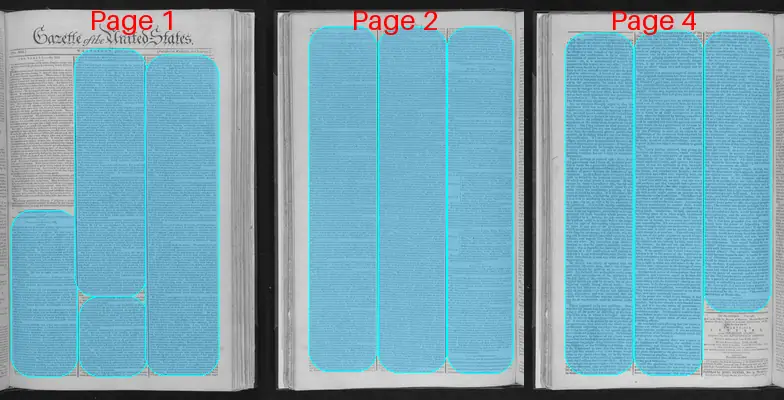
Gazette Of The United States
New York, New York County, New York
What is this article about?
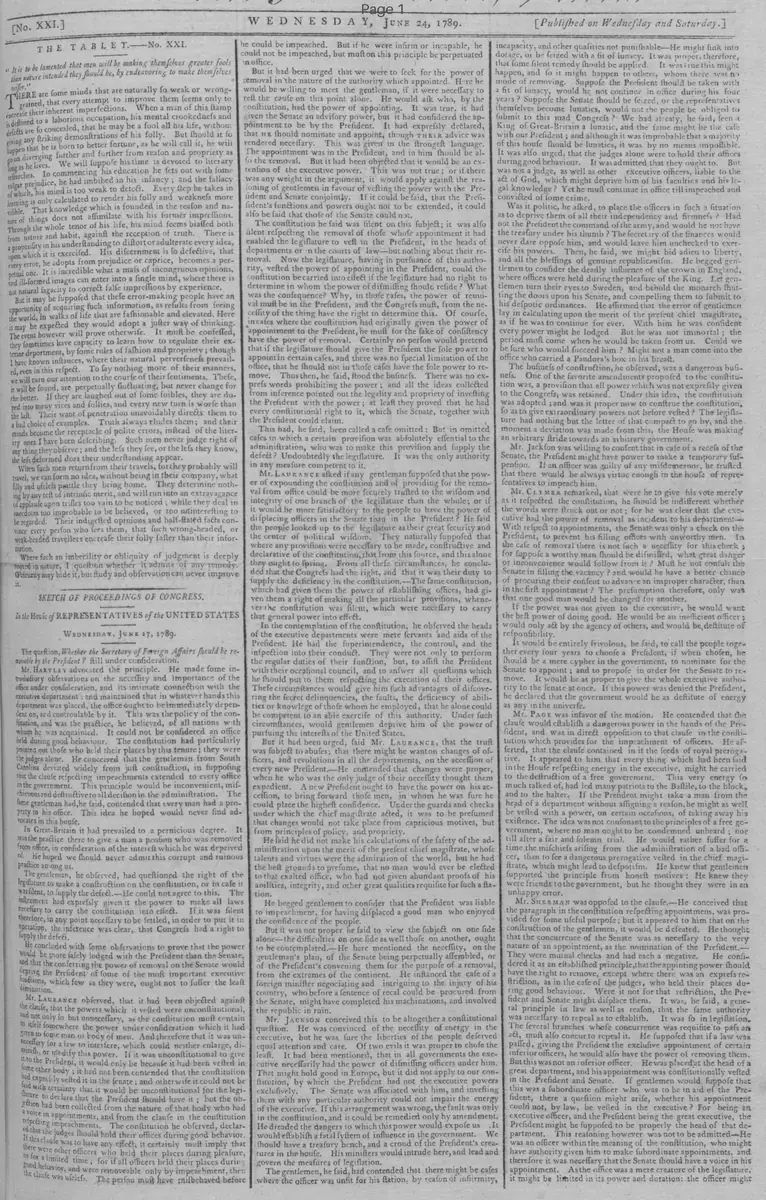
Detailed record of U.S. House of Representatives debates from June 17-23, 1789, on establishing the Department of Foreign Affairs, focusing on whether the President can remove the Secretary. Key speeches by Madison, Gerry, Laurance, and others argue constitutional interpretation, separation of powers, and executive energy vs. liberty. Bill passes affirming presidential removal.
Merged-components note: This is a single continuous article titled 'SKETCH OF PROCEEDINGS OF CONGRESS' spanning multiple pages, including the remainder of the debate on page 4. Merged based on textual continuation and sequential reading order.
Clippings
1 of 3
OCR Quality
Full Text
In the House of Representatives of the United States
Wednesday, June 17, 1789
The question, Whether the Secretary of Foreign Affairs should be removable by the President? still under consideration.
Mr. Hartley advocated the principle. He made some introductory observations on the necessity and importance of the office under consideration, and its intimate connection with the executive department; and maintained that in whatever hands this department was placed, the office ought to be immediately dependent on, and controllable by it. This was the policy of the constitution, and was the practice, he believed, of all nations with whom he was acquainted. It could not be considered an office held during good behaviour. The constitution had particularly pointed out those who held their places by this tenure; they were the judges alone. He conceived that the gentleman from South Carolina deviated widely from just construction, in supposing that the clause respecting impeachments extended to every office in the government. This principle would be inconvenient, mischievous and destructive to all decision in the administration. The same gentleman had, he said, contended that every man had a property in his office. This idea he hoped would never find advocates in this house. In Great-Britain it had prevailed to a pernicious degree. It was the practice there to give a man a pension who was removed from office, in consideration of the interest which he was deprived of. He hoped we should never admit this corrupt and ruinous practice among us. The gentleman, he observed, had questioned the right of the legislature to make a construction on the constitution, or in case it was silent, to supply the defect.—He could not agree to this. The instrument had expressly given it the power to make all laws necessary to carry the constitution into effect. If it was silent therefore, in any point necessary to be settled, in order to put it in operation, the inference was clear, that Congress had a right to supply the defect. He concluded with some observations to prove that the power would be more safely lodged with the President than the Senate, and that the conferring the power of removal on the Senate would deprive the President of some of the most important executive functions, which few as they were, ought not to suffer the least diminution.
Mr. Laurance observed, that it had been objected against the clause, that the powers which it vested were unconstitutional, and not only so but unnecessary as the constitution must contain in itself somewhere the power under consideration which it had given to some man or body of men. And therefore that it was unnecessary for a law to interfere which could neither enlarge, diminish, or modify this power. If it was unconstitutional to give it to the President it would only be because it had been vested in some other body; it had not been contended that the constitution had expressly vested it in the Senate and otherwise it would with certainty be unconstitutional for the legislature to declare that the President should have it but the objection had been collected from the nature of that body who had a voice in appointments, and from the clause in the constitution respecting impeachments judges should hold their offices during good behavior. If this clause was to have any effect it certainly must imply that there were or for a limited time officers were removable who if all held only by impeachment their places during then the clause was useless. The person must have misbehaved before he could be impeached. But if he were infirm or incapable, he could not be impeached, but must on this principle be perpetuated in office.
But it had been urged that we were to seek for the power of removal in the nature of the authority which appointed. Here he would be willing to meet the gentleman, if it were necessary to rest the cause on this point alone. He would ask who, by the constitution, had the power of appointing. It was true, it had given the Senate an advisory power, but it had considered the appointment to be by the President. It had expressly declared, that HE should nominate and appoint, though THEIR advice was rendered necessary. This was given in the strongest language. The appointment was in the President, and in him should also be the removal. But it had been objected that it would be an extension of the executive power. This was not true; or if there was any weight in the argument, it would apply against the reasoning of gentlemen in favour of vesting the power with the President and Senate conjointly. If it could be said, that the President's functions and powers ought not to be extended, it could also be said that those of the Senate could not. The constitution he said was silent on this subject; it was also silent respecting the removal of those whose appointment it had enabled the legislature to vest in the President, in the heads of departments or in the courts of law—but nothing about their removal. Now the legislature, having in pursuance of this authority, vested the power of appointing in the President, could the constitution be carried into effect if the legislature had no right to determine in whom the power of dismissing should reside? What was the consequence? Why, in those cases, the power of removal must be in the President, and the Congress must, from the necessity of the thing have the right to determine this. Of course, in cases where the constitution had originally given the power of appointment to the President, he must for the sake of consistency have the power of removal. Certainly no person would pretend that if the legislature should give the President the sole power to appoint in certain cases, and there was no special limitation of the office, that he should not in those cases have the sole power to remove.
Thus then, he said, stood the business. There was no express words prohibiting the power; and all the ideas collected from inference pointed out the legality and propriety of investing the President with the power; at least they proved that he had every constitutional right to it, which the Senate, together with the President could claim. This had, he said, been called a case omitted: But in omitted cases in which a certain provision was absolutely essential to the administration, who was to make this provision and supply the defect? Undoubtedly the legislature. It was the only authority in any measure competent to it.
Mr. Laurance asked if any gentleman supposed that the power of expounding the constitution and of providing for the removal from office could be more securely trusted to the wisdom and integrity of one branch of the legislature than the whole; or if it would be more satisfactory to the people to have the power of displacing officers in the Senate than in the President? He said the people looked up to the legislature as their great security and the center of political wisdom. They naturally supposed that where any provisions were necessary to be made, constructive and declarative of the constitution, that from this source, and this alone they ought to spring. From all these circumstances, he concluded that the Congress had the right, and that it was their duty to supply the deficiency in the constitution. The same constitution, which had given them the power of establishing offices, had given them a right of making all the particular provisions, whenever the constitution was silent, which were necessary to carry that general power into effect.
In the contemplation of the constitution, he observed the heads of the executive departments were mere servants and aids of the President. He had the superintendence, the controul, and the inspection into their conduct. They were not only to perform the regular duties of their function, but, to assist the President with their occasional council, and to answer all questions which he should put to them respecting the execution of their offices. These circumstances would give him such advantages of discovering the secret delinquencies, the faults, the deficiency of abilities or knowledge of those whom he employed, that he alone could be competent to an able exercise of this authority. Under such circumstances, would gentlemen deprive him of the power of pursuing the interests of the United States.
But it had been urged, said Mr. Laurance, that the trust was subject to abuses; that there might be wanton changes of officers, and revolutions in all the departments, on the accession of every new President. He contended that changes were proper, when he who was the only judge of their necessity thought them expedient. A new President ought to have the power on his accession, to bring forward those men, in whom he was sure he could place the highest confidence. Under the guards and checks under which the chief magistrate acted, it was to be presumed that changes would not take place from capricious motives, but from principles of policy, and propriety.
He said he did not make his calculations of the safety of the administration upon the merit of the present chief magistrate, whose talents and virtues were the admiration of the world, but he had the best grounds to presume, that no man would ever be elected to that exalted office, who had not given abundant proofs of his abilities, integrity, and other great qualities requisite for such a station.
He begged gentlemen to consider that the President was liable to impeachment, for having displaced a good man who enjoyed the confidence of the people.
But it was not proper he said to view the subject on one side alone—the difficulties on one side as well those on another, ought to be contemplated. He here mentioned the necessity, on the gentleman's plan, of the Senate being perpetually assembled, or of the President's convening them for the purpose of a removal, from the extremes of the continent. He instanced the case of a foreign minister negociating and intriguing to the injury of his country, who before a sentence of recall could be procured from the Senate, might have completed his machinations, and involved the republic in ruin.
Mr. Jackson conceived this to be altogether a constitutional question. He was convinced of the necessity of energy in the executive, but he was sure the liberties of the people deserved equal attention and care. Of two evils it was proper to chuse the least. It had been mentioned, that in all governments the executive necessarily had the power of dismissing officers under him. That might hold good in Europe, but it did not apply to our constitution, by which the President had not the executive powers exclusively. The Senate was associated with him, and investing them with any particular authority could not impair the energy of the executive. If this arrangement was wrong, the fault was only in the constitution, and it could be remedied only by amendment. He dreaded the dangers to which this power would expose us. It would establish a fatal system of influence in the government. We should have a treasury bench, and a crowd of the President's creatures in the house. His ministers would intrude here, and lead and govern the measures of legislation.
The gentlemen, he said, had contended that there might be cases where the officer was unfit for his station, by reason of infirmity, incapacity, and other qualities not punishable—He might sink into dotage, or be seized with a fit of lunacy. It was proper, therefore, that some silent remedy should be applied. It was true this might happen, and so it might happen to others, whom there was no mode of removing. Suppose the President should be taken with a fit of lunacy, would he not continue in office during his four years? Suppose the Senate should be seized, or the representatives themselves become lunatics, would not the people be obliged to submit to this mad Congress? We had already, he said, seen a King of Great-Britain a lunatic, and the same might be the case with our President; and although it was improbable that a majority of this house should be lunatics, it was by no means impossible.
It was also urged, that the judges alone were to hold their offices during good behaviour. It was admitted that they ought to. But was not a judge, as well as other executive officers, liable to the act of God, which might deprive him of his faculties and his legal knowledge? Yet he must continue in office till impeached and convicted of some crime.
Was it politic, he asked, to place the officers in such a situation as to deprive them of all their independency and firmness? Had not the President the command of the army, and would he not have the treasury under his thumb? The secretary of the finances would never dare oppose him, and would leave him unchecked to exercise his powers. Then, he said, we might bid adieu to liberty, and all the blessings of genuine republicanism. He begged gentlemen to consider the deadly influence of the crown in England, where offices were held during the pleasure of the King. Let gentlemen turn their eyes to Sweden, and behold the monarch shutting the doors upon his Senate, and compelling them to submit to his despotic ordinances. He affirmed that the error of gentlemen lay in calculating upon the merit of the present chief magistrate, as if he was to continue for ever. With him he was confident every power might be lodged. But he was not immortal; the period must come when he would be taken from us. Could we be sure who would succeed him? Might not a man come into the office who carried a Pandora's box in his breast.
The business of construction, he observed, was a dangerous business. One of the favorite amendments proposed to the constitution was, a provision that all power which was not expressly given to the Congress, was retained. Under this idea, the constitution was adopted; and was it proper now to construe the constitution, so as to give extraordinary powers not before vested? The legislature had nothing but the letter of that compact to go by, and the moment a deviation was made from this, the House was making an arbitrary stride towards an arbitrary government.
Mr. Jackson was willing to consent that in case of a recess of the Senate, the President might have power to make a temporary suspension. If an officer was guilty of any misdemeanor, he trusted that there would be always virtue enough in the house of representatives to impeach him.
Mr. Clymer remarked, that were he to give his vote merely as it respected the constitution, he would be indifferent whether the words were struck out or not; for he was clear that the executive had the power of removal as incident to his department— With respect to appointments, the Senate was only a check on the President, to prevent his filling offices with unworthy men. In the case of removal there is not such a necessity for this check; for suppose a worthy man should be dismissed, what great danger or inconvenience would follow from it? Must he not consult the Senate in filling the vacancy? and would he have a better chance of procuring their consent to advance an improper character, than in the first appointment? The presumption therefore, only was that one good man would be changed for another.
If the power was not given to the executive, he would want the best power of doing good. He would be an inefficient officer; would only act by the agency of others, and would be destitute of responsibility.
It would be entirely frivolous, he said, to call the people together every four years to chuse a President, if when chosen, he should be a mere cypher in the government, to nominate for the Senate to appoint; and to propose in order for the Senate to remove. It would be as proper to give the whole executive authority to the senate at once. If this power was denied the President, he declared that the government would be as destitute of energy as any in the universe.
Mr. Page was in favor of the motion. He contended that the clause would establish a dangerous power in the hands of the President, and was in direct opposition to that clause in the constitution which provides for the impeachment of officers. He asserted, that the clause contained in it the seeds of royal prerogative. It appeared to him that every thing which had been said in the House respecting energy in the executive, might be carried to the destruction of a free government. This very energy so much talked of, had led many patriots to the Bastile, to the block, and to the halter. If the President might take a man from the head of a department without assigning a reason, he might as well be vested with a power, on certain occasions, of taking away his existence. The idea was not consonant to the principles of a free government, where no man ought to be condemned unheard; nor till after a fair and solemn trial. He would rather suffer for a time the mischiefs arising from the administration of a bad officer, than to see a dangerous prerogative vested in the chief magistrate, which might lead to despotism. He knew that gentlemen supported the principle from honest motives: He knew they were friends to the government, but he thought they were in an unhappy error.
Mr. Sherman was opposed to the clause.—He conceived that the paragraph in the constitution respecting appointments, was provided for some useful purpose; but it appeared to him that on the construction of the gentlemen, it would be defeated. He thought that the concurrence of the Senate was as necessary to the very nature of an appointment, as the nomination of the President.— They were mutual checks and had each a negative. He considered it as an established principle, that the appointing power should have the right to remove, except where there was an express restriction, as in the case of the judges, who held their places during good behaviour. Were it not for that restriction, the President and Senate might displace them. It was, he said, a general principle in law as well as reason, that the same authority was necessary to repeal as to establish. It was so in legislation. The several branches whose concurrence was requisite to pass an act, must also concur to repeal it. He supposed that if a law was passed, giving the President the exclusive appointment of certain inferior officers, he would also have the power of removing them. But this was not an inferior officer. He was placed at the head of a great department, and his appointment was constitutionally vested in the President and Senate. If gentlemen would suppose that this was a subordinate officer who was to be in aid of the President, there a question might arise, whether his appointment could not, by law, be vested in the executive? For being an executive officer, and the President being the great executive, the President might be supposed to be properly the head of that department. This reasoning however was not to be admitted—He was an officer within the meaning of the constitution, who might have authority given him to make subordinate appointments, and therefore it was necessary that the Senate should have a voice in his appointment. As the office was a mere creature of the legislature, it might be limited in its power and duration: the officer might be annually elected, and displaced for certain crimes, as neglect of duty, &c.
Mr. Stone (Maryland) considered it the duty of the House to determine on the question. He was opposed to the leaving it so to the decision of a court of law or any other power than the legislature.
When the question was brought forward, his mind, he said, was in doubt. He had reflected upon it, and had formed an opinion: which was entirely satisfactory to himself. He thought that whatever officer should be removable by the power that appointed him.
It was in the very nature of things. The power of appointment arose from a power over the subject on which the officer was to act; it was founded on an interest which the principal possessed in the transactions of his agent. Therefore in general, appointing officers appeared to be nothing more than authorizing agents for the dispatch of business. This was in his opinion an established principle, and it would operate from a Minister of State down to a tide-waiter. The constitution, it had been admitted, recognized this principle, and it could not be denied but that when general appointments were made, they were during will and pleasure; that where appointments were made during good behavior, they were exceptions from the general rule, in which the exercise of the creating power was limited.
He would examine whence originated the power of Congress respecting these offices. He presumed that if it was vested in Congress, by clear deduction from that instrument, to erect departments, that no gentleman would consent to diminish it, or restrict them in the exercise of it. The Congress had power to levy and collect taxes. This would include to establish an office of treasury—to regulate commerce with foreign nations, and with Indian tribes. This comprehended a power of erecting a board of trade, &c. and in order to carry these powers into execution, they were to make all laws necessary to carry the constitution into effect.
Now it appeared to him that the establishment of this department was clearly within the constitution, and that as Congress, in their legislative capacity, had an interest in, and power over the whole affairs of the department, they might appoint and displace its officers. But again, the constitution had limited the legislature with respect to appointments, and given them to the President and Senate. The question then was, whether the Senate, having a share in appointing, did not possess the power of removal as incidental to it.
Mr. Stone asked, what qualities were necessary for an appointment that were not requisite for dismissing? Information. impartiality, and judgment in the business to be conducted. Were not the same qualities necessary in order to dismiss? He was not able to subscribe to the principle, that the executive in its nature comprehended a necessary power of appointing or removing officers.
Why did it imply it? The appointment of officers requiring qualities which are necessary to judge of the merits of men—so the dismissing them—to know what was necessary for an executive officer—what for a judge, &c.
This knowledge was acquired by experience, and might belong to one body of men as well as another. In the nature of things, therefore, there was no necessary connection between the executive functions, and the power of removal. That body which could best judge of the qualities necessary to transact business, were the most proper disposers of offices, and if it was contended that the executive magistrate was in the best situation, and under the best advantages to judge of these qualities, still this was a mere matter of fact, which might depend on circumstances; and the nature of the office did not necessarily involve the capacity of judging, or imply the power of exercising that judgment.
Mr. Stone then took notice of the principles which had been contended for, in another view, as it applied to the situation of other nations where a hereditary monarch was established, who had a personal property in the government and administration, and who was considered as the natural fountain of honor and office. It was supposed that he had necessarily the power of choosing and controlling those who were to manage his property But this had no application to our country, where the chief magistrate had no species of property in the government, and was not the master; but the great servant of the people.
These circumstances concurred to prove that the President of the United States had no natural right to be the sole judge of the merits of officers; and as far as he could conclude from examining the constitution, it never intended to bestow it upon him.
It therefore struck his mind that all control of officers independent of the agency of the Senate, was confined to the case of such inferior officers, the appointment of which the constitution had enabled the legislature to vest solely in him. It struck him also that as to the power of pardoning, the President should be precluded from the exercise of this power, in case where the Senate had convicted an offender. So that it appeared to him, that the Senate were a body to whom the constitution had given great weight in the executive scale, and in the administration of government.
In determining whether it was proper on the score of expediency to give the power to the President, or to him with the Senate, the degree of confidence which was to be placed in those bodies were to be considered: Was it more probable, he asked, that one man should do wrong, or that a number of men, chosen with equal care, and acting under the same obligations, should do wrong?
Where were the greatest obstacles? Who would have the greatest objects to attain?
He concluded with proposing that the President should have the power of suspension, in order to remedy a difficulty which had been suggested in case of a recess of the Senate, when it became necessary to punish an officer by removal.
Mr. Madison: I feel the importance of the question before us, as our decision will be a permanent exposition of the constitution in this point, and as on this decision will depend, in a great degree, the genius and character of our government. On the determination which will now take place, will depend perhaps the preservation of the government on that equal balance which the constitution designed. It is therefore of the utmost importance that we weigh the subject with the most cautious deliberation. I own to you, I feel an anxiety on this subject. I feel anxious, because I am called on to give my voice on a question which may effect the fundamental principles of the government. But all that I can do on an occasion of this kind, is to weigh the arguments which have been advanced on both sides, with an honest desire to discover the truth, and to form my opinion under the influence of an attachment to that spirit of liberty, which this constitution is happily calculated to preserve.
Several constructions have been put on the constitution, relative to the point in question. It has been contended that the power of displacing from office is subject to a legislative discretion, which is to create and to modify.—At first sight, Sir, this doctrine appears considerably plausible. But when I consider that a prime object of the constitution was to maintain a marked distinction between the legislature, executive, and judicial departments, and when I consider that the legislature, on this principle of discretion, may transfer at their pleasure, powers from one department to another—that they may narrow the executive, center new powers on the Senate, and enlarge the general mass of their own authority; when I consider the consequences of this doctrine, and compare them with the true objects of the constitution. I own I cannot subscribe to it.
Another doctrine, which has a very respectable patronage. is that when an officer is appointed, he can be removed only by impeachment, for some misdemeanor in office. This would give a permanency to the executive system, which would be more incompatible with the genius of republicanism than any principle that could be advocated. The danger to liberty, the danger of despotism has never been found to spring so much from the difficulty of procuring virtuous men to fill the offices of government as the difficulty of displacing those who have been found unworthy of trust. If it be said that an officer when once appointed, should not be removed without a crime and conviction, I would be glad to know what security there would be for a faithful administration of the government.—Every individual between the highest and lowest link in the long chain of executive magistracy, would find a security, which would greatly relax his fidelity in the discharge of his duty.
A doctrine which stands most in opposition with the principle we have contended for, is, that the power to make appointments implies in its own nature a power of removal as incidental to it.
If nothing more was said in the constitution than that the President, with the Senate, should appoint officers, there would be force in the observation, that the power of dismissing results from the power of appointing. But, Sir, there is another part of the constitution as explicit as that on which the gentlemen found their doctrine : It is that which declares that the executive power shall be vested in the President of the United States. The association of the Senate with the President in the exercise of one particular executive function, is an exception to this general principle; and exceptions to general rules are ever taken strictly. But there is still another part of the constitution, which in my judgment, clearly favors the construction I give. The President is required, Sir, to take care that the laws be faithfully executed. If the faithful execution of the laws be required at the hands of the executive magistrate, it should seem that in general the constitution must have intended that he should have that species of power in all its extent, which is necessary to accomplish the purposes of the department, and to enable him to answer for their accomplishment.
Now, if the officer, when once appointed, is not to depend for his official existence upon the President, but upon a distinct body, (for where there is a mutual negative, either alone can secure this dependence) I do not see how the former can provide for the execution of the laws. It is true, that by a circuitous mode he may obtain an impeachment, and gain the concurrence of the Senate'; but will not this deprive him of that control which is essential to a responsibility for the administration?
There is another maxim which ought to direct us in expounding the constitution. It is the opinion of all great civilians and political writers, that the great departments of government ought to be preserved separate and distinct. That in any case where they are blended together, it ought to be under special restrictions and guards. This is laid down as essential to liberty. Therefore when we review the several parts of the constitution, which provide that the legislative powers shall be vested in two Houses, and the executive in a President, with certain exceptions, we must conclude that the intention of the constitution was, that these departments should be kept perfectly separate, where they were not expressly mixed, and that we ought to construe the instrument in such a manner as to confound them as little as possible.
Sir, every thing which relates to the merits of the question, as distinguished from a constitutional question, seems to turn on the danger of such a power vested in the President. But when I consider the checks which will attend the President in the exercise of it, I confess, I feel no apprehensions. If there are any dangers incident to that power, they must belong to it wherever it exists, whether you place it in one body or another. I will not repeat what has been said with respect to the mode of the President's selection, and the extreme improbability that any citizen will be selected from the common mass, who is not distinguished by his virtue and worth. In this alone we have an unusual security for the faithful exercise of the power. But leaving that out of the question, let us consider the obligations and restraints he will feel when placed in that exalted responsible station. Perhaps, as has been observed, the great danger arises from the continuance of unworthy men in office; but so is the system contrived that though the President may be vested by law with a power of removal, he is restrained and prevented from continuing a corrupt officer. For if an unworthy man be not displaced by the supreme executive, the House of Representatives may at any time impeach him, and he may be removed in spite of the President. But it is contended that the danger consists in this, that the President may remove from office a man whose merit requires that he should be continued in it.
Let us consider what motives he can have for such an abuse of power, and what will be the checks on him. In the first place, he himself will be impeachable for the wanton removal of a meritorious officer, and will himself be removed from his high trust.
Again, what can be his motive for displacing a worthy man? It must be with the expectation of filling the vacancy with some unworthy favorite. Can he accomplish this himself? Must he not consult the Senate? They may reject the person he nominates. Sir, he can have no security for success in his projects. The Senate will judge of them by the merits and character of the person removed; and having been guilty of one obnoxious measure, he will himself thereby furnish a check to his own design : But let us consider the consequence. The injured man will be supported by the public opinion. The community at large will take side against the President—and combinations will be produced which may effectually prevent his re-election. To displace a man of high merit, and one who from his station may be supposed a man of extensive influence, will excite jealousies, and create an interested opposition in the system, and in the people. He will have his friends, his dependents, and the public sympathy on his side, and if it should not give birth to an impeachment in the legislature, it would probably produce a fatal impeachment before the community at large.
But suppose the persecuted individual should not be able to accomplish the object of his resentment in this way, there are other modes in which he can be very troublesome to the President. If he has not influence enough to direct the vengeance of the whole community, in all probability he will be able to obtain appointments in one or the other branch of the legislature, and possessing weight and talents, he will be able at least to give him considerable disturbance. We have seen in the history of other nations, examples that justify the remark I now make. Though the prerogative of the British King is great, and his resources of influence extensive and commanding, there have been examples of his ministers being opposed, and removed by the decision of one branch of the legislature.—If this be the case with a hereditary monarch, possessed of such high prerogatives, and furnished with such means of influence, can we suppose that a President of the United States, elected for four years only, dependent on the popular voice, impeachable by the legislature, and not perhaps distinguished in point of wealth or personal talents from the head of the department himself, can we suppose, I say, that in defiance of all these considerations, he will presume wantonly to dismiss a meritorious and virtuous officer from his service? I own it is an abuse of power which exceeds my imagination, and of which I can form no rational conception. But let us not contemplate the dangers only on one side. Vest this power in the Senate, jointly with the President, and in my opinion you destroy that great principle of responsibility, which was intended for the security of liberty itself. Vest the power in the President, the chain of dependence is this—The officer of the lowest grade, the officer of the middle and higher grades, will be dependent on the President, and he again on the people—The chain of security therefore terminates in the general community, who will possess, in aid of their great original power, the decisive engine of impeachment. Take the other supposition, that the power should be vested in the Senate, upon the principle that the power to displace is necessarily connected with the power to appoint, subordinate appointments may depend upon the heads of departments—and they must therefore remove. I see a very different prospect present itself. Where shall we find the responsibility? Where does it terminate? If you begin with an inferior officer, he is dependent on his superior, and he again on his superior, and so on till you come to the Senate, a permanent body; a body, by the singular mode of their election, existing in reality forever; a body that possesses that portion of aristocratic power which the constitution has wisely established. Shall we trust the Senate rather than the whole community? For though the Senators will not hold their offices for life, yet the fact is, that they will not possess any responsibility whatever, which will make it safe to trust them with such a power.
But, Sir, what an aspect will it give to the executive department? Instead of keeping it distinct from the legislative, you transfer its best powers to a body in which the constitution never vested it; you render the executive merely subservient to the other branch, you destroy its responsibility and defeat the purposes for which an executive was established. Sir, the laws cannot be executed but by officers chosen for the purpose; and the control over the officers must be in the executive power. If any other doctrine be admitted, what is the consequence? certainly, Sir, that you may go on with equal reason and set the Senate at the head of the executive department. You may declare that all officers should hold their places during the pleasure of either branch of the legislature. And by this means you may link together branches which the preservation of liberty requires to be constantly separated.
For the remainder of Wednesday's Debate, see last Page.
Monday, June 22, 1789.
The resolve which came down from the Senate, respecting the appropriation of the rooms in the federal hall—was read, and concurred.
The order of the day being called for, the bill for establishing the department of foreign affairs, as reported from the committee of the whole, with the several amendments, were read, and the amendments agreed to by the House.
Mr. Carroll proposed a clause to limit the duration of the bill: Among other reasons for the motion, Mr. Carroll observed, that he conceived the necessity of such an officer would cease in a short time, by reason of the gradual withdrawing of our intercourse with European countries; and in the course of a very few years all political connexion with those powers will be at an end, which would render the establishment a superfluous expense.
Mr. Page seconded the motion—and added, That he could not conceive the propriety of gentlemen, who were elected only for two years, willing to extend the laws of their enacting to a period beyond the time, when the use and design of such laws should exist, and thus perpetuate the power and influence of the House.
Mr. Ames opposed the addition of the clause as it would be unfavorable to the stability of government; and was little better than infusing a premature principle of mortality into the executive department.
Mr. Gerry was in favor of a limitation : He supposed, that if the expiration of the bill was not provided for, at the present time, it would be extremely difficult to effect its reduction, when the officers of this department shall have formed connexions with foreign courts; and by means of those connexions, an extensive sphere of business uninteresting to the United States, shall be created.
The vote being taken, it passed in the negative.
Mr. Benson proposed an amendment, which he conceived would more fully express the sense of the committee, as it respected the constitutionality of the decision which had taken place: The amendment was, to strike out in the second clause of the bill, these words, " In case of vacancy in the said office of Secretary of the United States, for the department of foreign affairs;" and to insert in lieu thereof the following, " Whenever the said principal officer, shall be removed by the President, or a vacancy in any other way shall happen."
This produced some debate, and the ayes and nays being called for, it was determined in the affirmative, as follow, viz.
Messieurs Ames, Baldwin, Benson, Brown, Burke, Carroll, Clymer, Contee, Fitzsimons, Gilman, Goodhue, Griffin Hartley, Heister, Laurance, Lee, Leonard, Madison,
Ayes-30.
Moore, P. Muhlenberg, Scott, Sedgwick, Seney, Sinnickson, Smith, (Maryland), Sylvester, Thatcher, Trumbull Vining, Wadsworth.—Thirty.
Messieurs Cadwallader, Coles, Gerry, Grout, Hathorn, Huntington, Livermore, Matthews, Page, Parker, Partridge, Van Rensselaer, Sherman, Smith, (S. C.) Sturgis, Sumpter, Tucker, White.—Eighteen.
Nays-18
It was then moved to strike out these words in the first clause, "removable by the President of the United States."
The principal reason assigned for striking out these words was, that as the bill now stands, it appears to be a grant of power; whereas it was presumed to be the sense of the committee, that the power was vested in the President by the Constitution. A recapitulation of arguments upon this point ensued, and the question was finally determined by ayes and nays.—Some gentlemen voted in the negative, supposing that retaining the words, would be an additional evidence of the sense of the House that the power was vested in the President.
Messieurs Ames, Baldwin, Benson, Brown, Burke, Clymer, Coles, Gerry, Goodhue, Griffin, Grout, Hathorn, Huntington, Leonard, Livermore, Madison, Matthews,
Ayes-31
Moore, P. Muhlenberg, Page, Parker, Partridge, Van Rensselaer, Scott, Sherman, Sinnickson, Smith, (S.C.) Sturgis, Sumpter, Vining, White.—Thirty-one.
Messieurs Boudinot, Cadwallader, Carroll, Contee, Fitzsimons, Gilman, Hartley, Heister, Laurance, Lee, Sherman, Sedgwick, Seney, Smith, (Maryland), Sylvester,
Nays-19
Thatcher, Trumbull, Tucker, Wadsworth.—Nineteen.
These additional amendments being completed, the bill passed to be engrossed for a third reading to-morrow.
And then the House adjourned.
Tuesday, June 23.
The committee appointed for that purpose, brought in a bill for securing to authors and inventors the benefits of their respective publications and inventions—which was read and laid on the table.
The order of the day was then called for—and the engrossed bill for establishing an executive department, to be denominated the department of foreign affairs, was read a third time.
Mr. Sumter moved, that the final consideration of the bill should be postponed.
Mr. White proposed, that the bill should be re-committed to a committee of the whole, in order that the other departments might be added, and one system formed, which should embrace the whole—this motion after a short discussion was negatived.
Mr. Sumter then renewed his motion for postponement, and that the bill should lie on the table till to-morrow.—The vote upon this motion passed in the affirmative.
Mr. Laurance moved, that the House should take into consideration the amendments to the impost bill, which were yet to be decided—this motion was adopted.—And the enacting clause as amended by the Senate being read, which is in these words, " Be it enacted by the Senate and Representatives," &c. Mr. Thatcher proposed, that " House of" should be inserted immediately before Representatives—this motion was agreed to.
The next amendment which the Senate had not receded from was, to strike out the clause which makes a discrimination in the duty imposed on distilled spirits imported from countries with whom the United States were in treaty, and from those with whom no treaties had been formed-It was moved and the House should accede to the amendment : This produced an animated debate, in which many new observations occurred, and those which had been adduced in the former discussion, were repeated The vote being taken it passed in the negative twenty-five being in favor of acceding, and twenty-seven against it.
So the discrimination remains as it originally stood.
The House then adjourned.
It is a pleasing reflection, that the attention of Congress to public business, has not been interrupted by any unfavorable incidents : It is near three months since the session commenced, and only one member has fallen sick—an evidence of the salubrity of the air, and healthiness of the situation of this city.
Remainder of Wednesday's Debate.
But, Sir, another species of argument has been urged against the clause—It has been said that it is improper or at least unnecessary to come to any decision on the subject. It has been said that it will be officious in this branch of the legislature to expound the constitution, so far as relates to the division of power between the President and Senate. Sir, it is undoubtedly of as much importance to this branch as to any other, that the constitution should be preserved entire: It is our duty as well as interest to take care that its principles be adhered to. A breach of the constitution in one point may lead to a breach in another. A breach in this point may destroy that equilibrium in the government, by which this House maintains its share of authority. I do not think we can be charged with officious interference, as this bill before it can have effect, is to be submitted to both those branches who are particularly interested in it. The Senate may negative it—The President may object to it.
Sir, an objection strongly urged is, that the legislature itself has no right to expound the constitution; that whenever its meaning is doubtful, you must leave it undecided till the judiciary shall be called on to declare its meaning. I conceive, that in the ordinary course of things, the exposition of the constitution devolves on the judiciary. But I beg to know on what principle it can be contended that any one department derives from the constitution greater powers than another, in declaring what are the true limits of the constitution. We have a great charter which assigns certain great boundaries and fences to the several departments of government; if these constitutional boundaries be brought into question, I cannot conceive why any one of those independent branches has not a right to express its sentiments.
This is perhaps an omitted case; there is no one government that I know of, in which provision is made for a particular authority to determine the great constitutional limits, and the great division of power between the branches of government. In all systems there are points which must be settled by the branches themselves, and to which no other power is competent. If they cannot be, there is no resource left, but the will of the community to be collected, either by the mode which our constitution provides, or by a mode dictated by necessity. It is therefore a fair question before us, whether the great point may not as well be decided by the whole legislature as by a part—by us, as well as by the executive or the judiciary. As it will be equally constitutional, it cannot be less safe that the explanation should come from the legislature, particularly as it comprehends all those branches whose powers can be affected by it; besides, Sir, I do not see, how the question could be brought before the judges were the right of determining assigned to them.
If there is any part of the government from which an opinion on this capital point can come with singular advantage, it is this house, who being not so immediately interested can form their opinion, and express their sense with less bias than any other. My conclusion from these reflections is, that the clause is perfectly constitutional; that it expresses the meaning of the constitution as a fair construction must explain it, and that it is not only consistent with liberty, but more favorable to it than any other possible interpretation.
Mr. Gerry was clearly of opinion with the gentleman last on the floor, that it was of importance to decide the question on its true principles. He declared that he should be ready to oppose every encroachment of the legislature on the just rights of the executive. He considered himself bound not only by an oath, but by an obligation equally strong, that of honor. Gentlemen had laboured to prove the constitutionality of the clause. He said he had listened to their arguments, and was convinced that the clause was as inconsistent with the constitution as any set of words which could be inserted in the bill.
There appeared to be two questions. One, whether the people had delegated to the government at all the power of dismissing at pleasure. The other was, to whom it belonged. As to the first, he agreed that the power had been delegated. It seemed to be proved by the arguments of the gentlemen, that otherwise the clause in the constitution respecting the judges was nugatory. As to the second question, it was agreed that the power must rest in some department. He believed that gentlemen in support of the clause would agree that the house did not possess the power, any more than the judges—It lay therefore either with the President, or the President and Senate: And if so, it appeared to him that the clause in either case was useless. For if the Senate would assent to the clause when sent up by the House, they would assent to the provision contained in it when the President should exercise it. If the Senate thought the power ought to be vested in the supreme executive, they would freely consent to his using it; if not, they would reject this clause. In either case the clause was nugatory.
Mr. Gerry argued that by the operation of the clause there would be a clashing of powers, and some which the Senate were allowed to possess would be rendered of no effect. Their power of appointment would be defeated in its object, by the power of the President to remove; and the power of judging on impeachments, would be rendered vain by the power of dismissing; for a power of judging implied a power of acquittal, which would in its operation, be totally insignificant, if the President could immediately displace an officer whom they had judged and declared innocent.
He insisted that as to the danger of abuses, the remedy against them, which had been mentioned, that is, the power of impeaching the President if he dismissed a good man, involved an absurdity. How could the House impeach the President, when they had declared that he could lawfully do as he pleased? Would they impeach him for exercising a discretion which they had given him in a most unlimited manner?
If the legislature gave him an unlimited control over all officers, he would have, he said, the absolute control over the treasury. We might as well give him the appropriation of monies; for it would be of little consequence to make laws, when the President by looking at an officer, could make it his interest to break that law. It must be expected that from this general control, there would rise up a government of revenue instead of a government of laws. It would be easy for the President to cover all his crimes by an application of the revenue to those who were his judges, and such an application would certainly be made, in case of a corrupt President; and corruption in him was what it was necessary to guard against.
Mr. Gerry further observed, that giving the President the power to remove, would virtually give him a considerable power of appointment, independent of the Senate; for if the Senate should reject his favorite, and agree to his nomination of one less agreeable to him, he might immediately remove the latter on the recess of the Senate, and introduce the favorite; for the constitution had vested him expressly with the power of appointing in the recess of the Senate.
It had been observed, he said, that this was a case omitted; and that Congress had a power of supplying the defect. But they ought to consider on what ground they stood. An attempt to supply such a case might appear an attempt at an amendment to the constitution. The system had provided a mode of making amendments—The legislature could pursue that alone. Any attempt to obtain amendments in another form, would be a high crime and misdemeanor; perhaps something worse. Gentlemen, he said, appeared to be leading them on to what might be deemed treason against the constitution. The system, it could not be denied, was in many parts obscure and unintelligible. If it was once determined that Congress might explain and declare what the constitution was, it could not be denied that they could change it at pleasure. This obscurity had been one of the great arguments against accepting it. It had been urged that it was remarkably obscure—It was indeed, he said, most studiously obscure. By this very act, the House were, he asserted, assuming a power to form a constitution. If the people of the United States supposed that it is in the power of the legislature to give constructions to the constitution, they would revolt from it. The idea of the legislature having a right to make any alterations in the constitution was repugnant to the feelings of every freeman, and to the principles of the revolution.
He then took notice of the argument that the legislative and executive ought to be kept distinct; and asked what department the Senate was, when acting with the President? clearly an executive one. If so, the argument fell to the ground. If they acted as legislative, it would be absurd. They were a constitutional council to the President, and were completely executive.
If the power was vested in the Senate, it had been said the executive would be a two-headed monster; but it was already a two-headed monster, and if it was the desire of gentlemen to make it less monstrous, it ought to be made a consistent monster. He thought it would be monstrous indeed to give the Senate the power of appointing, and deprive them of that power of dismissing officers.
He concluded with asserting that the clause in debate was useless and unnecessary, and inconsistent with the constitution. It was an officious interposition of the House in a business which did not properly come before it.
Mr. Benson supposed there was a power in the legislature of supplying the omission in the constitution, and determining by what power officers should be removed. The constitution had given the power to the government generally to remove at pleasure: for it could not be rationally contended that all offices should be held during good behaviour.
Could the gentleman be serious, he asked, when he suggested that this was a case to be proposed to a convention of the people for an amendment to the constitution? Did the gentleman suppose that whenever a doubt arose respecting any part of the constitution, it should be referred to a convention, and that the different doubts of different individuals should all be settled in this way! Did he suppose that no part of the constitution was to be taken by construction?
It was unquestionable, he said, that no constitution or law could possibly be formed which would not involve the necessity of construction.
Mr. Benson proceeded to prove the impropriety of vesting the power in the Senate, by showing the difficulty and embarrassments which would result. He would put the case of the officer to which the bill related. To him were to be committed the negotiations with foreign ministers; a very delicate trust. The supreme executive, in controlling this department, would frequently be obliged to act on suspicion, and that of the most delicate kind, and the circumstances on which it was founded, not proper to be explained. He would be in a situation which would render it improper to make use of the evidences of his suspicion. Was it to be supposed then that the Senate would implicitly submit to his will and his proposal. They would not; they would certainly require the reasons. Suppose he should tell them that he suspected the man's fidelity, they must then proceed further and insist on a full communication. Was it not to be supposed that this officer would have at least one friend in the Senate, who would contend for a hearing, and a fair trial? The President was then to be the complainant, and a subordinate officer the defendant; and the Senate would sit in judgment between the chief magistrate of the United States, and one of his officers. He begged gentlemen to tell him if this absurd scene looked like good government. In every instance of a proposition for removal, on account of incapacity, or any other cause, an enquiry would take place, for a man would always have some friend to demand this in his favor. All these inconveniences would be done away by giving the President the power to remove the officer.
One argument, strongly urged, he said, was, that the same power which appoints, should have the right to remove. But a distinction properly took place here. If the President and Senate were to be considered as one body deliberating together in the business of appointments, and if the appointment itself was their joint act, and each individual had a right to make propositions, the reasoning might hold good. But on the contrary, they acted as distinct bodies; the Senate had only a simple negative or affirmative; and no member had a power to offer an original proposition. The moment this simple principle was deviated from, the power in the Senate which was only intended as a check, would become an original authority, and the executive department would be split, divided, and distracted.
But it had been proposed that the President should have the power of suspending. What would be the consequence of this? If the Senate should on their convening restore the officer, the President would have a man forced on him whom he considered as unfaithful, and who was disagreeable to him; a man who was properly his mere instrument. How would business be conducted? What communication—what confidence could exist between the President, and the reinstated officer? The executive administration would become impracticable; it would be made up of discordant materials, and its operations would be subject to perpetual divisions and jarring. In short, it appeared to him indispensable, to the exercise of the authority which the constitution had vested in the President, that he should have the power of removal; and he was convinced that the liberties of the people would not derive a particle of additional security from restraining or withholding any part of this power.
Mr. Smith (S. C.) entered into a general reply to the arguments in favour of the clause, and was answered by Mr. Vining. This concluded the business of Wednesday.
[Being unavoidably prevented from attending the debates on Wednesday last we are indebted to the Daily Advertiser for the foregoing. The importance of the subject to which they allude, will, we trust, apologize for the re-publication.—A. B.—Americanus.—Price Current— and many other articles omitted, will appear in our next.]
What sub-type of article is it?
What themes does it cover?
What keywords are associated?
What entities or persons were involved?
Where did it happen?
Story Details
Key Persons
Location
House Of Representatives, Federal Hall, New York
Event Date
June 17, 1789 To June 23, 1789
Story Details
Debate on bill establishing Department of Foreign Affairs, centering on presidential power to remove Secretary. Speakers argue constitutionality, separation of powers, executive responsibility vs. checks against abuse. Bill passes with amendments affirming President's removal authority. Additional business includes impost bill amendments and health note on Congress.