Thank you for visiting SNEWPapers!
Sign up free
Editorial
November 11, 1911
The Catholic Bulletin
Saint Paul, Ramsey County, Minnesota
What is this article about?
Bishop Canevin condemns drunkenness as a grave sin that destroys God's image in man, enslaves the soul, and becomes nearly inseparable from one's nature, ruining body, mind, and spirit. Recovery is possible through repentance, prayer, and divine grace.
Clipping
OCR Quality
98%
Excellent
Full Text
DRUNKENNESS A SIN.
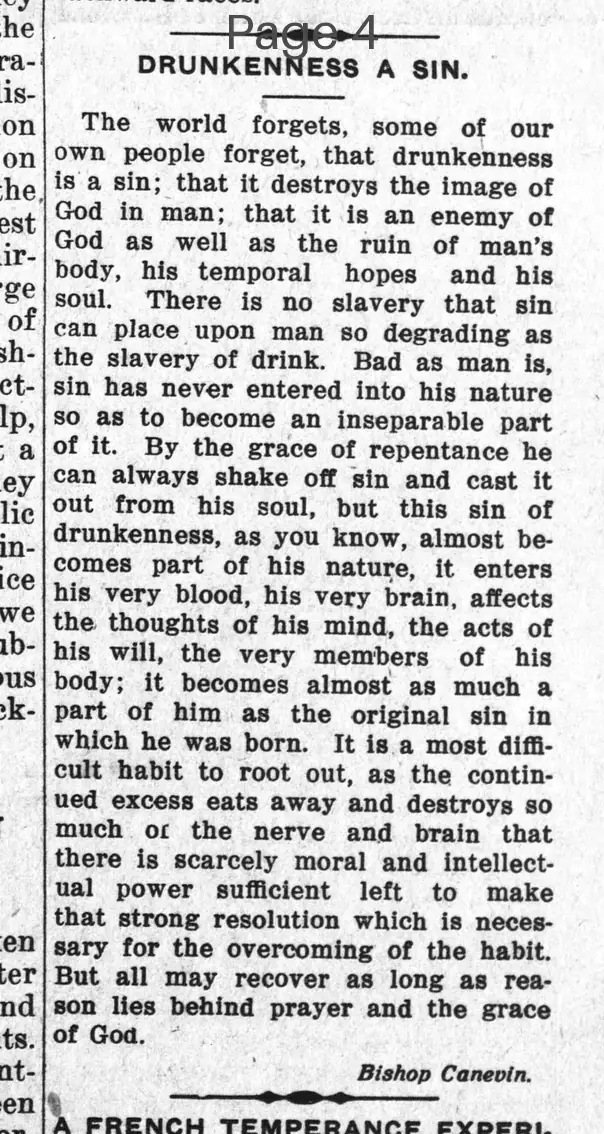
The world forgets, some of our own people forget, that drunkenness is a sin; that it destroys the image of God in man; that it is an enemy of God as well as the ruin of man's body, his temporal hopes and his soul. There is no slavery that sin can place upon man so degrading as the slavery of drink. Bad as man is, sin has never entered into his nature so as to become an inseparable part of it. By the grace of repentance he can always shake off sin and cast it out from his soul, but this sin of drunkenness, as you know, almost becomes part of his nature, it enters his very blood, his very brain, affects the thoughts of his mind, the acts of his will, the very members of his body; it becomes almost as much a part of him as the original sin in which he was born. It is a most difficult habit to root out, as the continued excess eats away and destroys so much of the nerve and brain that there is scarcely moral and intellectual power sufficient left to make that strong resolution which is necessary for the overcoming of the habit.
But all may recover as long as reason lies behind prayer and the grace of God.
Bishop Canevin.
The world forgets, some of our own people forget, that drunkenness is a sin; that it destroys the image of God in man; that it is an enemy of God as well as the ruin of man's body, his temporal hopes and his soul. There is no slavery that sin can place upon man so degrading as the slavery of drink. Bad as man is, sin has never entered into his nature so as to become an inseparable part of it. By the grace of repentance he can always shake off sin and cast it out from his soul, but this sin of drunkenness, as you know, almost becomes part of his nature, it enters his very blood, his very brain, affects the thoughts of his mind, the acts of his will, the very members of his body; it becomes almost as much a part of him as the original sin in which he was born. It is a most difficult habit to root out, as the continued excess eats away and destroys so much of the nerve and brain that there is scarcely moral and intellectual power sufficient left to make that strong resolution which is necessary for the overcoming of the habit.
But all may recover as long as reason lies behind prayer and the grace of God.
Bishop Canevin.
What sub-type of article is it?
Temperance
Moral Or Religious
What keywords are associated?
Drunkenness
Sin
Temperance
Slavery Of Drink
Repentance
Grace Of God
What entities or persons were involved?
Bishop Canevin
God
Editorial Details
Primary Topic
Drunkenness As A Sin And Its Degrading Effects
Stance / Tone
Strongly Condemnatory And Exhortative
Key Figures
Bishop Canevin
God
Key Arguments
Drunkenness Is A Sin That Destroys The Image Of God In Man
It Is An Enemy Of God And Ruins Man's Body, Hopes, And Soul
No Slavery Is As Degrading As The Slavery Of Drink
Unlike Other Sins, Drunkenness Becomes Nearly Inseparable From One's Nature, Affecting Blood, Brain, Mind, Will, And Body
It Is Akin To Original Sin In Its Integration
The Habit Is Extremely Difficult To Overcome Due To Damage To Nerves And Brain
Recovery Is Possible Through Repentance, Prayer, Reason, And God's Grace