Thank you for visiting SNEWPapers!
Sign up free
Story
April 26, 1859
Staunton Spectator
Staunton, Virginia
What is this article about?
Editorial commentary on the acquittal of the Echo slaver crew by a Charleston jury, arguing it reflects southern hypocrisy on slavery laws, and drawing parallels to northern resistance to the fugitive slave law, advocating enforcement of both as law.
Clipping
OCR Quality
95%
Excellent
Full Text
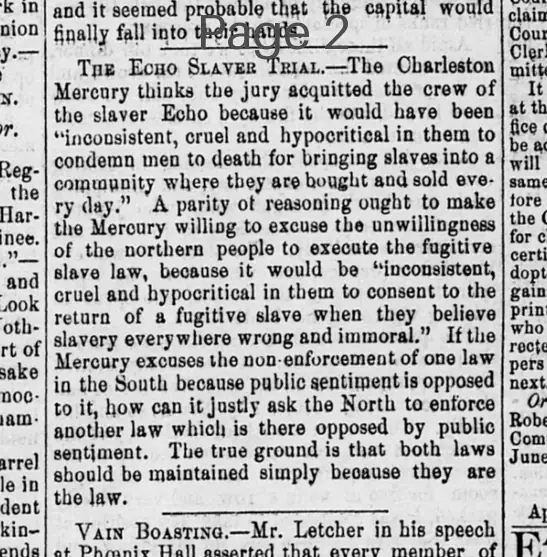
The ECHO Slave Trial.—The Charleston Mercury thinks the jury acquitted the crew of the slaver Echo because it would have been "inconsistent, cruel and hypocritical in them to condemn men to death for bringing slaves into a community where they are bought and sold every day." A parity of reasoning ought to make the Mercury willing to excuse the unwillingness of the northern people to execute the fugitive slave law, because it would be "inconsistent, cruel and hypocritical in them to consent to the return of a fugitive slave when they believe slavery everywhere wrong and immoral." If the Mercury excuses the non-enforcement of one law in the South because public sentiment is opposed to it, how can it justly ask the North to enforce another law which is there opposed by public sentiment. The true ground is that both laws should be maintained simply because they are the law.
What sub-type of article is it?
Crime Story
Historical Event
What themes does it cover?
Justice
Crime Punishment
What keywords are associated?
Echo Slave Trial
Jury Acquittal
Charleston Mercury
Fugitive Slave Law
Slavery Enforcement
Public Sentiment
What entities or persons were involved?
Crew Of The Slaver Echo
Where did it happen?
Charleston
Story Details
Key Persons
Crew Of The Slaver Echo
Location
Charleston
Story Details
The Charleston Mercury justifies the jury's acquittal of the Echo slaver crew due to local slavery practices, but the commentary argues this logic should excuse northern non-enforcement of the fugitive slave law based on anti-slavery sentiment, insisting both laws must be upheld as law.