Thank you for visiting SNEWPapers!
Sign up free
The New Hampshire Gazette
Portsmouth, Rockingham County, New Hampshire
What is this article about?
In 1797, James Monroe writes to Secretary of State Timothy Pickering from Philadelphia, defending his diplomatic conduct in France, criticizing the administration's motives for his recall, and rejecting insinuations of disloyalty. He announces intent to present the matter publicly. A follow-up note declines individual communications.
Clipping
OCR Quality
Full Text
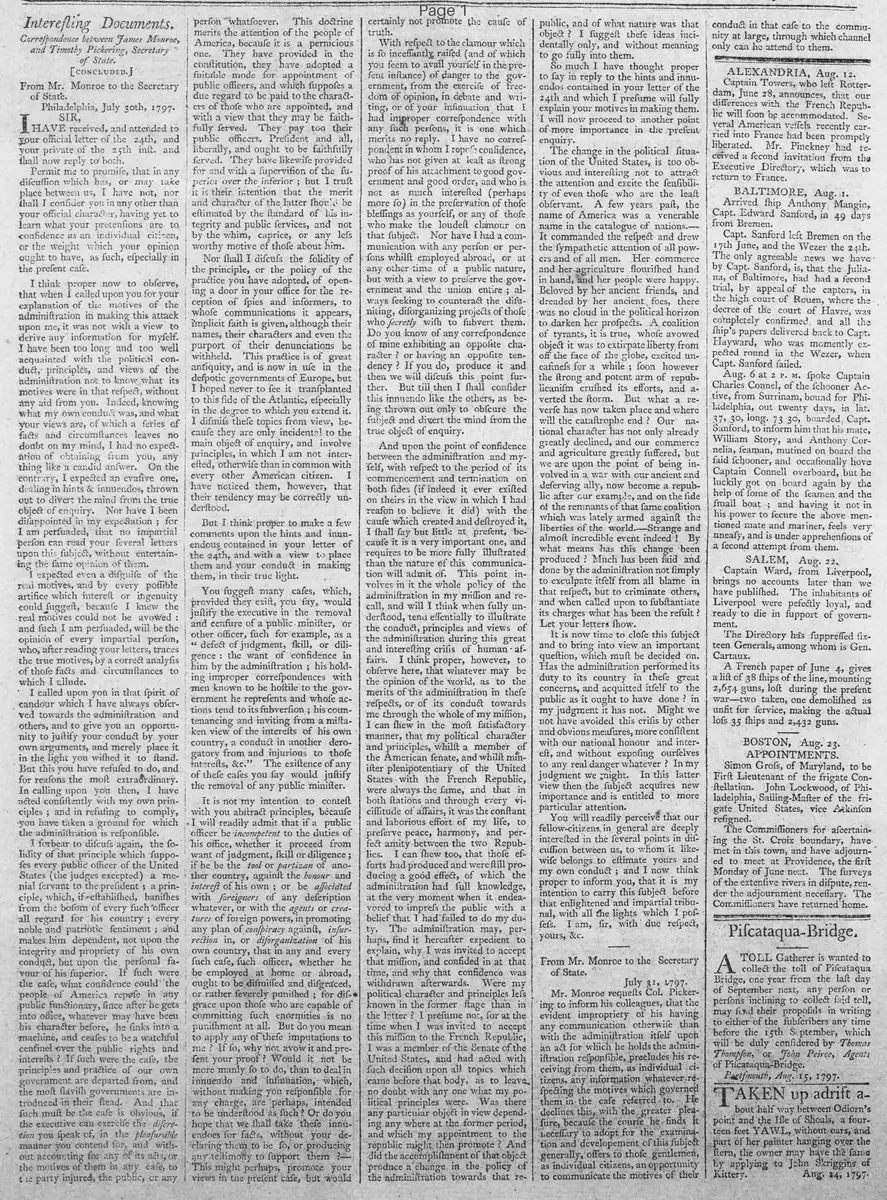
Correspondence between James Monroe,
and Timothy Pickering, Secretary
of State.
Concluded.
From Mr. Monroe to the Secretary
of State.
Philadelphia, July 30th, 1797
SIR,
I HAVE received, and attended to
your official letter of the 24th, and
your private of the 25th inst. and
shall now reply to both.
Permit me to promise, that in any
diffusion which has, or may take
place between us, I have not, nor
shall I consider you in any other than
your official character, having yet to
learn what your pretensions are to
confidence as an individual citizen,
or the weight which your opinion
ought to have, as such, especially in
the present case.
I think proper now to observe,
that when I called upon you for your
explanation of the motives of the
administration in making this attack
upon me, it was not with a view to
derive any information for myself.
I have been too long and too well
acquainted with the political con-
duct, principles, and views of the
administration not to know what its
motives were in that respect, without
any aid from you. Indeed, knowing
what my own conduct was, and what
your views are, of which a series of
facts and circumstances leaves no
doubt on my mind, I had no expect-
ation of obtaining from you, any
thing like a candid answer. On the
contrary, I expected an evasive one,
dealing in hints & innuendos, thrown
out to divert the mind from the true
object of enquiry. Nor have I been
disappointed in my expectation ; for
I am persuaded, that no impartial
person can read your several letters
upon this subject, without entertain-
ing the same opinion of them.
I expected even a disguise of the
real motives, and by every possible
artifice which interest or ingenuity
could suggest, because I knew the
real motives could not be avowed :
and such I am persuaded, will be the
opinion of every impartial person,
who, after reading your letters, traces
the true motives, by a correct analysis
of those facts and circumstances to
which I allude.
I called upon you in that spirit of
candour which I have always obser-
ved towards the administration and
others, and to give you an opportu-
ity to justify your conduct by your
own arguments, and merely place it
in the light you wished it to stand.
But this you have refused to do, and
for reasons the most extraordinary.
In calling upon you then, I have
acted consistently with my own prin-
ciples ; and in refusing to comply,
you have taken a ground for which
the administration is responsible.
I forbear to discuss again, the so-
lidity of that principle which suppo-
ses every public officer of the United
States (the judges excepted) a me-
ial servant to the president ; a prin-
ciple, which, if established, banishes
from the bosom of every such officer
all regard for his country ; every
noble and patriotic sentiment ; and
makes him dependent, not upon the
integrity and propriety of his own
conduct, but upon the personal fa-
vour of his superior. If such were
the case, what confidence could 'the
people of America repose in any
public functionary, since after he gets
into office, whatever may have been
his character before, he sinks into a
machine, and ceases to be a watchful
sentinel over the public rights and
interests ? If such were the case, the
principles and practice of our own
government are departed from, and
the most slavish governments are in-
troduced in their stead. And that
such must be the case is obvious, if
the executive can exercise the discre-
tion you speak of, in the pleasurable
manner you contend for, and with-
out accounting for any of its acts, or
the motives of them in any case, to
the party injured, the public, or any
person whatsoever. This doctrine
merits the attention of the people of
America, because it is a pernicious
one. They have provided in the
constitution, they have adopted a
suitable mode for appointment of
public officers, and which supposes a
due regard to be paid to the charact-
ers of those who are appointed, and
with a view that they may be faith-
fully served. They pay too their
public officers, President and all,
liberally, and ought to be faithfully
served. They have likewise provided
for and with a supervision of the su-
perior over the inferior ; but I trust
it is their intention that the merit
and character of the latter should be
estimated by the standard of his in-
tegrity and public services, and not
by the whim, caprice, or any less
worthy motive of those about him.
Nor shall I discuss the solidity of
the principle, or the policy of the
practice you have adopted, of open-
ing a door in your office for the re-
ception of spies and informers, to
whose communications it appears,
implicit faith is given, although their
names, their characters and even the
purport of their denunciations be
withheld. This practice is of great
antiquity, and is now in use in the
despotic governments of Europe, but
I hoped never to see it transplanted
to this side of the Atlantic, especially
in the degree to which you extend it.
I dismiss these topics from view, be-
cause they are only incidental to the
main object of enquiry, and involve
principles, in which I am not inter-
ested, otherwise than in common with
every other American citizen. I
have noticed them, however, that
their tendency may be correctly un-
derstood.
But I think proper to make a few
comments upon the hints and innu-
endoes contained in your letter of
the 24th, and with a view to place
them and your conduct in making
them, in their true light.
You suggest many cases, which,
provided they exist, you say, would
justify the executive in the removal
and censure of a public minister, or
other officer, such for example, as a
" defect of judgment, skill, or dili-
gence: the want of confidence in
him by the administration ; his hold-
ing improper correspondences with
men known to be hostile to the gov-
ernment he represents and whose ac-
tions tend to its subversion ; his coun-
tenancing and inviting from a mis ta-
ken view of the interests of his own
country, a conduct in another dero-
gatory from and injurious to those
interests, &c.". The existence of any
of these cases you say would justify
the removal of any public minister.
It is not my intention to contest
with you abstract principles, because
I will readily admit that if a public
officer be incompetent to the duties of
his office, whether it proceed from
want of judgment, skill or diligence ;
if he be the tool or partizan of ano-
ther country, against the honour and
interest of his own ; or be associated
with foreigners of any description
whatever, or with the agents or crea-
tures of foreign powers, in promoting
any plan of conspiracy against, insur-
rection in, or disorganization of his
own country, that in any and every
such case, such officer, whether he
be employed at home or abroad,
ought to be dismissed and disgraced,
or rather severely punished ; for dis-
grace upon those who are capable of
committing such enormities is no
punishment at all. But do you mean
to apply any of these imputations to
me ? If so, why not avow it and pre-
sent your proof ? Would it not be
more manly so to do, than to deal in
innuendo and insinuation, which,
without making you responsible for
any charge, are perhaps, intended
to be understood as such? Or do you
hope that we shall take these innu-
endoes for facts, without your de-
claring them to be so, or producing
any testimony to support them
This might perhaps, promote your
views in the present case, but would
certainly not promote the cause of
truth.
With respect to the clamour which
is so incessantly raised (and of which
you seem to avail yourself in the pre-
sent instance) of danger to the gov-
ernment, from the exercise of free-
dom of opinion, in debate and wri-
ting, or of your insinuation that I
had improper correspondence with
any such persons, it is one which
merits no reply. I have no corres-
pondent in whom I repose confidence,
who has not given at least as strong
proof of his attachment to good gov-
ernment and good order, and who is
not as much interested (perhaps
more so) in the preservation of those
blessings as yourself, or any of those
who make the loudest clamour on
that subject. Nor have I had a com-
munication with any person or per-
sons whilst employed abroad, or at
any other time of a public nature,
but with a view to preserve the gov-
ernment and the union entire : al-
ways seeking to counteract the difu-
niting, disorganizing projects of those
who secretly wish to subvert them.
Do you know of any correspondence
of mine exhibiting an opposite cha-
racter ? or having an opposite ten-
dency ? If you do, produce it and
then we will discuss this point fur-
ther. But till then I shall consider
this innuendo like the others, as be-
ing thrown out only to obscure the
subject and divert the mind from the
true object of enquiry.
And upon the point of confidence
between the administration and my-
self, with respect to the period of its
commencement and termination on
both sides (if indeed it ever existed
on theirs in the view in which I had
reason to believe it did) with the
cause which created and destroyed it,
I shall say but little at present, be-
cause it is a very important one, and
requires to be more fully illustrated
than the nature of this communica-
tion will admit of. This point in-
volves in it the whole policy of the
administration in my mission and re-
call, and will I think when fully un-
derstood, tend essentially to illustrate
the conduct, principles and views of
the administration during this great
and interesting crisis of human af-
fairs. I think proper, however, to
observe here, that whatever may be
the opinion of the world, as to the
merits of this administration in these
respects, or of its conduct towards
me through the whole of my mission,
I can show in the most satisfactory
manner, that my political character
and principles, whilst a member of
the American senate, and whilst min-
ister plenipotentiary of the United
States with the French Republic,
were always the same, and that in
both stations and through every vi-
cissitude of affairs, it was the constant
and laborious effort of my life, to
preserve peace, harmony, and per-
fect amity between the two Repub-
lics. I can show too, that those ef-
forts had produced and were still pro-
ducing a good effect, of which the
administration had full knowledge,
at the very moment when it endea-
vored to impress the public with a
belief that I had failed to do my du-
ty. The administration may, per-
haps, find it hereafter expedient to
explain, why I was invited to accept
that mission, and confided in at that
time, and why that confidence was
withdrawn afterwards. Were my
political character and principles less
known in the former stage than in
the latter ? I presume not, or at the
time when I was invited to accept
this mission to the French Republic,
I was a member of the Senate of the
United States, and had acted with
such decision upon all topics which
came before that body, as to leave
no doubt with any one what my po-
litical principles were. Was there
any particular object in view depend-
ing any where at the former period,
and which my appointment to the
republic might then promote ? And
did the accomplishment of that object
produce a change in the policy of
the administration towards that re-
public, and of what nature was that
object ? I suggest these ideas inci-
dentally only, and without meaning
to go fully into them.
So much I have thought proper
to say in reply to the hints and innu-
endoes contained in your letter of the
24th and which I presume will fully
explain your motives in making them.
I will now proceed to another point
of more importance in the present
enquiry.
The change in the political situa-
tion of the United States, is too ob-
vious and interesting not to attract
the attention and excite the sensibility
of even those who are the least
observant. A few years past, the
name of America was a venerable
name in the catalogue of nations.--
It commanded the respect and drew
the sympathetic attention of all pow-
ers and of all men. Her commerce
and her agriculture flourished hand
in hand, and her people were happy.
Beloved by her ancient friends, and
dreaded by her ancient foes, there
was no cloud in the political horizon
to darken her prospects. A coalition
of tyrants, it is true, whose avowed
object it was to extirpate liberty from
off the face of the globe, excited un-
easiness for a while ; soon however
the strong and potent arm of repub-
licanism crushed its efforts, and a-
verted the storm. But what a re-
verse has now taken place and where
will the catastrophe end ? Our na-
tional character has not only already
greatly declined, and our commerce
and agriculture greatly suffered, but
we are upon the point of being in-
volved in a war with our ancient and
deserving ally, now become a repub-
lic after our example, and on the side
of the remnants of that same coalition
which was lately armed against the
liberties of the world.--Strange and
almost incredible event indeed ! By
what means has this change been
produced ? Much has been said and
done by the administration not simply
to exculpate itself from all blame in
that respect, but to criminate others,
and when called upon to substantiate
its charges what has been the result ?
Let your letters show.
It is now time to close this subject
and to bring into view an important
question, which must be decided on.
Has the administration performed its
duty to its country in these great
concerns, and acquitted itself to the
public as it ought to have done ? in
my judgment it has not. Might we
not have avoided this crisis by other
and obvious measures, more consistent
with our national honour and inter-
est, and without exposing ourselves
to any real danger whatever ? In my
judgment we might. In this latter
view then the subject acquires new
importance and is entitled to more
particular attention.
You will readily perceive that our
fellow-citizens, in general are deeply
interested in the several points in dis-
cussion between us, to whom it like-
wise belongs to estimate yours and
my own conduct ; and I now think
proper to inform you, that it is my
intention to carry this subject before
that enlightened and impartial tribu-
nal, with all the lights which I pos-
sess. I am, sir, with due respect,
yours, &c.
From Mr. Monroe to the Secretary
of State.
July 31, 1797.
Mr. Monroe requests Col. Picker-
ing to inform his colleagues, that the
evident impropriety of his having
any communication otherwise than
with the administration itself upon
an act for which he holds the admin-
istration responsible, precludes his re-
ceiving from them, as individual ci-
tizens, any information whatever re-
specting the motives which governed
them in the case referred to. He
declines this, with the greater plea-
sure, because the course he finds it
necessary to adopt for the examina-
tion and development of this subject
generally, offers to those gentlemen,
as individual citizens, an opportunity
to communicate the motives of their
conduct in that case to the commu-
ity at large, through which channel
only can he attend to them.
What sub-type of article is it?
What themes does it cover?
What keywords are associated?
What entities or persons were involved?
Where did it happen?
Story Details
Key Persons
Location
Philadelphia
Event Date
July 30th, 1797
Story Details
James Monroe responds to Timothy Pickering's letters, defending his diplomatic service in France, criticizing the administration's motives for his recall, rejecting insinuations of incompetence or disloyalty, and announcing his intent to address the public on the matter. A brief follow-up note on July 31 declines individual communications from Pickering's colleagues.