Thank you for visiting SNEWPapers!
Sign up free
The Alexandria Herald
Alexandria, Virginia
What is this article about?
Otho Lawrence defends his prior critique of the Allegany election in the Federal Gazette, arguing the return of four federal candidates is invalid under Maryland's 1805 election law due to procedural failures by judges. He rebukes the Federal Republican editor's personal attacks and praises the Gazette's impartiality.
Merged-components note: This is a single letter to the editor spanning two pages, argumentative political content signed Otho Lawrence.
Clippings
1 of 2
OCR Quality
Full Text
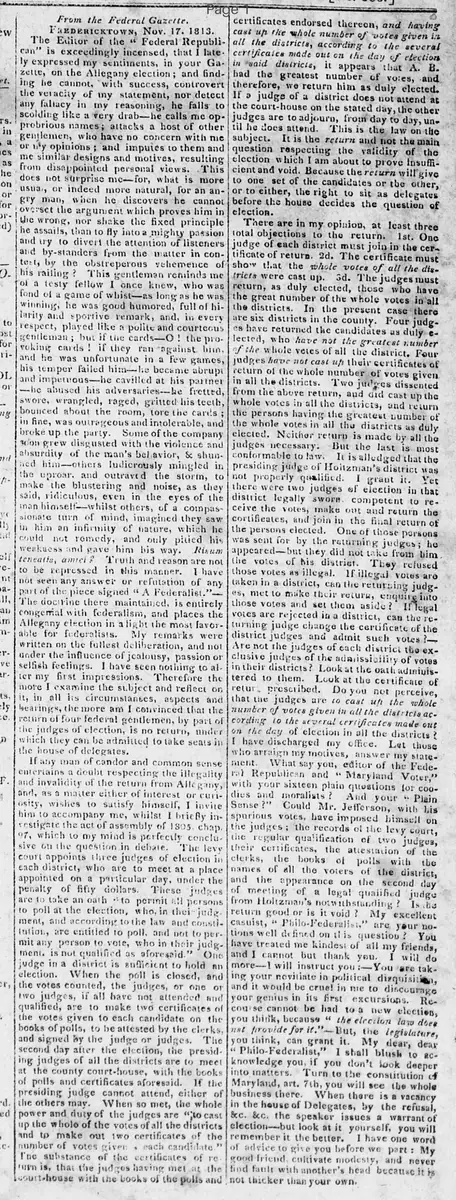
FREDERICKTOWN, Nov. 17. 1813.
The Editor of the "Federal Republican" is exceedingly incensed, that I lately expressed my sentiments, in your Gazette, on the Allegany election; and finding he cannot, with success, controvert the veracity of my statement, nor detect any fallacy in my reasoning, he falls to scolding like a very drab--he calls me opprobrious names; attacks a host of other gentlemen, who have no concern with me or my opinions; and imputes to them and me similar designs and motives, resulting from disappointed personal views. This does not surprise me--for, what is more usual, or indeed more natural, for an angry man, when he discovers he cannot overset the argument which proves him in the wrong, nor shake the fixed principle he assails, than to fly into a mighty passion and try to divert the attention of listeners and by-standers from the matter in contest, by the obstreperous vehemence of his railing? This gentleman reminds me of a testy fellow I once knew, who was fond of a game of whist--as long as he was winning, he was good humored, full of hilarity and sportive remark, and, in every respect, played like a polite and courteous gentleman; but if the cards--O! the provoking cards! if they ran against him, and he was unfortunate in a few games, his temper failed him--he became abrupt and impetuous--he cavilled at his partner--he abused his adversaries--he fretted, swore, wrangled, raged, gritted his teeth, bounced about the room, tore the cards; in fine, was outrageous and intolerable, and broke up the party. Some of the company soon grew disgusted with the violence and absurdity of the man's behavior, & shunned him--others ludicrously mingled in the uproar, and outraved the storm, to make the blustering and noise, as they said, ridiculous, even in the eyes of the man himself--whilst others, of a compassionate turn of mind, imagined they saw in him an infirmity of nature, which he could not remedy, and only pitied his weakness and gave him his way. Risum teneatis, amici? Truth and reason are not to be repressed in this manner. I have not seen any answer or refutation of any part of the piece signed "A Federalist."
The doctrine there maintained, is entirely congenial with federalism, and places the Allegany election in a light the most favorable for federalists. My remarks were written on the fullest deliberation, and not under the influence of jealousy, passion or selfish feelings. I have seen nothing to alter my first impressions. Therefore the more I examine the subject and reflect on it, in all its circumstances, aspects and bearings, the more am I convinced that the return of four federal gentlemen, by part of the judges of election, is no return, under which they can be admitted to take seats in the house of delegates.
If any man of candor and common sense entertains a doubt respecting the illegality and invalidity of the return from Allegany, and, as a matter of either of interest or curiosity, wishes to satisfy himself, I invite him to accompany me, whilst I briefly investigate the act of assembly of 1805, chap. 97, which to my mind is perfectly conclusive on the question in debate. The levy court appoints three judges of election in each district, who are to meet at a place appointed on a particular day, under the penalty of fifty dollars. These judges are to take an oath "to permit all persons to poll at the election, who, in their judgment, and according to the law and constitution, are entitled to poll, and not to permit any person to vote, who in their judgment, is not qualified as aforesaid." One judge in a district is sufficient to hold an election. When the poll is closed, and the votes counted, the judges, or one or two judges, if all have not attended and qualified, are to make two certificates of the votes given to each candidate on the books of polls, to be attested by the clerks, and signed by the judge or judges. The second day after the election, the presiding judges of all the districts are to meet at the county court-house, with the books of polls and certificates aforesaid. If the presiding judge cannot attend, either of the others may. When so met, the whole power and duty of the judges are "to cast up the whole of the votes of all the districts and to make out two certificates of the number of votes given each candidate."
The substance of the certificates of return is, that the judges having met at the court-house with the books of the polls and certificates endorsed thereon, and having cast up the whole number of votes given in all the districts, according to the several certificates made out on the day of election in said districts, it appears that A. B. had the greatest number of votes, and therefore, we return him as duly elected.
If a judge of a district does not attend at the court-house on the stated day, the other judges are to adjourn, from day to day, until he does attend. This is the law on the subject. It is the return and not the main question respecting the validity of the election which I am about to prove insufficient and void. Because the return will give to one set of the candidates or the other, or to either, the right to sit as delegates before the house decides the question of election.
There are in my opinion, at least three total objections to the return. 1st. One judge of each district must join in the certificate of return. 2d. The certificate must show that the whole votes of all the districts were cast up. 3d. The judges must return, as duly elected, those who have the great number of the whole votes in all the districts. In the present case there are six districts in the county. Four judges have returned the candidates as duly elected, who have not the greatest number of the whole votes of all the district. Four judges have not cast up their certificates of return of the whole number of votes given in all the districts. Two judges dissented from the above return, and did cast up the whole votes in all the districts, and return the persons having the greatest number of the whole votes in all the districts as duly elected. Neither return is made by all the judges necessary. But the last is most conformable to law. It is alleged that the presiding judge of Holtzman's district was not properly qualified. I grant it. Yet there were two judges of election in that district legally sworn, competent to receive the votes, make out and return the certificates, and join in the final return of the persons elected. One of those persons was sent for by the returning judges; he appeared--but they did not take from him the votes of his district. They refused those votes as illegal. If illegal votes are taken in a district, can the returning judges, met to make their return, enquire into those votes and set them aside? If legal votes are rejected in a district, can the returning judge change the certificate of the district judges and admit such votes? Are not the judges of each district the exclusive judges of the admissibility of votes in their districts? Look at the oath administered to them. Look at the certificate of return prescribed. Do you not perceive, that the judges are to cast up the whole number of votes given in all the districts according to the several certificates made out on the day of election in all the districts?
I have discharged my office. Let those who arraign my motives, answer my statement. What say you, editor of the Federal Republican and "Maryland Voter," with your sixteen plain questions for coxcombs and moralists? And your "Plain Sense?" Could Mr. Jefferson, with his spurious votes, have imposed himself on the judges; the records of the levy court, the regular qualification of two judges, their certificates, the attestation of the clerks, the books of polls with the names of all the voters of the district, and the appearance on the second day of meeting of a legal qualified judge from Holtzman's notwithstanding? Is he return good! or is it void? My excellent casuist, "Philo-Federalist," are your notions well defined on this question? You have treated me kindest of all my friends, and I cannot but thank you. I will do more--I will instruct you:--You are taking your novitiate in political disquisition, and it would be cruel in me to discourage your genius in its first excursions. Recourse cannot be had to a new election, you think, because "the election law does not provide for it."--But, the legislature, you think, can grant it. My dear, dear "Philo-Federalist," I shall blush to acknowledge you, if you don't look deeper into matters. Turn to the constitution of Maryland, art. 7th, you will see the whole business there. When there is a vacancy in the house of Delegates, by the refusal, &c. &c. the speaker issues a warrant of election--but look at it yourself, you will remember it the better. I have one word of advice to give you before we part: My good friend, cultivate modesty, and never find fault with another's head because it is not thicker than your own,
Before I close my paper I have an acknowledgement to make to the editor of the Federal Gazette or his publication of my remarks under the signature of "A Federalist." The candid and temperate spirit of the Gazette, and the judicious and proper plan on which it is conducted, have gained it an extensive support, and recommended it to the approbation of all reflecting men. At a time like the present, when difference of opinion is stigmatized and persecuted as crime, and attempts are made to render reason and integrity an incumbrance and curse to those who consult their own oracles or listen to their dictators, it is no ordinary merit in an editor of a newspaper to maintain, on political topics, a gentlemanly and liberal toleration of sentiment, and to respect the rights, the motives, and feelings of others. Yet, sir, what is more deserving of praise and imitation? What more elevated and honorable than such a conduct? I am sure it is not in the little sneering & carping of passionate men to drive you from your course; for if the wise and free constitutions bequeathed to us by our fathers be a heritage, worthy to be transmitted to our children, we owe it to ourselves, we owe it to the venerated memory of departed patriots, to preserve those invaluable charters of right from violation and abuse. The man who deserts his principles and acts in opposition to the conviction of his judgment and conscience, may not abandon his party, but he is the basest of all traitors, both to his country and himself. Let no such one be trusted! I should be criminal to desire to have it thought that I am of the party of that man, whatever his party is, who is resolved in all cases to differ from his adversary, even if his adversary is right. I will not go wrong merely to disagree with others, and I should be loth to trust to the verdict of the man who would, my life, my liberty or my property. This may be called warmth, or art, or obtrusion: but, sir, these are my sentiments and style--I am a federalist.
OTHO LAWRENCE.
What sub-type of article is it?
What themes does it cover?
What keywords are associated?
What entities or persons were involved?
Letter to Editor Details
Author
Otho Lawrence
Recipient
The Editor Of The Federal Gazette
Main Argument
the return of four federal candidates from the allegany election is invalid and insufficient under the act of assembly of 1805, chapter 97, due to failures in judicial participation, failure to cast up all district votes, and not returning those with the greatest overall votes; only the dissenting judges' return conforms to law.
Notable Details