Thank you for visiting SNEWPapers!
Sign up free
Las Vegas Age
Las Vegas, Clark County, Lincoln County, Nevada
What is this article about?
Arizona's Colorado River commission breaks off tri-state negotiations with California and Nevada over Boulder Dam water and power division, citing unfair allotments, and plans to sue. Secretary Wilbur and Senator Johnson express no concern, anticipating court resolution to hasten project.
Merged-components note: Continuation of the story on Arizona breaking off negotiations for the tri-state agreement across pages.
Clippings
1 of 2
OCR Quality
Full Text
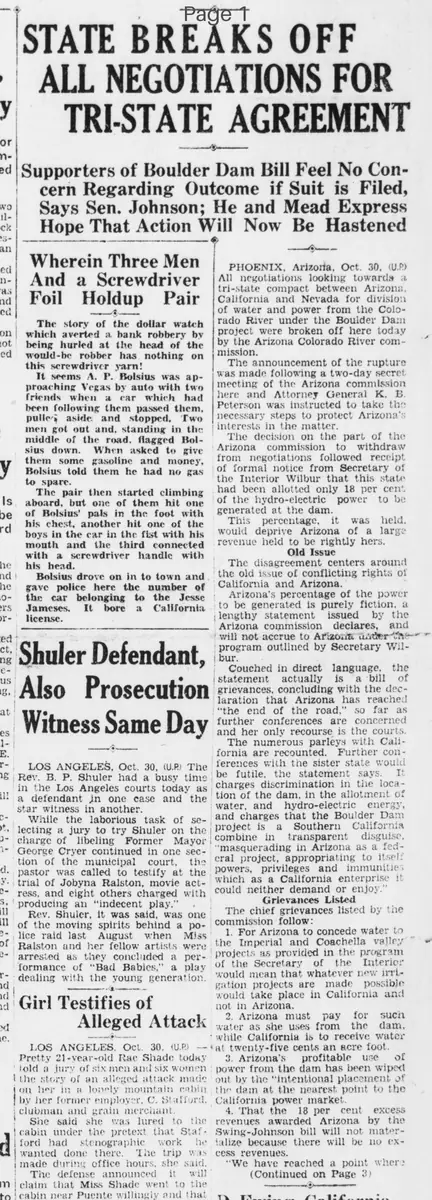
Supporters of Boulder Dam Bill Feel No Concern Regarding Outcome if Suit is Filed, Says Sen. Johnson; He and Mead Express Hope That Action Will Now Be Hastened
PHOENIX, Arizona, Oct. 30. (U.P)
All negotiations looking towards a tri-state compact between Arizona, California and Nevada for division of water and power from the Colorado River under the Boulder Dam project were broken off here today by the Arizona Colorado River commission.
The announcement of the rupture was made following a two-day secret meeting of the Arizona commission here and Attorney General K. B. Peterson was instructed to take the necessary steps to protect Arizona's interests in the matter.
The decision on the part of the Arizona commission to withdraw from negotiations followed receipt of formal notice from Secretary of the Interior Wilbur that this state had been allotted only 18 per cent of the hydro-electric power to be generated at the dam.
This percentage, it was held, would deprive Arizona of a large revenue held to be rightly hers.
Old Issue
The disagreement centers around the old issue of conflicting rights of California and Arizona.
Arizona's percentage of the power to be generated is purely fiction, a lengthy statement issued by the Arizona commission declares, and will not accrue to Arizona under the program outlined by Secretary Wilbur.
Couched in direct language, the statement actually is a bill of grievances, concluding with the declaration that Arizona has reached "the end of the road," so far as further conferences are concerned and her only recourse is the courts.
The numerous parleys with California are recounted. Further conferences with the sister state would be futile, the statement says.
It charges discrimination in the location of the dam, in the allotment of water, and hydro-electric energy, and charges that the Boulder Dam project is a Southern California combine in transparent disguise, "masquerading in Arizona as a federal project, appropriating to itself powers, privileges and immunities, which as a California enterprise it could neither demand or enjoy."
Grievances Listed
The chief grievances listed by the commission follow:
1. For Arizona to concede water to the Imperial and Coachella valley projects as provided in the program of the Secretary of the Interior would mean that whatever new irrigation projects are made possible would take place in California and not in Arizona.
2. Arizona must pay for such water as she uses from the dam, while California is to receive water at twenty-five cents an acre foot.
3. Arizona's profitable use of power from the dam has been wiped out by the "intentional placement of the dam at the nearest point to the California power market.
4. That the 18 per cent excess revenues awarded Arizona by the Swing-Johnson bill will not materialize because there will be no excess revenues.
"We have reached a point where
(Continued on Page 3)
Arizona Ends Negotiations
(Continued from Page I)
It is evident," Chairman Charles E. Ward of the Arizona commission concluded, "from our experience with California that Arizona is to be foreclosed on her rights."
WASHINGTON, Oct. 30 (AP)
Secretary of Interior Ray Lyman Wilbur said today the action of Arizona's Colorado River commission in breaking off negotiations with California and Nevada for division of water and power under the Boulder Dam bill had come sooner than the Interior Department officials expected.
Senator Johnson, Republican of California, said the commencement of suit by Arizona was a foregone conclusion among supporters of the act which bears his name, and that they felt no concern about the outcome.
Hopes for Haste
"I trust they will begin right away," he said "for we are all confident that the act will be upheld and the work will go forward."
Likelihood that Arizona will challenge the constitutionality of the act in the courts led to the prediction by interior department officials that construction of the huge dam project will be postponed until after all legal difficulties are settled.
The opinion was expressed that Arizona's move would take the form of seeking an injunction to hold up the work on the dam.
Not Unexpected
The state commission's action was not unexpected by Wilbur, but he indicated surprise that it should come at this time
Commissioner Mead of the reclamation bureau said if Arizona intended to take the matter into the courts, the sooner it was done the more he will be pleased.
Senator Ashurst, Arizona democrat who fought bitterly against the bill on the senate floor, declined to comment.
What sub-type of article is it?
What keywords are associated?
What entities or persons were involved?
Where did it happen?
Domestic News Details
Primary Location
Phoenix, Arizona
Event Date
Oct. 30
Key Persons
Outcome
negotiations broken off; arizona plans to file suit to protect interests; potential injunction to delay dam construction; no concern from supporters about outcome.
Event Details
Arizona Colorado River commission ends tri-state compact negotiations with California and Nevada after receiving notice of only 18% hydroelectric power allotment, citing grievances over water and power division, dam location, and discrimination favoring California; instructs Attorney General to pursue legal action.