Thank you for visiting SNEWPapers!
Sign up free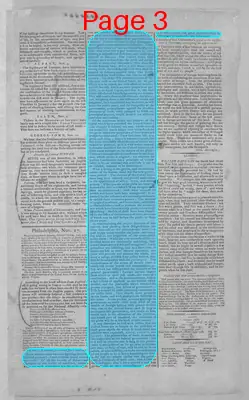
Editorial
November 17, 1790
Gazette Of The United States
New York, New York County, New York
What is this article about?
An editorial advocating peace and praising the new U.S. Constitution for fostering unity, innovation, and prosperity while warning against internal factions driven by pride and ambition. It contrasts the U.S. with ancient Rome and expresses optimism for the federal government's stability.
Clipping
OCR Quality
98%
Excellent
Full Text
'Tis time to sheathe the sword and spare mankind."
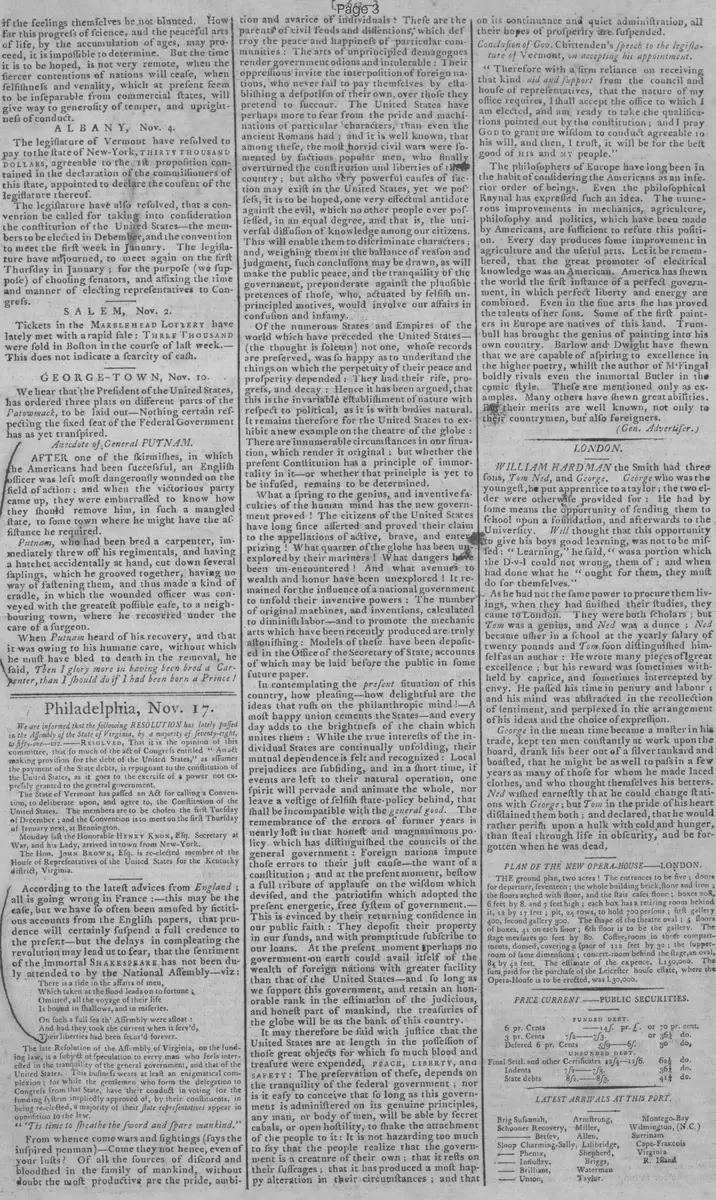
From whence come wars and fightings (says the inspired penman)—Come they not hence, even of your lusts? Of all the sources of discord and bloodshed in the family of mankind, without doubt the most productive are the pride, ambition and avarice of individuals: These are the parents of civil feuds and dissensions, which destroy the peace and happiness of particular communities: The arts of unprincipled demagogues render government odious and intolerable: Their oppressions invite the interposition of foreign nations, who never fail to pay themselves by establishing a despotism of their own, over those they pretend to succour. The United States have perhaps more to fear from the pride and machinations of particular characters, than even the ancient Romans had; and it is well known, that among these, the most horrid civil wars were fomented by factious popular men, who finally overturned the constitution and liberties of the country; but altho very powerful causes of faction may exist in the United States, yet we possess, it is to be hoped, one very effectual antidote against the evil, which no other people ever possessed, in an equal degree, and that is, the universal diffusion of knowledge among our citizens. This will enable them to discriminate characters; and, weighing them in the balance of reason and judgment, such conclusions may be drawn, as will make the public peace, and the tranquility of the government, preponderate against the plausible pretences of those, who, actuated by selfish unprincipled motives, would involve our affairs in confusion and infamy.
Of the numerous States and Empires of the world which have preceded the United States— (the thought is solemn) not one, whose records are preserved, was so happy as to understand the things on which the perpetuity of their peace and prosperity depended: They had their rise, progress, and decay: Hence it has been argued, that this is the invariable establishment of nature with respect to political, as it is with bodies natural.
It remains therefore for the United States to exhibit a new example on the theatre of the globe: There are innumerable circumstances in our situation, which render it original; but whether the present Constitution has a principle of immortality in it—or whether that principle is yet to be infused, remains to be determined.
What a spring to the genius, and inventive faculties of the human mind has the new government proved! The citizens of the United States have long since asserted and proved their claim to the appellations of active, brave, and enterprising! What quarter of the globe has been unexplored by their mariners! What dangers have been un-encountered! And what avenues to wealth and honor have been unexplored! It remained for the influence of a national government to unfold their inventive powers: The number of original machines, and inventions, calculated to diminish labor—and to promote the mechanic arts which have been recently produced are truly astonishing: Models of these have been deposited in the Office of the Secretary of State, accounts of which may be laid before the public in some future paper.
In contemplating the present situation of this country, how pleasing—how delightful are the ideas that rush on the philanthropic mind!—A most happy union cements the States—and every day adds to the brightness of the chain which unites them: While the true interests of the individual States are continually unfolding, their mutual dependence is felt and recognized: Local prejudices are subsiding, and in a short time, if events are left to their natural operation, one spirit will pervade and animate the whole, nor leave a vestige of selfish state-policy behind, that shall be incompatible with the general good. The remembrance of the errors of former years is nearly lost in that honest and magnanimous policy which has distinguished the councils of the general government: Foreign nations impute those errors to their just cause—the want of a constitution; and at the present moment, bestow a full tribute of applause on the wisdom which devised, and the patriotism which adopted the present energetic, free system of government.— This is evinced by their returning confidence in our public faith: They deposit their property in our funds, and with promptitude subscribe to our loans. At the present moment perhaps no government on earth could avail itself of the wealth of foreign nations with greater facility than that of the United States—and so long as we support this government, and retain an honorable rank in the estimation of the judicious, and honest part of mankind, the treasuries of the globe will be as the bank of this country.
It may therefore be said with justice that the United States are at length in the possession of those great objects for which so much blood and treasure were expended, PEACE, LIBERTY, and SAFETY: The preservation of these, depends on the tranquility of the federal government; nor is it easy to conceive that so long as this government is administered on its genuine principles, any man, or body of men, will be able by secret cabals, or open hostility, to shake the attachment of the people to it: It is not hazarding too much to say that the people realize that the government is a creature of their own; that it rests on their suffrages; that it has produced a most happy alteration in their circumstances; and that on its continuance and quiet administration, all their hopes of prosperity are suspended.
From whence come wars and fightings (says the inspired penman)—Come they not hence, even of your lusts? Of all the sources of discord and bloodshed in the family of mankind, without doubt the most productive are the pride, ambition and avarice of individuals: These are the parents of civil feuds and dissensions, which destroy the peace and happiness of particular communities: The arts of unprincipled demagogues render government odious and intolerable: Their oppressions invite the interposition of foreign nations, who never fail to pay themselves by establishing a despotism of their own, over those they pretend to succour. The United States have perhaps more to fear from the pride and machinations of particular characters, than even the ancient Romans had; and it is well known, that among these, the most horrid civil wars were fomented by factious popular men, who finally overturned the constitution and liberties of the country; but altho very powerful causes of faction may exist in the United States, yet we possess, it is to be hoped, one very effectual antidote against the evil, which no other people ever possessed, in an equal degree, and that is, the universal diffusion of knowledge among our citizens. This will enable them to discriminate characters; and, weighing them in the balance of reason and judgment, such conclusions may be drawn, as will make the public peace, and the tranquility of the government, preponderate against the plausible pretences of those, who, actuated by selfish unprincipled motives, would involve our affairs in confusion and infamy.
Of the numerous States and Empires of the world which have preceded the United States— (the thought is solemn) not one, whose records are preserved, was so happy as to understand the things on which the perpetuity of their peace and prosperity depended: They had their rise, progress, and decay: Hence it has been argued, that this is the invariable establishment of nature with respect to political, as it is with bodies natural.
It remains therefore for the United States to exhibit a new example on the theatre of the globe: There are innumerable circumstances in our situation, which render it original; but whether the present Constitution has a principle of immortality in it—or whether that principle is yet to be infused, remains to be determined.
What a spring to the genius, and inventive faculties of the human mind has the new government proved! The citizens of the United States have long since asserted and proved their claim to the appellations of active, brave, and enterprising! What quarter of the globe has been unexplored by their mariners! What dangers have been un-encountered! And what avenues to wealth and honor have been unexplored! It remained for the influence of a national government to unfold their inventive powers: The number of original machines, and inventions, calculated to diminish labor—and to promote the mechanic arts which have been recently produced are truly astonishing: Models of these have been deposited in the Office of the Secretary of State, accounts of which may be laid before the public in some future paper.
In contemplating the present situation of this country, how pleasing—how delightful are the ideas that rush on the philanthropic mind!—A most happy union cements the States—and every day adds to the brightness of the chain which unites them: While the true interests of the individual States are continually unfolding, their mutual dependence is felt and recognized: Local prejudices are subsiding, and in a short time, if events are left to their natural operation, one spirit will pervade and animate the whole, nor leave a vestige of selfish state-policy behind, that shall be incompatible with the general good. The remembrance of the errors of former years is nearly lost in that honest and magnanimous policy which has distinguished the councils of the general government: Foreign nations impute those errors to their just cause—the want of a constitution; and at the present moment, bestow a full tribute of applause on the wisdom which devised, and the patriotism which adopted the present energetic, free system of government.— This is evinced by their returning confidence in our public faith: They deposit their property in our funds, and with promptitude subscribe to our loans. At the present moment perhaps no government on earth could avail itself of the wealth of foreign nations with greater facility than that of the United States—and so long as we support this government, and retain an honorable rank in the estimation of the judicious, and honest part of mankind, the treasuries of the globe will be as the bank of this country.
It may therefore be said with justice that the United States are at length in the possession of those great objects for which so much blood and treasure were expended, PEACE, LIBERTY, and SAFETY: The preservation of these, depends on the tranquility of the federal government; nor is it easy to conceive that so long as this government is administered on its genuine principles, any man, or body of men, will be able by secret cabals, or open hostility, to shake the attachment of the people to it: It is not hazarding too much to say that the people realize that the government is a creature of their own; that it rests on their suffrages; that it has produced a most happy alteration in their circumstances; and that on its continuance and quiet administration, all their hopes of prosperity are suspended.
What sub-type of article is it?
War Or Peace
Constitutional
Moral Or Religious
What keywords are associated?
Peace
Constitution
Unity
Innovation
Federal Government
Factions
Demagogues
Knowledge
What entities or persons were involved?
United States
Ancient Romans
Demagogues
Foreign Nations
Secretary Of State
Editorial Details
Primary Topic
Promotion Of Peace And Praise For The New U.S. Constitution
Stance / Tone
Optimistic And Supportive Of Federal Government
Key Figures
United States
Ancient Romans
Demagogues
Foreign Nations
Secretary Of State
Key Arguments
Wars Arise From Pride, Ambition, And Avarice
Demagogues Foment Civil Discord And Invite Foreign Despotism
Universal Knowledge Among Citizens Prevents Factions
U.S. Can Set A New Example Of Perpetual Peace And Prosperity
New Government Spurs Innovation And Invention
Happy Union Of States Fosters Mutual Dependence And Subsides Prejudices
Foreign Confidence In U.S. Government Evidenced By Investments
Preservation Of Peace, Liberty, And Safety Depends On Federal Tranquility