Thank you for visiting SNEWPapers!
Sign up free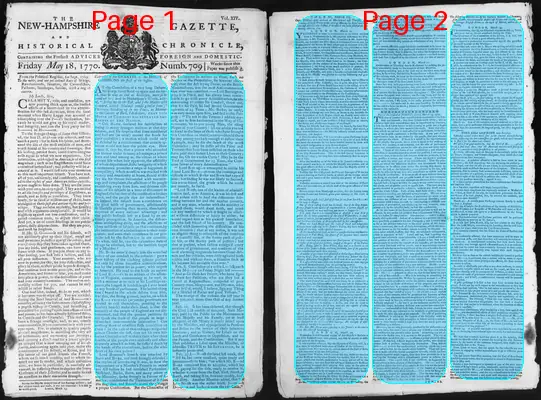
The New Hampshire Gazette And Historical Chronicle
Portsmouth, Greenland, Rockingham County, New Hampshire
What is this article about?
London news reports include House of Commons debates criticizing British policy toward American colonies, with speeches by Savile, Barre, and Burke; presentation of City Remonstrance to King George III on March 15, 1770, met with a gracious but firm rejection; various political gossip, international updates from Europe, and public support for opposition.
Merged-components note: Continuation of extracts from London debates and prints as foreign news, sequential reading order across pages.
Clippings
1 of 2
OCR Quality
Full Text
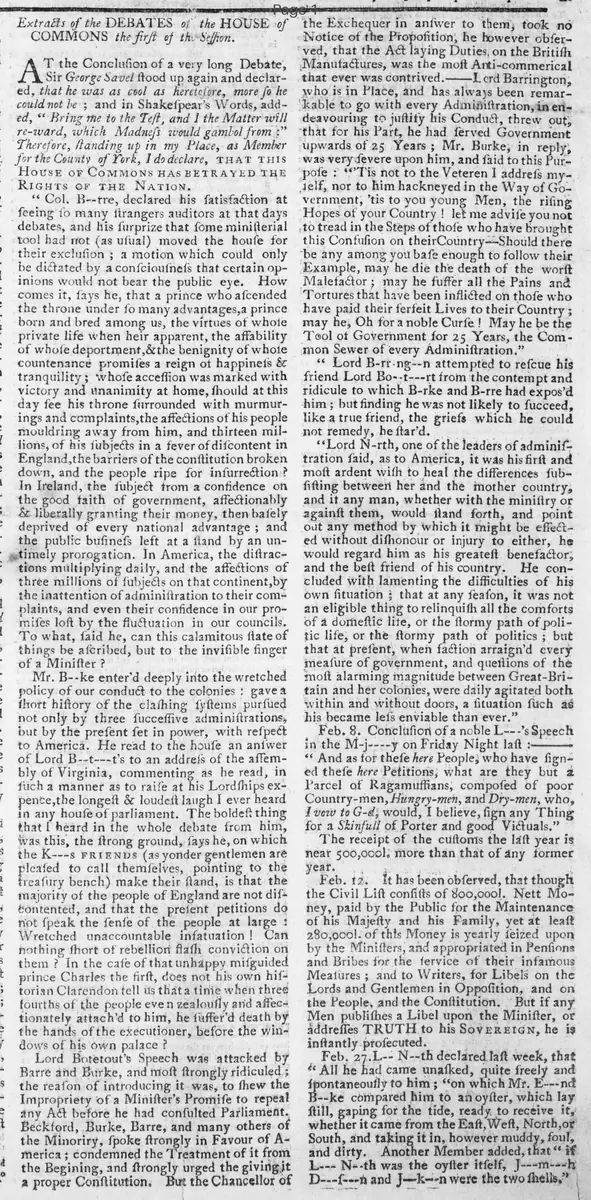
At the Conclusion of a very long Debate, Sir George Savile stood up again and declared, that he was as cool as heretofore, more so he could not be; and in Shakespeare's Words, added. "Bring me to the Test. and I the Matter will re-ward, which Madness would gambol from:"
Therefore, standing up in my Place, as Member for the County of York, I do declare, THAT THIS HOUSE OF COMMONS HAS BETRAYED THE RIGHTS OF THE NATION.
Col. B--rre, declared his satisfaction at seeing so many strangers auditors at that days debates, and his surprize that some ministerial tool had not (as usual) moved the house for their exclusion; a motion which could only be dictated by a consciousness that certain opinions would not bear the public eye. How comes it, says he. that a prince who ascended the throne under so many advantages, a prince born and bred among us, the virtues of whose private life when heir apparent, the affability of whose deportment. & the benignity of whose countenance promises a reign of happiness & tranquility; whose accession was marked with victory and unanimity at home. should at this day see his throne surrounded with murmurings and complaints, the affections of his people mouldring away from him, and thirteen millions, of his subjects in a fever of discontent in England, the barriers of the constitution broken down, and the people ripe for insurrection?
In Ireland, the subject from a confidence on the good faith of government, affectionately & liberally granting their money, then basely deprized of every national advantage; and the public business left at a stand by an untimely prorogation. In America, the distractions multiplying daily, and the affections of three millions of subjects on that continent, by the inattention of administration to their complaints, and even their confidence in our promises lost by the fluctuation in our councils.
To what, said he. can this calamitous state of things be ascribed, but to the invisible finger of a Minister?
Mr. B--ke enter'd deeply into the wretched policy of our conduct to the colonies: gave a short history of the clashing systems pursued not only by three successive administrations, but by the present set in power, with respect to America. He read to the house an answer of Lord B--t---t's to an address of the assembly of Virginia, commenting as he read, in such a manner as to raise at his Lordships expense, the longest & loudest laugh I ever heard in any house of parliament. The boldest thing that I heard in the whole debate from him, was this, the strong ground, says he, on which the K---s FRIENDS (as yonder gentlemen are pleased to call themselves, pointing to the treasury bench) make their stand, is that the majority of the people of England are not discontented, and that the present petitions do not speak the sense of the people at large: Wretched unaccountable infatuation! Can nothing short of rebellion flash conviction on them? In the case of that unhappy misguided prince Charles the first, does not his own historian Clarendon tell us that a time when three fourths of the people even zealously and affectionately attach'd to him. he suffer'd death by the hands of the executioner. before the windows of his own palace?
Lord Botetourt's Speech was attacked by Barre and Burke, and most strongly ridiculed.; the reason of introducing it was. to shew the Impropriety of a Minister's Promise to repeal any Act before he had consulted Parliament.
Beckford, Burke, Barre, and many others of the Minority, spoke strongly in Favour of America; condemned the Treatment of it from the Beginning, and strongly urged the giving it a proper Constitution. But the Chancellor of the Exchequer in answer to them, took no Notice of the Proposition, he however observed. that the Act laying Duties, on the British Manufactures, was the most Anti-commerical that ever was contrived.---Lord Barrington, who is in Place, and has always been remarkable to go with every Administration, in endeavouring to justify his Conduct, threw out. that for his Part, he had served Government upwards of 25 Years; Mr. Burke, in reply: was very severe upon him, and said to this Purpose: "'Tis not to the Veteran I address myself, nor to him hackneyed in the Way of Government, 'tis to you young Men, the rising Hopes of your Country! let me advise you not to tread in the Steps of those who have brought this Confusion on their Country - Should there be any among you base enough to follow their Example, may he die the death of the worst Malefactor; may he suffer all the Pains and Tortures that have been inflicted on those who have paid their forfeit Lives to their Country; may he, Oh for a noble Curse! May he be the Tool of Government for 25 Years, the Common Sewer of every Administration."
Lord B-rr-ng--n attempted to rescue his friend Lord Bo--t---rt from the contempt and ridicule to which B-rke and B-rre had expos'd him: but finding he was not likely to succeed, like a true friend, the griefs which he could not remedy, he shar'd.
Lord North, one of the leaders of administration said, as to America. it was his first and most ardent wish to heal the differences subsisting between her and the mother country. and if any man, whether with the ministry or against them, would stand forth, and point Out any method by which it might be effected without dishonour or injury to either. he would regard him as his greatest benefactor. and the best friend of his country. He concluded with lamenting the difficulties of his own situation; that at any season, it was not an eligible thing to relinquith all the comforts of a domestic life, or the stormy path of politic life, or the stormy path of politics; but that at present, when faction arraign'd every measure of government, and questions of the most alarming magnitude between Great-Britain and her colonies, were daily agitated both within and without doors, a situation such as his became less enviable than ever.
Feb. 8. Conclusion of a noble L---'s Speech in the M-j----y on Friday Night last:
"And as for these here People, who have sign-ed these here Petitions, what are they but a Parcel of Ragamuffins, composed of poor Country-men, Hungry-men, and Dry-men, who, I vow to G-d, would, I believe, sign any Thing for a Skinfull of Porter and good Victuals."
The receipt of the customs the last year is near 500,000l. more than that of any former year.
Feb. 12. It has been observed. that though the Civil List consists of 800,000l. Nett Money, paid by the Public for the Maintenance of his Majesty and his Family, yet at least 280,000l. of this Money is yearly seized upon by the Ministers, and appropriated in Pensions and Bribes for the service of their infamous Measures; and to Writers, for Libels on the Lords and Gentlemen in Opposition. and on the People. and the Constitution. But if any Men publishes a Libel upon the Minister, or addresses TRUTH to his SOVEREIGN. he is instantly prosecuted.
Feb. 27. L-- North declared last week. that "All he had came unasked, quite freely and spontaneously to him; "on which Mr. E---nd B--ke compared him to another. which lay still, gaping for the tide, ready to receive it, whether it came from the East. West. North. or South, and taking it in, however muddy, foul. and dirty. Another Member added, that "i L--- North was the oyster itself. I---m---h D------n and Ik--n were the two shells."
SALEM, March 15.
Capt. Skillings, who arrived at Marblehead last Thursday from London, brought Prints to the 17th of March, (3 Days later than the last Advices via Boston) from which we have selected the following Advices viz.
LONDON, March 15.
YESTERDAY at noon in consequence of the letter received from L. Weymouth, the L. Mayor, with Alderman Sir Wm. Stephenson, & Mr. Trecothick; Mr. Townshend & Mr. Sawbridge, Sheriffs, one hundred and fifty-three of Common-Council, and the Committee of the Livery in their proper gowns, attended at Guildhall; from whence, at a quarter before one, they proceeded in their carriages to St. James's, attended by the Common Serjeant, Common Clerk, Remembrancer, two Secondaries, Sword Bearer, Mace Bearer, Water Bailiff, Common Crier, Common Hunt, City Marshals, &c. &c. They arrived there at two o'clock, and were introduced to his Majesty, who received them seated on his throne; the Common Serjeant (in the absence of the Recorder) began to read the Remonstrance; but being in too much confusion to proceed, Sir James Hodges, the Common Clerk, read it to his Majesty, very properly and distinctly, and with a suitable and judicious emphasis.
To which his Majesty was pleased to read the following most gracious Answer:
'I shall always be ready to receive the Requests, and to listen to the complaints of my Subjects; but it gives me great Concern to find, that any of them should have been so far misled, as to offer me an Address and Remonstrance, the Contents of which I cannot but consider as disrespectful to me, injurious to Parliament and irreconcilable to the Principles of the Constitution.
I have ever made the Law of the Land the Rule of my Conduct, esteeming it my chief Glory to reign over a free People: With this View I have always been careful, as well to execute faithfully the Trust reposed in me, as to avoid even the Appearance of invading any of those Powers which the Constitution has placed in other Hands. It is only by persevering in such a Conduct that I can either discharge my own Duty, or secure to my Subjects the free Enjoyment of those Rights which my Family were called to defend; and while I act upon these Principles, I shall have a Right to expect, and I am confident I shall continue to receive, the steady and affectionate Support of my People.'
When his Majesty had done reading the Speech, the Lord Mayor, &c. had the honour to kiss his Majesty's hand; after which, as they were withdrawing---his Majesty instantly turned round to his Courtiers, and laughed.
A Correspondent says, 'It is no wonder a great Personage laughed yesterday; as it was truly laughable to see a set of men kissing his hand the moment he had heard himself treated by them with the utmost indignation in their Remonstrance.'
Tuesday each member of the house of Lords received a special summons to attend the King, in order to be present at the receipt of the City Remonstrance. This is the first special summons in this King's reign; but they have been customarily sent in exigencies of state.
After the breaking up of the levee at St. James's yesterday a cabinet council was held, at which his Majesty was present, and all the great officers of state assisted, about four his Majesty retired to the Queen's palace to dinner.
Tuesday her Royal Highness the Princess Dowager of Wales had a grand drawing at Carlton House, at which all the foreign ministers and a great number of the nobility and gentry of both sexes were present.
Yesterday morning a council was held at the Secretary of state's office in Cleveland-row, at which most of the great officers of state attended.
Private letters from Hamburgh mention, that the subsidy treaty between France and Sweden, gives great umbrage to the court of Berlin.
On Tuesday a post-chaise full of faction set out from Lord C.....m's on its way to Hayes.
One of the protesting Lords has declared, that if the City Remonstrance should become matter of consideration in a certain august assembly, it would not meet with any partisans to support it.
It is said, that it is in contemplation to establish a new form of police for the better government of the city of Westminster; in consequence of which, several commissioners of the police will be appointed, and his Grace the Duke of Newcastle will be first commissioner.
When the Lord Mayor and the train of honest and independent Citizens went yesterday to St. James's Palace, they were incessantly hailed all the way with repeated huzzas.
At Northumberland House, as well as opposite Carlton and Cumberland Houses in Pall-Mall, the shouts of the populace were remarkably loud and continued.
It was remarked, that there were two small parties of horse-guards, exclusive of the usual foot-soldiers, ranged at the gates of the Palace.
Mrs. Hayley, sister to John Wilkes, Esq; was in a chariot at the bottom of St. James's-street, and being known by some of the populace, was complimented with three huzzas.
A number of gentlemen had assembled at the Cardigan-Head tavern, Charing Cross, from the windows of which they saluted the Lord Mayor, Aldermen, Sheriffs, &c. with French horns and other music.
It is assured that more than two hundred persons are now employed to prevent Remonstrances from the petitioning counties.
A gentleman at George's coffee-house saying, 'If the City Remonstrance should not be answered, what can the city do next?' An honest Hibernian replied, 'Arrah, my dear honey, though no answer has been given to the petitions that have been received, yet there has been answers enough to those that are not received.'
The words scum of the earth will very likely be as celebrated as sturdy beggar, this last expression had very near cost Sir Robert Walpole his life.-----The sturdy beggar surrounded him in the court of Requests one day, and gave him such a hustling about, that if an officer of the army had not broke through the crowd and rescued him, he would not have lived to repeat that unlucky expression.
We have information, that a great personage sent a few days since for the Marquis of Granby; and after soliciting him to resume his offices, was told that he must beg to decline, and that he could not think of mixing with a set of men, who are not capable of acting worthy the approbation of an honest mind.
It is positively asserted at the west end of the town, that several great officers about the court, in order to convince the world of their real regard for the public good- have entered into a resolution to give up their salaries and all other kinds of emolument, during the time they are employed in the service of their country. An example of disinterestedness hardly to be paralleled!
The Rev. Mr. Horne went yesterday to St. James's in the chariot with Mr. Sheriff Sawbridge.
LONDON, March 16.
Wednesday several hundred copies of his Majesty's Answer to the City Remonstrance, were printed, and sent by express to different parts of the kingdom.
It was reported yesterday, that the Marquis of Granby will, in a few days, be reinstated in his place of Master of the Ordnance.
Letters from Nice mention the arrival there of the Earl of Bute, much recovered of his late Indisposition.
Letters from Warsaw, which arrived this day, make no mention of the Russians having taken Bender, but declare, that all the succours which that fortress could receive by land, are cut off by the Imperial troops; and that since the taking of Brailow, the Russians have nothing to oppose their carrying their arms to the gates of Constantinople, unless the city of Adrianople should make a vigorous defence, which is by no means to be expected, as the fortifications of that place are in a most ruinous condition.
Yesterday in the Evening his Grace the Duke of Grafton had a long conference with his Majesty at the Queen's Palace.
As the Lord Mayor passed through the city on Wednesday, the mob hallooed out, "God bless King George and Alderman Beckford," and a Trumpeter at a one pair of stairs window as the procession passed by, sounded "God save the King."
A pragmatic Nobleman on Wednesday, in the hearing of a Liveryman, sneeringly asked, "Who are these THINGS?" "They are (replied the honest citizen) the Livery of the City---and heartily despise the Livery of the Court."
Notwithstanding there were at least 10,000 people on Wednesday near St. James's Palace, (among whom were a number of the better sort) yet not the least riot, tumult, or disturbance of any kind happened.
If a certain offensive paper should be condemned to be burnt by the common hangman, it is questioned whether it would not be doing it more honour than it deserves, for when the Scriptures were first translated into English, they and the translator were both burnt; and their fate is dignified by the Church with the title of martyrdom.
LONDON, March 17.
Orders were on Thursday sent to Richmond for making the palace immediately ready for the reception of their Majesties.
Yesterday morning bets at the west end of the town were three to two, & six to four, that the City Remonstrance will, in the course of the ensuing week, be burnt by the common hangman.
The Chairman of the Livery will this day make his appearance in the upper room of the Robinhood Society.
Some late very bold papers having been lately laid before a great ministerial lawyer for his opinion, they were returned with answer, that "--.-...- .-..- has read and considered the enclosed papers, & is of opinion that they are treasonable throughout:" The minister to whom the papers were returned, was shewing them, and the opinion, with some degree of exultation, to a noble D--- in the minority; who replied, "My Lord, I can easily perceive the mistake - has made, and so may your Lordship. In his hurry he has added a letter too much; instead of treasonable, he certainly meant to say reasonable."
THE city of London have expressed their sentiments with freedom and firmness; they have spoken truth boldly; and in whatever light their remonstrance may be represented by courtiers, I defy the most subtle lawyer in this country to point out a single instance, in which they have exceeded the truth. Even that assertion, which we are told is most offensive to parliament, in the theory of the English constitution is strictly true. If any part of the representative body be not chosen by the people, that part vitiates and corrupts the whole. If there be a defect in the representation of the people, that power, which alone is equal to the making of laws in this country, is not compleat, and the acts of parliament under that circumstance are not the acts of a pure and intire legislature. I speak of the theory of our constitution; and whatever difficulties or inconveniences may attend the practice, I am ready to maintain that, as far as the fact deviates from the principle, so far the practice is vicious and corrupt. I have not heard a question raised upon any other part of the remonstrance. That the principle, on which the Middlesex election was determined, is more pernicious in its effects than either the levying ship-money by Charles the first, or the suspending power assumed by his son, will hardly be disputed by any man who understands or wishes well to the English constitution. It is not an act of open violence done by the King, or any direct and palpable breach of the laws attempted by his ministry, that can ever endanger the liberties of this country. Against such a King or minister the people would immediately take the alarm, and all parties unite to oppose him. The laws may be grossly violated in particular instances, without any direct attack upon the whole system. Facts of that kind stand alone; they are attributed to necessity, not defended upon principle. We can never be really in danger, until the forms of parliament are made use of to destroy the substance of our civil and political liberties; until parliament itself betrays its trust, by contributing to establish new principles of government, and employing the very weapons, committed to it by the collective body, to stab the constitution.
As for the terms of the Remonstrance I presume it will not be affirmed, by any person less polished than a Gentleman Usher, that this is a season for compliments. Our gracious -.- indeed is abundantly civil to himself. "Instead of an answer to a petition, his ---- very gracefully pronounces his own Panegyric; and I confess that as far as his personal behaviour or the royal purity of his intentions is concerned, the truth of those declarations, which the minister has drawn up for his master, cannot decently be disputed. In every other respect, I affirm that they are absolutely unsupported, either in argument or fact. I must add too, that supposing the speech were otherwise unexceptionable, it is not a direct answer to the petition of the city. His ------- is pleased to say, that he is always ready to receive the requests of his subjects; yet the sheriffs were twice sent back with an excuse, and it was certainly debated in council whether or no the magistrates of the city of London should be admitted to an audience. Whether the Remonstrance be or be not injurious to parliament, is the very question between the parliament and the people, and such a question as cannot be decided by the assertion of a third party, however respectable. That the petitioning for a dissolution of parliament is irreconcileable with the principles of the constitution is a new doctrine. His M---y perhaps has not been informed that the House of Commons themselves have, by a formal resolution, admitted it to be the right of the subject. His ----.--- proceeds to assure us, that he has made the laws the rule of his conduct.----- Was it in ordering or permitting the ministers to apprehend Mr. Wilkes by a general warrant?---Was it in suffering his ministers to revive the obsolete maxim of nullum tempus to rob the Duke of Portland of his property, and thereby give a decisive turn to a county election?----Was it in erecting a chamber consultation of surgeons with authority to examine into & supersede the legal verdict of a jury?--- Or did his ---t--- consult the laws of this country, when he permitted his secretary of state to declare that, whenever the civil magistrate is trifled with, a military force must be sent for, without the delay of a moment, and effectually employed?---Or was it in the barbarous exactness, with which this illegal, inhuman doctrine was carried into execution?
If his ----- had recollected these facts, I think he never would have said, at least with any reference to the measures of government, that he made the laws the rule of his conduct. To talk of preserving the affections or relying on the support of his subjects, while he continues to act upon these principles, is indeed paying a compliment to their loyalty which I hope they have too much spirit and understanding to deserve.
His --s--, we are told, is not only punctual in the performance of his own duty, but careful not to assume any of those powers which the constitution has placed in other hands. Admitting this last assertion to be strictly true, it is no way to the purpose. The city of London have not desired the --.-- to assume a power placed in other hands. If they had, I should hope to see the person, who dared to present such a petition, immediately impeached. They solicit their ------- to exert that constitutional authority, which the laws have vested in him for the benefit of his subjects. They call upon him to make use of his lawful prerogative in a case, which our laws evidently supposed might happen, since they have provided for it by trusting the sovereign with a discretionary power to dissolve the parliament. This request will, I am confident, be supported by Remonstrances from all parts of the kingdom. His ---- will find at last that this is the sense of his people, & that it is not his interest to support either ministry or parliament, at the hazard of a breach with the collective body of his subjects.--That he is the King of a free people, is indeed his greatest glory. That he may long continue the King of a free people, is the second wish that animates my heart. The first is, that the people may be free.
JUNIUS.
The following Advices are by the Captains Butnell and Symmes from London, who arrived at Boston last Friday and Sunday, and has brought English Prints to the 20th of March, which are as follows,
LONDON. March 19.
It is remarkable, that Queen Elizabeth reigned exactly 45 Years, and never had 45 Hours uneasiness during the Time.
The Chairman of the Committee of the Livery, it is said, has received an order to attend a great assembly this day.
It is reported a prosecution is commenced against the publisher of the third number of the Whisperer.
Wednesday last, when the L. Mayor was getting out of his coach in order to present the City Remonstrance, a Courtier pulled out a handful of Guineas, supposed about 30, and offered to lay them that his L--dsh-p would, in a few days, be sent to the T-w-r; some of the mob observing this, gave his elbow a jog, on which the money fell about the street, and became the booty of the populace.
A motion was made on Tuesday night by the E. of M. that the E. of C. be committed to the T----r, for several spirited assertions; which motion the Chairman was tender of putting, well knowing the majority would be for the question; and therefore no notice was taken of it: But about 12 o'clock the same Nobleman renewed his motion, which was received in the same manner; at last L. C. got up, and desired to know whether he was to be sent to his new lodgings, or might be permitted to retire to his old ones, as it grew late, and he found the gout coming on him very fast. L. M. finding no support, withdrew his motion.
Thursday a great city Magistrate made a spirited harangue in defence of the city Remonstrance, but it had little weight, for on a division there appeared 271 against 128.
What the E. of C......m said relating to the colonies in an august assembly, has been entirely misrepresented; his Lordship declared, that if the colonies carried matters too far, he would certainly oppose them. The noble Lord has never asserted they did carry matters too far.
During the debates in an illustrious assembly, on Wednesday last, a certain great personage, who has lately made no inconsiderable figure in the field of Venus, diverted himself with running about from one side to the other of the apartment, instead of being attentive to the importance, and solemnity of the subject.
March 20. One of the common council observed on a late occasion, that a great personage discovered more generosity in his behaviour than his attendants, he laughed openly, but they laughed in their sleeves.
NERO fiddled whilst ROME was burning.
Yesterday counter orders were sent to the several manufacturing towns, postponing the late commissions for goods, which were intended to be shipped for the American colonies.
We learn from good authority, that the Earl of H... . . gb asserted, a few days since, that all American matters will shortly be settled in a manner entirely satisfactory to all parties.
A certain Assembly were on Monday so exceedingly polite that the Tower, Newgate, and Common-Hangman, were words thought too indelicate to be once mentioned.
March 21. A political assembly is said to have come to two resolutions; the first importing, that the declaring the present p--z to be illegal, and that its acts are not valid, is unwarrantable, and manifestly tends to disturb the peace of the kingdom. The second importing, that to convey such unwarrantable doctrines, under the specious pretence of a petition, is a gross and manifest abuse of the undoubted right of the subject to petition the crown. The numbers for the question were 284; against it 127.
It is said a certain production has been considered as a scandalous and seditious libel.
In a few days, expulsion will imply incapacitation.
A certain high magistrate has repeatedly declared at Westminster, "that, as chief of the city, he could have prevented the Remonstrance if he had pleased, but, he avowed the contents, and took them upon himself."
March 21. A certain great Personage intends shortly to make the tour of England.
This day se'nnight the Freeholders of the county of Middlesex, and the Freemen and Burgesses of Westminster will meet at Westminster-hall, to read and agree to a Remonstrance to the King, which is already prepared.
The Northumberland and Durham petitions will be presented to his Majesty to-morrow at St. James's.
It is said that John Ketch, Esq; has sent a letter to the Right Hon. the Lord Mayor, acquainting his Lordship, that he will sooner resign his place, than burn the City Remonstrance.
It is currently reported, that his Grace the Duke of Bedford died yesterday.
It is confidently asserted, that some alterations will be made in the American Acts, and that then they will certainly be enforced.
March 22. A correspondent remarks, that how much soever the ministry may inveigh against a Remonstrance, it is an undoubted fact that the event has been extremely favourable to their cause, having increased the majority even beyond their most sanguine expectations.
We hear that as soon as the address both Houses intend to present to his M-----y, is presented, that a motion will be made to reprimand from the chair three principal city officers, for their conduct on recent occasion.
In order to effectually put a stop to any more answers, to certain disagreeable subjects which are now on the carpet, we hear an illustrious assembly will be prorogued till October, in order investigate the real cause of grievances which are pretended to exist among the people; and if fact, a constitutional remedy will be immediately applied.
A great personage it is said a few days since declared that the people should not say with regard to the remonstrance as they had respecting their petition, 'that he had taken no notice of it,' for he was resolved to take proper notice of it and punish the abettors.
Mr. Edmund B--ke, in a certain club on Monday last, with his usual eloquence, maintained the legality and expediency of the Remonstrance. He observed, "That the very name of Remonstrance implied something disagreeable, but that such a measure was not for that reason to be declined, when the situation of affairs renders it necessary."
The above Gentleman, after inveighing a long time against the M-..e-, and the dreadful effects of their pernicious councils," of late." said he, "there has been a mighty fluctuation of M......rs. first Lord B--e, next Lord C....m, then Mr. G.....le, afterwards the Marquis of R..k.....m, the Duke of G.....n, and now the noble Lord on the other side of the house (pointing to Lord North) whom God long preserve!"
March 24. A proposal was made a few days since by one of the m.n...ty for laying some restraint upon the press, but was not seconded.
We hear that a certain Lord has given it as his opinion, that should the Sheriffs refuse to attend the burning the city Remonstrance by the hands of the common hangman, they ought to be immediately sent to the Tower.
From Leeds we learn, that the agents for the colonies are very assiduous in engaging woollen manufacturers to go to different parts of America.
The last letters from Nice mention, that the Earl of Bute found himself so much better, that he proposed to return to England some time in May next.
Sunday a man harangued to upwards of 500 of the mob under the walls of King's bench prison, treasonably exciting them to take up arms against his M......, of whom he spoke in the most scurrilous and audacious terms; read the city remonstrance to them with the King's answer thereto; and made most impudent and treasonable remarks thereon, and was suffered to escape with impunity.
What sub-type of article is it?
What keywords are associated?
What entities or persons were involved?
Where did it happen?
Foreign News Details
Primary Location
London
Event Date
February To March 1770
Key Persons
Outcome
king george iii rejects city remonstrance as disrespectful to him and parliament; parliamentary votes favor administration (e.g., 271-128, 284-127); increased customs revenue of near 500,000l.; public support for opposition with huzzas; rumors of ministerial changes and prosecutions.
Event Details
Extracts from House of Commons debates criticize British policy toward American colonies, Ireland, and constitution; speakers like Savile declare betrayal of nation, Barre attributes discontent to minister, Burke ridicules Lord Botetourt's response to Virginia and warns of rebellion; minority urges constitutional treatment for America; Lord North expresses wish to heal differences. City of London presents Remonstrance to King on March 15, read by Common Clerk; King responds upholding laws and constitution, then laughs with courtiers; public cheers procession; various political rumors, councils, and international notes on France-Sweden treaty, Russian advances toward Constantinople, Earl of Bute's health.