Thank you for visiting SNEWPapers!
Sign up free
Story
March 21, 1955
The Key West Citizen
Key West, Monroe County, Florida
What is this article about?
Senator Capehart accuses economist John Kenneth Galbraith of praising communism in a 1949 pamphlet during Senate Banking Committee hearings on the stock market, sparking controversy. Galbraith denies it, calling it a warning. Democrats defend him amid political tensions with Republicans.
Clipping
OCR Quality
75%
Good
Full Text
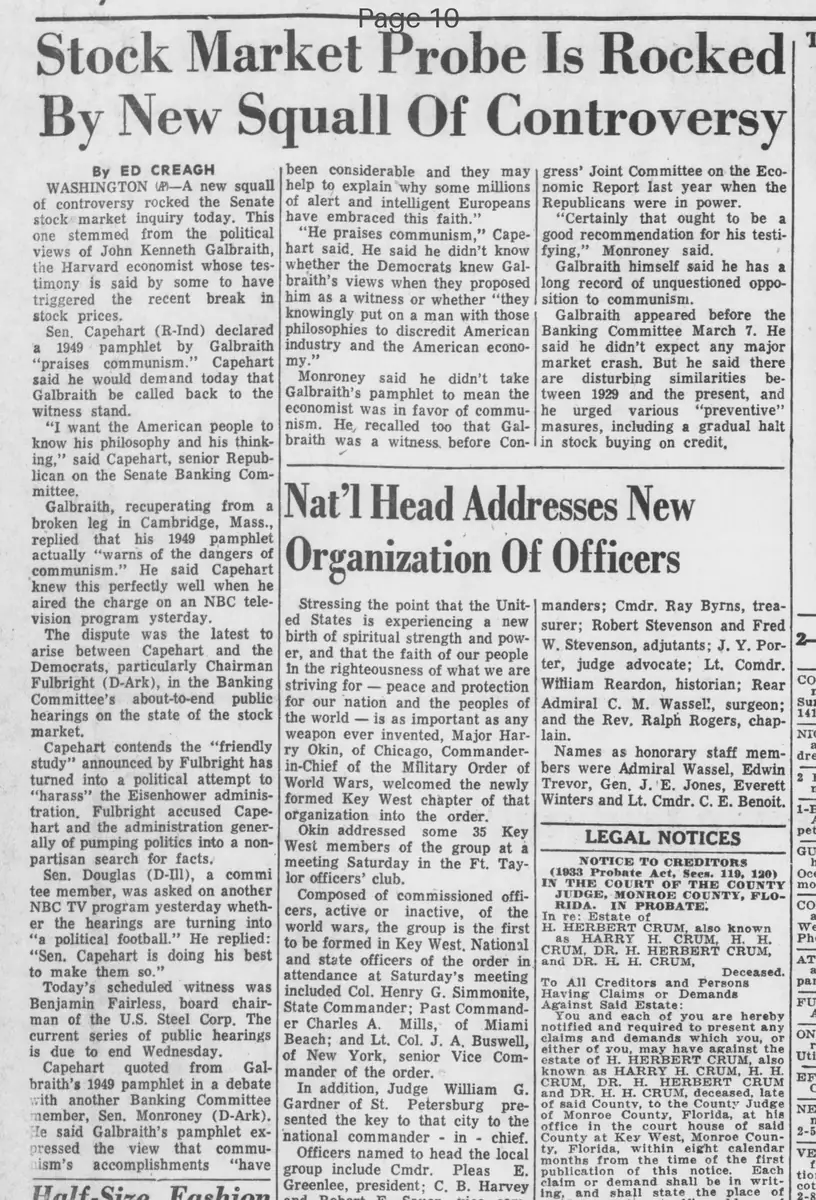
Stock Market Probe Is Rocked
By New Squall Of Controversy
Sen. Capehart (R-Ind) declared a 1949 pamphlet by Galbraith "praises communism." Capehart said he would demand today that Galbraith be called back to the witness stand.
"I want the American people to know his philosophy and his thinking," said Capehart, senior Republican on the Senate Banking Committee.
"He praises communism," Capehart said. He said he didn't know whether the Democrats knew Galbraith's views when they proposed him as a witness or whether "they knowingly put on a man with those philosophies to discredit American industry and the American economy."
Capehart quoted from Galbraith's 1949 pamphlet in a debate with another Banking Committee member, Sen. Monroney (D-Ark). He said Galbraith's pamphlet expressed the view that communism's accomplishments "have been considerable and they may help to explain why some millions of alert and intelligent Europeans have embraced this faith."
Monroney said he didn't take Galbraith's pamphlet to mean the economist was in favor of communism. He recalled too that Galbraith was a witness before Congress' Joint Committee on the Economic Report last year when the Republicans were in power.
"Certainly that ought to be a good recommendation for his testifying," Monroney said.
Galbraith himself said he has a long record of unquestioned opposition to communism.
Galbraith, recuperating from a broken leg in Cambridge, Mass., replied that his 1949 pamphlet actually "warns of the dangers of communism." He said Capehart knew this perfectly well when he aired the charge on an NBC television program yesterday.
The dispute was the latest to arise between Capehart and the Democrats, particularly Chairman Fulbright (D-Ark), in the Banking Committee's about-to-end public hearings on the state of the stock market.
Capehart contends the "friendly study" announced by Fulbright has turned into a political attempt to "harass" the Eisenhower administration. Fulbright accused Capehart and the administration generally of pumping politics into a non-partisan search for facts.
Sen. Douglas (D-Ill), a committee member, was asked on another NBC TV program yesterday whether the hearings are turning into "a political football." He replied: "Sen. Capehart is doing his best to make them so."
Today's scheduled witness was Benjamin Fairless, board chairman of the U.S. Steel Corp. The current series of public hearings is due to end Wednesday.
He said he didn't expect any major market crash. But he said there are disturbing similarities between 1929 and the present, and he urged various "preventive" measures, including a gradual halt in stock buying on credit.
By New Squall Of Controversy
Sen. Capehart (R-Ind) declared a 1949 pamphlet by Galbraith "praises communism." Capehart said he would demand today that Galbraith be called back to the witness stand.
"I want the American people to know his philosophy and his thinking," said Capehart, senior Republican on the Senate Banking Committee.
"He praises communism," Capehart said. He said he didn't know whether the Democrats knew Galbraith's views when they proposed him as a witness or whether "they knowingly put on a man with those philosophies to discredit American industry and the American economy."
Capehart quoted from Galbraith's 1949 pamphlet in a debate with another Banking Committee member, Sen. Monroney (D-Ark). He said Galbraith's pamphlet expressed the view that communism's accomplishments "have been considerable and they may help to explain why some millions of alert and intelligent Europeans have embraced this faith."
Monroney said he didn't take Galbraith's pamphlet to mean the economist was in favor of communism. He recalled too that Galbraith was a witness before Congress' Joint Committee on the Economic Report last year when the Republicans were in power.
"Certainly that ought to be a good recommendation for his testifying," Monroney said.
Galbraith himself said he has a long record of unquestioned opposition to communism.
Galbraith, recuperating from a broken leg in Cambridge, Mass., replied that his 1949 pamphlet actually "warns of the dangers of communism." He said Capehart knew this perfectly well when he aired the charge on an NBC television program yesterday.
The dispute was the latest to arise between Capehart and the Democrats, particularly Chairman Fulbright (D-Ark), in the Banking Committee's about-to-end public hearings on the state of the stock market.
Capehart contends the "friendly study" announced by Fulbright has turned into a political attempt to "harass" the Eisenhower administration. Fulbright accused Capehart and the administration generally of pumping politics into a non-partisan search for facts.
Sen. Douglas (D-Ill), a committee member, was asked on another NBC TV program yesterday whether the hearings are turning into "a political football." He replied: "Sen. Capehart is doing his best to make them so."
Today's scheduled witness was Benjamin Fairless, board chairman of the U.S. Steel Corp. The current series of public hearings is due to end Wednesday.
He said he didn't expect any major market crash. But he said there are disturbing similarities between 1929 and the present, and he urged various "preventive" measures, including a gradual halt in stock buying on credit.
What sub-type of article is it?
Political Controversy
Congressional Hearing
What themes does it cover?
Deception
What keywords are associated?
Stock Market Probe
Communism Accusation
Senate Hearings
Capehart Galbraith
Political Controversy
What entities or persons were involved?
Sen. Capehart
Galbraith
Sen. Monroney
Chairman Fulbright
Sen. Douglas
Benjamin Fairless
Where did it happen?
Senate Banking Committee, Washington; Cambridge, Mass.
Story Details
Key Persons
Sen. Capehart
Galbraith
Sen. Monroney
Chairman Fulbright
Sen. Douglas
Benjamin Fairless
Location
Senate Banking Committee, Washington; Cambridge, Mass.
Event Date
1955
Story Details
Senator Capehart accuses Galbraith of praising communism in a 1949 pamphlet during stock market hearings, demanding his recall. Galbraith refutes it as a warning against communism. Dispute highlights partisan tensions between Republicans and Democrats in the committee.