Thank you for visiting SNEWPapers!
Sign up free
Montana Oil And Mining Journal
Great Falls, Billings, Cascade County, Yellowstone County, Montana
What is this article about?
In 1877, Dr. W. A. Allen captained an emigrant wagon train from Dakota to Montana, thwarting horse thieves, surviving Sioux attacks that killed five, navigating without a reliable guide, and enduring hardships to reach Bozeman amid gold rush hopes.
Clipping
OCR Quality
Full Text
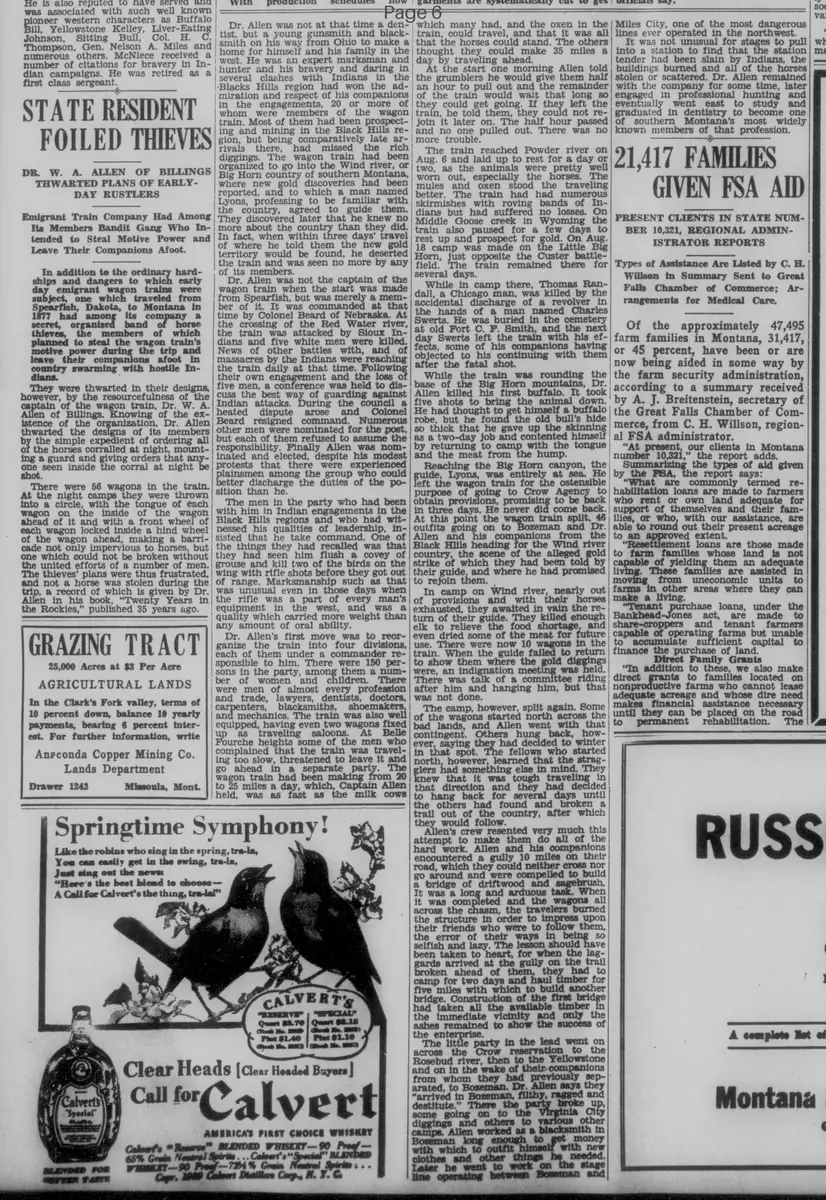
FOILED THIEVES
DR. W. A. ALLEN OF BILLINGS THWARTED PLANS OF EARLY-DAY RUSTLERS
Emigrant Train Company Had Among Its Members Bandit Gang Who Intended to Steal Motive Power and Leave Their Companions Afoot.
In addition to the ordinary hardships and dangers to which early day emigrant wagon trains were subject, one which traveled from Spearfish, Dakota, to Montana in 1877 had among its company a secret, organized band of horse thieves, the members of which planned to steal the wagon train's motive power during the trip and leave their companions afoot in country swarming with hostile Indians.
They were thwarted in their designs, however, by the resourcefulness of the captain of the wagon train, Dr. W. A. Allen of Billings. Knowing of the existence of the organization, Dr. Allen thwarted the designs of its members by the simple expedient of ordering all of the horses corralled at night, mounting a guard and giving orders that anyone seen inside the corral at night be shot.
There were 56 wagons in the train. At the night camps they were thrown into a circle, with the tongue of each wagon on the inside of the wagon ahead of it and with a front wheel of each wagon locked inside a hind wheel of the wagon ahead, making a barricade not only impervious to horses, but one which could not be broken without the united efforts of a number of men.
The thieves' plans were thus frustrated and not a horse was stolen during the trip, a record of which is given by Dr. Allen in his book, "Twenty Years in the Rockies," published 35 years ago.
Dr. Allen was not at that time a dentist, but a young gunsmith and blacksmith on his way from Ohio to make a home for himself and his family in the west. He was an expert marksman and hunter and his bravery and daring in several clashes with Indians in the Black Hills region had won the admiration and respect of his companions in the engagements, 20 or more of whom were members of the wagon train. Most of them had been prospecting and mining in the Black Hills region, but being comparatively late arrivals there, had missed the rich diggings. The wagon train had been organized to go into the Wind river, or Big Horn country of southern Montana, where new gold discoveries had been reported, and to which a man named Lyons, professing to be familiar with the country, agreed to guide them.
They discovered later that he knew no more about the country than they did. In fact, when within three days' travel of where he told them the new gold territory would be found, he deserted the train and was seen no more by any of its members.
Dr. Allen was not the captain of the wagon train when the start was made from Spearfish, but was merely a member of it. It was commanded at that time by Colonel Beard of Nebraska. At the crossing of the Red Water river, the train was attacked by Sioux Indians and five white men were killed. News of other battles with, and of massacres by the Indians were reaching the train daily at that time. Following their own engagement and the loss of five men, a conference was held to discuss the best way of guarding against Indian attacks. During the council a heated dispute arose and Colonel Beard resigned command. Numerous other men were nominated for the post, but each of them refused to assume the responsibility. Finally Allen was nominated and elected, despite his modest protests that there were experienced plainsmen among the group who could better discharge the duties of the position.
The men in the party who had been with him in Indian engagements in the Black Hills regions and who had witnessed his qualities of leadership, insisted that he take command. One of the things they had recalled was that they had seen him flush a covey of grouse and kill two of the birds on the wing with rifle shots before they got out of range. Marksmanship such as that was unusual even in those days when the rifle was a part of every man's equipment in the west, and was a quality which carried more weight than any amount of oral ability.
Dr. Allen's first move was to reorganize the train into four divisions, each of them under a commander responsible to him. There were 150 persons in the party, among them a number of women and children. There were men of almost every profession and trade, lawyers, dentists, doctors, carpenters, blacksmiths, shoemakers, and mechanics. The train was also well equipped, having even two wagons fixed up as traveling saloons. At Belle Fourche heights some of the men who complained that the train was traveling too slow, threatened to leave it and go ahead in a separate party. The wagon train had been making from 20 to 25 miles a day, which, Captain Allen held, was as fast as the milk cows which many had, and the oxen in the train, could travel, and that it was all that the horses could stand. The others thought they could make 35 miles a day by traveling ahead.
At the start one morning Allen told the grumblers he would give them half an hour to pull out and the remainder of the train would wait that long so they could get going. If they left the train, he told them, they could not rejoin it later on. The half hour passed and no one pulled out. There was no more trouble.
The train reached Powder river on Aug. 6 and laid up to rest for a day or two, as the animals were pretty well worn out, especially the horses. The mules and oxen stood the traveling better. The train had had numerous skirmishes with roving bands of Indians but had suffered no losses. On Middle Goose creek in Wyoming the train also paused for a few days to rest up and prospect for gold. On Aug. 18 camp was made on the Little Big Horn, just opposite the Custer battlefield. The train remained there for several days.
While in camp there, Thomas Randall, a Chicago man, was killed by the accidental discharge of a revolver in the hands of a man named Charles Swerts. He was buried in the cemetery at old Fort C. F. Smith, and the next day Swerts left the train with his effects, some of his companions having objected to his continuing with them after the fatal shot.
While the train was rounding the base of the Big Horn mountains, Dr. Allen killed his first buffalo. It took five shots to bring the animal down. He had thought to get himself a buffalo robe, but he found the old bull's hide so thick that he gave up the skinning as a two-day job and contented himself by returning to camp with the tongue and the meat from the hump.
Reaching the Big Horn canyon, the guide, Lyons, was entirely at sea. He left the wagon train for the ostensible purpose of going to Crow Agency to obtain provisions, promising to be back in three days. He never did come back. At this point the wagon train split, 46 outfits going on to Bozeman and Dr. Allen and his companions from the Black Hills heading for the Wind river country, the scene of the alleged gold strike of which they had been told by their guide, and where he had promised to rejoin them.
In camp on Wind river, nearly out of provisions and with their horses exhausted, they awaited in vain the return of their guide. They killed enough elk to relieve the food shortage, and even dried some of the meat for future use. There were now 10 wagons in the train. When the guide failed to return to show them where the gold diggings were, an indignation meeting was held. There was talk of a committee riding after him and hanging him, but that was not done.
The camp, however, split again. Some of the wagons started north across the bad lands, and Allen went with that contingent. Others hung back, however, saying they had decided to winter in that spot. The fellows who started north, however, learned that the stragglers had something else in mind. They knew that it was tough traveling in that direction and they had decided to hang back for several days until the others had found and broken a trail out of the country, after which they would follow.
Allen's crew resented very much this attempt to make them do all of the hard work. Allen and his companions encountered a gully 10 miles on their road, which they could neither cross nor go around and were compelled to build a bridge of driftwood and sagebrush. It was a long and arduous task. When it was completed and the wagons all across the chasm, the travelers burned the structure in order to impress upon their friends who were to follow them, the error of their ways in being so selfish and lazy. The lesson should have been taken to heart, for when the laggards arrived at the gully on the trail broken ahead of them, they had to camp for two days and haul timber for five miles with which to build another bridge. Construction of the first bridge had taken all the available timber in the immediate vicinity and only the ashes remained to show the success of the enterprise.
The little party in the lead went on across the Crow reservation to the Rosebud river, then to the Yellowstone and on in the wake of their companions from whom they had previously separated, to Bozeman. Dr. Allen says they "arrived in Bozeman, filthy, ragged and destitute." There the party broke up, some going on to the Virginia City diggings and others to various other camps. Allen worked as a blacksmith in Bozeman long enough to get money with which to outfit himself with new clothes and other things he needed. Later he went to work on the stage line operating between Bozeman and Miles City, one of the most dangerous lines ever operated in the northwest. It was not unusual for stages to pull into a station to find that the station tender had been slain by Indians, the buildings burned and all of the horses stolen or scattered. Dr. Allen remained with the company for some time, later engaged in professional hunting and eventually went east to study and graduated in dentistry to become one of southern Montana's most widely known members of that profession.
What sub-type of article is it?
What themes does it cover?
What keywords are associated?
What entities or persons were involved?
Where did it happen?
Story Details
Key Persons
Location
From Spearfish, Dakota, To Montana, Including Black Hills, Wind River, Big Horn, Powder River, Little Big Horn, Crow Reservation, Rosebud River, Yellowstone, Bozeman
Event Date
1877
Story Details
Dr. W. A. Allen leads an emigrant wagon train from Spearfish to Montana, foiling horse thieves by corralling horses at night, surviving Indian attacks, dealing with a deceptive guide, and overcoming hardships to reach Bozeman.