Thank you for visiting SNEWPapers!
Sign up free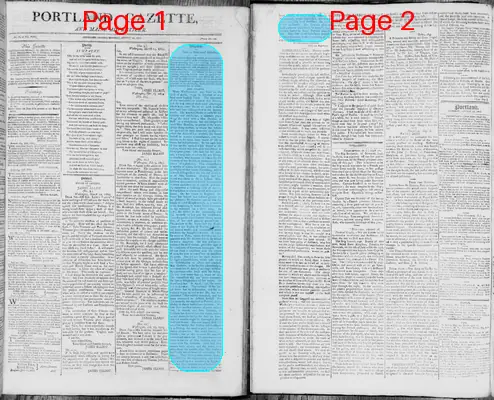
Portland Gazette, And Maine Advertiser
Portland, Cumberland County, Maine
What is this article about?
Biography of Mary Wollstonecraft (Mrs. Godwin), highlighting her unconventional life, literary works like Vindication of the Rights of Woman, relationship with Gilbert Imlay leading to despair and suicide attempts, marriage to William Godwin, and death in 1797 after childbirth.
Merged-components note: This is a continuation of the biography of Mrs. Godwin, which was incorrectly labeled as 'obituary' on page 2. The text flows directly from the end of the page 1 component.
Clippings

1 of 2
OCR Quality
Full Text
From the Merrimack Miscellany.
The subject of the present number is an extraordinary
instance of the folly of departing from the established
order of society, and is a convincing proof, that
when a woman, from a spirit of eccentric pride, disregards
and violates the most ornamental and necessary
quality of her sex, chastity, she purchases at a dear rate
her ideal enjoyments. She becomes the dupe of some
designing man, who, perhaps, under the mask of congeniality,
corrupts her mind, and debases her person.
Too late she discovers her error, and (no matter how
great her firmness and magnanimity) experiencing the
imbecility of her philosophy, seeks to relieve herself
from a wretched life, by suicide.
MRS. GODWIN.
Mary Wollstonecraft was born on the
27th of April, 1759, in London, or at a
farm upon Epping forest. The education
of this extraordinary woman was slender,
and she had none of those early advantages
which have been the lot of most women
who have been distinguished in the literary
world. She was remarkable in early life for
vivacity and resolution; at nineteen years
of age she lived with a Mrs. Dawson, at
Bath as a companion, but was obliged to
leave Mrs. Dawson, to attend to the wants
of her dying mother, to whom her behavior
appears to have been very dutiful.
After the death of her mother, she found
herself in narrow circumstances, and was
anxious to fix upon some mode of life to
secure her independence. In the 24th year
of her age she opened a day school at Islington,
which was soon after transferred to
Newington green. She had, for her partner,
a young lady, to whom she was strongly
attached, who repaired to Lisbon for the
recovery of her health, in pursuance of the
advice of a physician. This circumstance
is worthy of notice, for it gave occasion to
the display of that heroic friendship, which
so much distinguished the life and character
of Mrs. Godwin. Hearing that her
friend was likely to die at Lisbon, Mrs.
Godwin abandoned her school, in contempt
of every consideration of interest, and having
borrowed a sufficient sum of money,
flew to Lisbon to attend the last wishes of her
friend. On her return to England, she
found her School had suffered greatly by
her absence; she therefore entered into the
family of Lord Kingsborough, as governess
to his daughters, in which situation, however,
she remained but a short time. In
1787, she settled in the metropolis, and
had recourse to her pen for subsistence.
Here she pursued her literary labors; wrote
some of her most popular productions:
The Answer to Mr. Burke and the Vindication
of the Rights of Women. She translated
several works, and contributed many
articles to the Analytical Review. In 1792
she went to Paris, where she became acquainted
with Mr. Gilbert Imlay, by whom
she had a daughter. She had always entertained
the most violent prejudice against
the conditions of European marriages. She
did not think it consistent with the nature
of man, for him to enter into an indissoluble
union. She did not like those reciprocal
legal responsibilities, which take away
the individuality of action and conduct.
Mrs. Godwin, as she frankly acknowledges,
took upon her the duties of marriage without
the ceremony—she lived with Mr. Imlay.
She was now more than 33 years of age.
The connection did not prove fortunate.
Mr. Imlay disappointed all her hopes. He
abandoned her. In April, 1795, she returned
to London. The conduct of Mr. Imlay
drove her to desperation, and she attempted
to put an end to her life, but was
prevented. Her misery increased, and she
again attempted to destroy herself. For
this purpose, she repaired to Putney, determining
to throw herself into the river. We
have here another instance of great resolution.
It rained, and Mrs. Godwin, to
facilitate her descent into the water, walked
up and down the bridge for half an hour,
that her clothes might be thoroughly drenched
and heavy. She now leaped from the
top of the bridge, but finding still a difficulty
in sinking, she tried to press her clothes
closely around her. She at last became insensible;
but at this moment she was discovered
and taken out. The next remarkable
event in the life of Mrs. Godwin was her
union with Mr. Godwin. They had long
known each other; and the union took
place about six months after Mrs. Godwin
had finally lost all hopes of reclaiming Mr.
Imlay. They did not immediately marry,
both disliking the responsibility and conditions
attending that ceremony in England.
But after Mrs. Godwin found herself pregnant,
she thought it better to submit to the ceremony
of marriage, than to that exclusion
from society, to which living without it in this country,
would subject her, and which would infallibly
have narrowed the circle of her usefulness.
Mrs. Godwin died in consequence of child birth,
in August, 1797, and was buried in Saint Pancras church-yard.
Since her death have been published her posthumous works,
consisting of letters and fragments.
What sub-type of article is it?
What themes does it cover?
What keywords are associated?
What entities or persons were involved?
Literary Details
Title
Mrs. Godwin.
Author
From The Merrimack Miscellany
Subject
The Folly Of Departing From Established Order And Violation Of Chastity
Key Lines