Thank you for visiting SNEWPapers!
Sign up free
Story
June 24, 1881
Washington Standard
Olympia, Thurston County, Washington
What is this article about?
In London's Central Criminal Court, a man on trial for coining reveals his wife betrayed him by informing police after he tried to reconcile post-prison; the judge verifies and acquits him, leading to public support.
Clipping
OCR Quality
95%
Excellent
Full Text
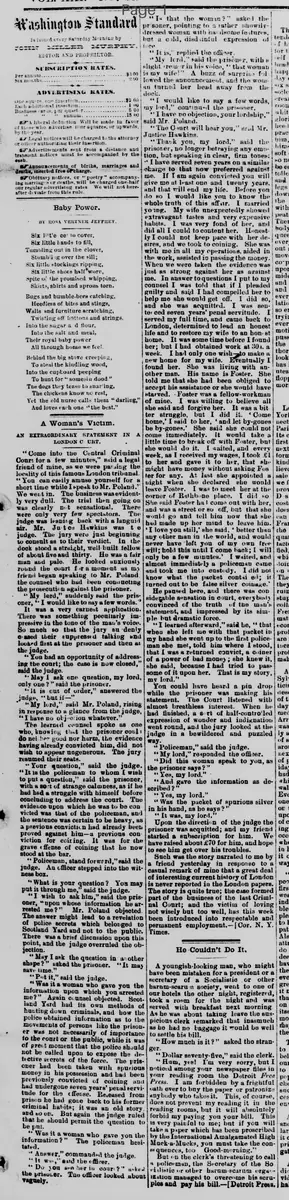
A WOMAN'S VICTIM.
AN EXTRAORDINARY STATEMENT IN LONDON COURT.
"Come into the Central Criminal Court for a few minutes," said a legal friend of mine, as we were passing the locality of this famous London tribunal. "You can easily amuse yourself for a short time while I speak to Mr. Poland."
We went in. The business was evidently very dull. The trial then going on was clearly not sensational. There were only very few spectators. The judge was leaning back with a languid air. Mr. Justice Hawkins was the judge. The jury were just beginning to consult as to their verdict. In the dock stood a straight, well-built fellow of about five and thirty. He was a fair man and pale. He looked anxiously round the court for a moment as my friend began speaking to Mr. Poland, the counsel who had been conducting the prosecution against the prisoner.
"My lord," suddenly said the prisoner, "I would like to say a few words."
It was a very earnest application. There was something peculiarly impressive in the tone of the man's voice. So much so that the jury suddenly ceased their suppressed talking and looked first at the prisoner and then at the judge.
"You had an opportunity of addressing the court; the case is now closed," said the judge.
"May I ask one question, my lord, only one?" said the prisoner.
"It is out of order," answered the judge, "but if—"
"My lord," said Mr. Poland, rising in response to a glance from the judge, "I have no objection whatever."
The learned counsel spoke as one who, knowing that the prisoner could do neither good nor harm, the evidence having already convicted him, did not wish to appear ungenerous. The jury resumed their seats.
"Your question," said the judge.
"It is the policeman to whom I wish to put a question," said the prisoner, with a sort of strange calmness, as if he had had a struggle with himself before concluding to address the court. The evidence upon which he was to be convicted was that of the policeman, and the sentence was certain to be heavy, as a previous conviction had already been proved against him—a previous conviction for coining. It was for the grave offense of coining that he now stood at the bar.
"Policeman, stand forward," said the judge. An officer stepped into the witness box.
"What is your question? You may put it through me," said the judge.
"I wish to ask him," said the prisoner, "upon whose information he arrested me?" Mr. Poland objected. The answer might lead to a revelation of police secrets which belonged to Scotland Yard and not to the public. There was a brief discussion upon this point, and the judge overruled the objection.
"May I ask the question in another shape?" asked the prisoner. "It may save time."
"Put it," said the judge.
"Was it a woman who gave you the information upon which you arrested me?" Again counsel objected. Scotland Yard had its own methods of hunting down criminals, and how the police obtained information as to the movements of persons like the prisoner was not necessarily of importance to the court or the public, while it was of great moment that the police should not be called upon to expose the detective secrets of the force. The prisoner had been taken with spurious money in his possession and had been previously convicted of coining and had undergone seven years' penal servitude for the offense. Released from prison he had gone back to his former criminal habits; it was an old story and so on. But again the judge ruled that he should permit the question to be put.
"Was it a woman who gave you the information?"
The policeman hesitated.
"Answer," commanded the judge.
"It was," said the officer.
"Do you see her in court?" asked the prisoner vaguely. The officer looked about.
"Is that the woman?" asked the prisoner, pointing to a rather showily dressed woman with handsome features, but a cold, disdainful expression of face.
"It is," replied the officer.
"My lord," said the prisoner, with a slight tremor in his voice, "that woman is my wife!" A buzz of surprise followed the announcement, and the woman turned her head away from the dock.
"I would like to say a few words, my lord," continued the prisoner.
"I have no objection, your lordship," said Mr. Poland.
"The Court will hear you," said Mr. Justice Hawkins.
"Thank you, my lord," said the prisoner, no longer betraying any emotion, but speaking in clear, firm tones: "I have served seven years on a similar charge to that now preferred against me. If I am again convicted you will give me at least one and twenty years, and that will end my life. Before you do so I would like you to know the whole truth of this affair. I married young. My wife unexpectedly showed extravagant tastes and very expensive habits. I was very fond of her, and did all I could to content her. Honestly I could not keep pace with her desires, and we took to coining. She was with me in all my operations, aided in the work, assisted in passing the money. When we were taken the evidence was just as strong against her as against me. In answer to questions I put to my counsel I was told that if I pleaded guilty and said I had compelled her to help me she would get off. I did so, and she was acquitted. I was sentenced seven years' penal servitude. I served my full time, and came back to London, determined to lead an honest life and to restore my wife to an honest home. It was some time before I found her; but I had obtained work at 30s. a week. I had only one wish—to make a new home for my wife. Eventually I found her. She was living with another man. His name is Foster. She told me that she had been obliged to accept his assistance or she would have starved. Foster was a fellow-workman of mine. I was willing to believe all she said and forgive her. It was a bitter struggle, but I did it. 'Come home,' I said to her, 'and let by-gones be by-gones.' She said she could not come immediately. It would take a little time to break off with Foster, but she would do it. I waited, and every week, as I received my wages, I took £1 to her and gave it to her, that she might have money without asking Foster for any. At last she appointed a night when she declared she would leave Foster. I was to meet her at the corner of Rathbone place. I did so. She said Foster had come out with her, and was a street or so off, but that she would go and tell him now that she had made up her mind to leave him. 'I love you still,' she said, 'better than any other man in the world, and would never have left you of my own free will; hold this until I come back; I will only be a few minutes.' I waited, and almost immediately a policeman came and took me into custody. I did not know what the packet contained; it turned out to be false silver coinage. He paused here, and there was considerable sensation in court, everybody convinced of the truth of the man's statement, and impressed by its simple but dramatic force.
"I learned afterward," said he, "that when she left me with that packet in my hand she went up to the first policeman she met, told him where I stood, that I was a returned convict, a coiner of a power of bad money; she knew it, she said, because I had tried to pass some of it upon her. That is my story, my lord."
You could have heard a pin drop while the prisoner was making his statement. The Court listened with almost breathless interest. When he had finished, a sort of half-controlled expression of wonder and indignation went round, and the jury looked at the judge in a bewildered and puzzled way.
"Policeman," said the judge.
"My lord," responded the officer.
"Did this woman speak to you, as the prisoner says?"
"Yes, my lord."
"And gave the information as described?"
"Yes, my lord."
"Was the packet of spurious silver in his hand, as he says?"
"It was, my lord."
Upon the direction of the judge the prisoner was acquitted; and my friend started a subscription for him. We have raised about £70 for him, and hope to see him get over his troubles.
Such was the story narrated to me by a friend yesterday in response to a casual remark of mine that a great deal of interesting current history of London is never reported in the London papers. The story is quite true; the case formed part of the business of the last Criminal Court; and the victim of loving not wisely but too well, has this week been introduced into respectable and permanent employment.—Cor. N. Y. Times.
AN EXTRAORDINARY STATEMENT IN LONDON COURT.
"Come into the Central Criminal Court for a few minutes," said a legal friend of mine, as we were passing the locality of this famous London tribunal. "You can easily amuse yourself for a short time while I speak to Mr. Poland."
We went in. The business was evidently very dull. The trial then going on was clearly not sensational. There were only very few spectators. The judge was leaning back with a languid air. Mr. Justice Hawkins was the judge. The jury were just beginning to consult as to their verdict. In the dock stood a straight, well-built fellow of about five and thirty. He was a fair man and pale. He looked anxiously round the court for a moment as my friend began speaking to Mr. Poland, the counsel who had been conducting the prosecution against the prisoner.
"My lord," suddenly said the prisoner, "I would like to say a few words."
It was a very earnest application. There was something peculiarly impressive in the tone of the man's voice. So much so that the jury suddenly ceased their suppressed talking and looked first at the prisoner and then at the judge.
"You had an opportunity of addressing the court; the case is now closed," said the judge.
"May I ask one question, my lord, only one?" said the prisoner.
"It is out of order," answered the judge, "but if—"
"My lord," said Mr. Poland, rising in response to a glance from the judge, "I have no objection whatever."
The learned counsel spoke as one who, knowing that the prisoner could do neither good nor harm, the evidence having already convicted him, did not wish to appear ungenerous. The jury resumed their seats.
"Your question," said the judge.
"It is the policeman to whom I wish to put a question," said the prisoner, with a sort of strange calmness, as if he had had a struggle with himself before concluding to address the court. The evidence upon which he was to be convicted was that of the policeman, and the sentence was certain to be heavy, as a previous conviction had already been proved against him—a previous conviction for coining. It was for the grave offense of coining that he now stood at the bar.
"Policeman, stand forward," said the judge. An officer stepped into the witness box.
"What is your question? You may put it through me," said the judge.
"I wish to ask him," said the prisoner, "upon whose information he arrested me?" Mr. Poland objected. The answer might lead to a revelation of police secrets which belonged to Scotland Yard and not to the public. There was a brief discussion upon this point, and the judge overruled the objection.
"May I ask the question in another shape?" asked the prisoner. "It may save time."
"Put it," said the judge.
"Was it a woman who gave you the information upon which you arrested me?" Again counsel objected. Scotland Yard had its own methods of hunting down criminals, and how the police obtained information as to the movements of persons like the prisoner was not necessarily of importance to the court or the public, while it was of great moment that the police should not be called upon to expose the detective secrets of the force. The prisoner had been taken with spurious money in his possession and had been previously convicted of coining and had undergone seven years' penal servitude for the offense. Released from prison he had gone back to his former criminal habits; it was an old story and so on. But again the judge ruled that he should permit the question to be put.
"Was it a woman who gave you the information?"
The policeman hesitated.
"Answer," commanded the judge.
"It was," said the officer.
"Do you see her in court?" asked the prisoner vaguely. The officer looked about.
"Is that the woman?" asked the prisoner, pointing to a rather showily dressed woman with handsome features, but a cold, disdainful expression of face.
"It is," replied the officer.
"My lord," said the prisoner, with a slight tremor in his voice, "that woman is my wife!" A buzz of surprise followed the announcement, and the woman turned her head away from the dock.
"I would like to say a few words, my lord," continued the prisoner.
"I have no objection, your lordship," said Mr. Poland.
"The Court will hear you," said Mr. Justice Hawkins.
"Thank you, my lord," said the prisoner, no longer betraying any emotion, but speaking in clear, firm tones: "I have served seven years on a similar charge to that now preferred against me. If I am again convicted you will give me at least one and twenty years, and that will end my life. Before you do so I would like you to know the whole truth of this affair. I married young. My wife unexpectedly showed extravagant tastes and very expensive habits. I was very fond of her, and did all I could to content her. Honestly I could not keep pace with her desires, and we took to coining. She was with me in all my operations, aided in the work, assisted in passing the money. When we were taken the evidence was just as strong against her as against me. In answer to questions I put to my counsel I was told that if I pleaded guilty and said I had compelled her to help me she would get off. I did so, and she was acquitted. I was sentenced seven years' penal servitude. I served my full time, and came back to London, determined to lead an honest life and to restore my wife to an honest home. It was some time before I found her; but I had obtained work at 30s. a week. I had only one wish—to make a new home for my wife. Eventually I found her. She was living with another man. His name is Foster. She told me that she had been obliged to accept his assistance or she would have starved. Foster was a fellow-workman of mine. I was willing to believe all she said and forgive her. It was a bitter struggle, but I did it. 'Come home,' I said to her, 'and let by-gones be by-gones.' She said she could not come immediately. It would take a little time to break off with Foster, but she would do it. I waited, and every week, as I received my wages, I took £1 to her and gave it to her, that she might have money without asking Foster for any. At last she appointed a night when she declared she would leave Foster. I was to meet her at the corner of Rathbone place. I did so. She said Foster had come out with her, and was a street or so off, but that she would go and tell him now that she had made up her mind to leave him. 'I love you still,' she said, 'better than any other man in the world, and would never have left you of my own free will; hold this until I come back; I will only be a few minutes.' I waited, and almost immediately a policeman came and took me into custody. I did not know what the packet contained; it turned out to be false silver coinage. He paused here, and there was considerable sensation in court, everybody convinced of the truth of the man's statement, and impressed by its simple but dramatic force.
"I learned afterward," said he, "that when she left me with that packet in my hand she went up to the first policeman she met, told him where I stood, that I was a returned convict, a coiner of a power of bad money; she knew it, she said, because I had tried to pass some of it upon her. That is my story, my lord."
You could have heard a pin drop while the prisoner was making his statement. The Court listened with almost breathless interest. When he had finished, a sort of half-controlled expression of wonder and indignation went round, and the jury looked at the judge in a bewildered and puzzled way.
"Policeman," said the judge.
"My lord," responded the officer.
"Did this woman speak to you, as the prisoner says?"
"Yes, my lord."
"And gave the information as described?"
"Yes, my lord."
"Was the packet of spurious silver in his hand, as he says?"
"It was, my lord."
Upon the direction of the judge the prisoner was acquitted; and my friend started a subscription for him. We have raised about £70 for him, and hope to see him get over his troubles.
Such was the story narrated to me by a friend yesterday in response to a casual remark of mine that a great deal of interesting current history of London is never reported in the London papers. The story is quite true; the case formed part of the business of the last Criminal Court; and the victim of loving not wisely but too well, has this week been introduced into respectable and permanent employment.—Cor. N. Y. Times.
What sub-type of article is it?
Crime Story
Deception Fraud
Tragedy
What themes does it cover?
Betrayal
Deception
Misfortune
What keywords are associated?
Coining Trial
Wife Betrayal
Court Acquittal
London Criminal Court
Police Informant
Returned Convict
What entities or persons were involved?
Prisoner
Prisoner's Wife
Mr. Poland
Mr. Justice Hawkins
Policeman
Foster
Where did it happen?
Central Criminal Court, London
Story Details
Key Persons
Prisoner
Prisoner's Wife
Mr. Poland
Mr. Justice Hawkins
Policeman
Foster
Location
Central Criminal Court, London
Event Date
Last Criminal Court
Story Details
A convicted coiner on trial reveals his wife, previously acquitted after he took the blame, betrayed him by planting fake coins and informing police during his attempt to reconcile; the court verifies and acquits him.