Thank you for visiting SNEWPapers!
Sign up free
The Union Daily Times
Union, Union County, South Carolina
What is this article about?
Peruvian government plans to request amplification of President Coolidge's Tacna-Arica arbitration award from the US State Department, citing Chilean atrocities and proposing a native constabulary to replace garrisons for a fair plebiscite. Washington officials believe existing provisions suffice for contesting irregularities.
Clipping
OCR Quality
Full Text
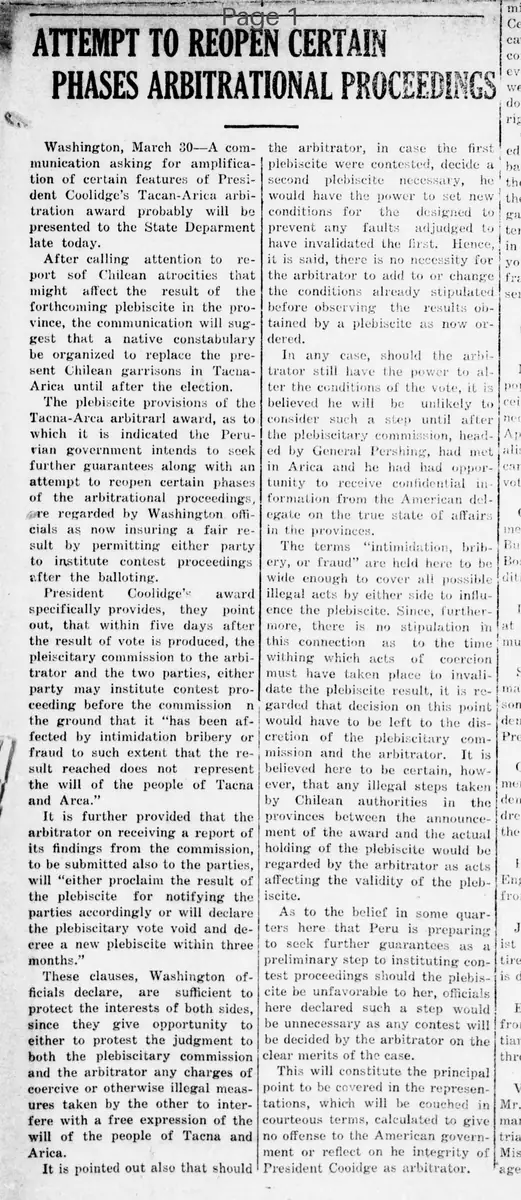
Washington, March 30. A communication asking for amplification of certain features of President Coolidge's Tacna-Arica arbitration award probably will be presented to the State Department late today.
After calling attention to reports of Chilean atrocities that might affect the result of the forthcoming plebiscite in the province, the communication will suggest that a native constabulary be organized to replace the present Chilean garrisons in Tacna-Arica until after the election.
The plebiscite provisions of the Tacna-Arica arbitrational award, as to which it is indicated the Peruvian government intends to seek further guarantees along with an attempt to reopen certain phases of the arbitrational proceedings, are regarded by Washington officials as now insuring a fair result by permitting either party to institute contest proceedings after the balloting.
President Coolidge's award specifically provides, they point out, that within five days after the result of vote is produced, the plebiscitary commission to the arbitrator and the two parties, either party may institute contest proceeding before the commission on the ground that it "has been affected by intimidation bribery or fraud to such extent that the result reached does not represent the will of the people of Tacna and Arica."
It is further provided that the arbitrator on receiving a report of its findings from the commission, to be submitted also to the parties, will "either proclaim the result of the plebiscite for notifying the parties accordingly or will declare the plebiscitary vote void and decree a new plebiscite within three months."
These clauses, Washington officials declare, are sufficient to protect the interests of both sides, since they give opportunity to either to protest the judgment to both the plebiscitary commission and the arbitrator any charges of coercive or otherwise illegal measures taken by the other to interfere with a free expression of the will of the people of Tacna and Arica.
It is pointed out also that should the arbitrator, in case the first plebiscite were contested, decide a second plebiscite necessary, he would have the power to set new conditions for the designed to prevent any faults adjudged to have invalidated the first. Hence, it is said, there is no necessity for the arbitrator to add to or change the conditions already stipulated before observing the results obtained by a plebiscite as now ordered.
In any case, should the arbitrator still have the power to alter the conditions of the vote, it is believed he will be unlikely to consider such a step until after the plebiscitary commission, headed by General Pershing, had met in Arica and he had had opportunity to receive confidential information from the American delegate on the true state of affairs in the provinces.
The terms "intimidation, bribery, or fraud" are held here to be wide enough to cover all possible illegal acts by either side to influence the plebiscite. Since, furthermore, there is no stipulation in this connection as to the time within which acts of coercion must have taken place to invalidate the plebiscite result, it is regarded that decision on this point would have to be left to the discretion of the plebiscitary commission and the arbitrator. It is believed here to be certain, however, that any illegal steps taken by Chilean authorities in the provinces between the announcement of the award and the actual holding of the plebiscite would be regarded by the arbitrator as acts affecting the validity of the plebiscite.
As to the belief in some quarters here that Peru is preparing to seek further guarantees as a preliminary step to instituting contest proceedings should the plebiscite be unfavorable to her, officials here declared such a step would be unnecessary as any contest will be decided by the arbitrator on the clear merits of the case.
This will constitute the principal point to be covered in the representations, which will be couched in courteous terms, calculated to give no offense to the American government or reflect on the integrity of President Coolidge as arbitrator.
What sub-type of article is it?
What keywords are associated?
What entities or persons were involved?
Where did it happen?
Foreign News Details
Primary Location
Tacna Arica
Event Date
March 30
Key Persons
Outcome
provisions allow contesting plebiscite results due to intimidation, bribery, or fraud; arbitrator may declare vote void and order new plebiscite within three months.
Event Details
Peruvian government to present communication to US State Department seeking amplification of Coolidge's Tacna-Arica award, highlighting Chilean atrocities and suggesting native constabulary to replace garrisons for fair plebiscite. Washington officials view existing award provisions as sufficient for protecting interests and contesting irregularities.