Thank you for visiting SNEWPapers!
Sign up free
Literary
October 27, 1901
San Antonio Daily Light
San Antonio, Bexar County, Texas
What is this article about?
During a Catholic retreat, a young woman confesses to Father John Burton that as a child, jealousy led her to deceive her sister Julie, causing the breakup of Julie's engagement to John (the priest himself) and her subsequent unhappy marriage. The priest, tormented, advises silence to spare her sister further pain, bearing the secret himself.
Clipping
OCR Quality
98%
Excellent
Full Text
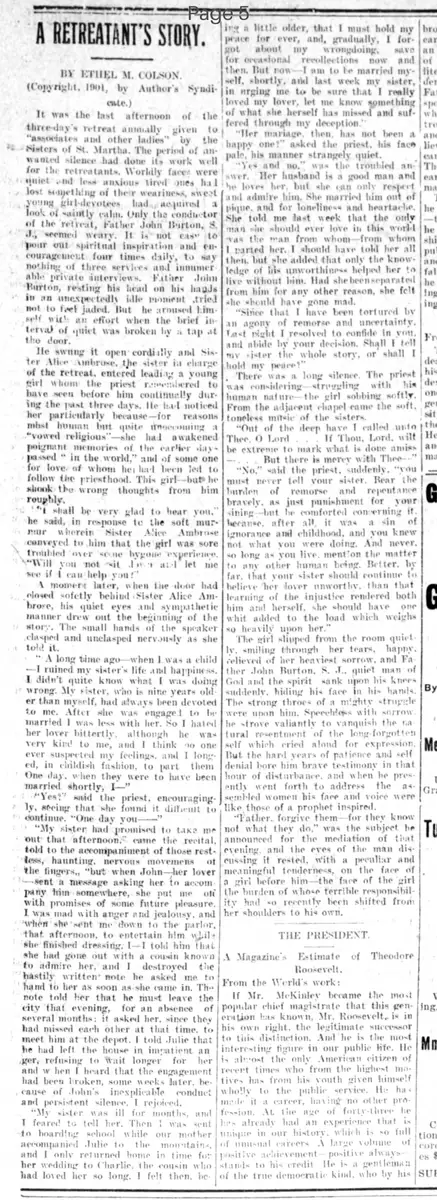
A RETREATANT'S STORY.
BY ETHEL M. COLSON.
(Copyright, 1901, by Author's Syndicate.)
It was the last afternoon of the three-day's retreat annually given to "associates and other ladies" by the Sisters of St. Martha. The period of enforced silence had done its work well for the retreatants. Worldly faces were quiet and less anxious; tired ones had lost something of their weariness; sweet young girl-devotees had acquired a look of saintly calm. Only the conductor of the retreat, Father John Burton, S. J., seemed weary. It is not easy to pour out spiritual inspiration and encouragement four times daily, to say nothing of the services and innumerable private interviews. Father John Burton, resting his head on his hands in an unexpectedly idle moment, tried not to feel jaded. But he aroused himself with an effort when the brief interval of quiet was broken by a tap at the door.
He swung it open cordially and Sister Alice Ambrose, the sister in charge of the retreat, entered leading a young girl whom the priest remembered to have seen before him continually during the past three days. He had noticed her particularly because—for reasons most human but quite unbecoming a "vowed religious"—she had awakened poignant memories of the earlier days passed "in the world," and of some one for love of whom he had been led to follow the priesthood. This girl—but he shook the wrong thoughts from him roughly.
"I shall be very glad to hear you," he said, in response to the soft murmur wherein Sister Alice Ambrose conveyed to him that the girl was sorely troubled "over some bygone experience. Will you not sit and let me see if I can help you?"
A moment later, when the door had closed softly behind Sister Alice Ambrose, his quiet eyes and sympathetic manner drew out the beginning of the story. The small hands of the speaker clasped and unclasped nervously as she told it.
"A long time ago—when I was a child—I ruined my sister's life and happiness. I didn't quite know what I was doing wrong. My sister, who is nine years older than myself, had always been devoted to me. After she was engaged to be married I was less with her. So I hated her lover bitterly, although he was very kind to me, and I think no one ever suspected my feelings, and I longed, in childish fashion, to part them.
One day, when they were to have been married shortly, I—"
"Yes?" said the priest, encouragingly, seeing that she found it difficult to continue. "One day you—"
"My sister had promised to take me out that afternoon," came the recital, told to the accompaniment of those restless, haunting, nervous movements of the fingers. "But when John—her lover—sent a message asking her to accompany him somewhere, she put me off with promises of some future pleasure. I was mad with anger and jealousy, and when she sent me down to the parlor that afternoon to entertain him while she finished dressing, I—I told him that she had gone out with a cousin known to admire her, and I destroyed the hastily written note he asked me to hand to her as soon as she came in. That note told her that he must leave the city that evening for an absence of several months; it asked her, since they had missed each other at that time, to meet him at the depot. I told Julie that he had left the house in impatient anger, refusing to wait longer for her, and when I heard that the engagement had been broken, some weeks later, because of John's inexplicable conduct and persistent silence, I rejoiced.
"My sister was ill for months, and I feared to tell her. Then I was sent to boarding school while our mother accompanied Julie to the mountains, and I only returned home in time for her wedding to Charlie, the cousin who had loved her so long. I felt then, being a little older, that I must hold my peace forever, and, gradually, I forgot about my wrongdoing, save for occasional recollections now and then. But now I am to be married myself, shortly, and last week my sister, in urging me to be sure that I really loved my lover, let me know something of what she herself has missed and suffered through my deception."
"Her marriage, then, has not been a happy one?" asked the priest, his face pale, his manner strangely quiet.
"Yes and no," was the troubled answer. "Her husband is a good man and he loves her, but she can only respect and admire him. She married him out of pique, and for loneliness and heartache. She told me last week that the only man she should ever love in this world was the man from whom—from whom I parted her. I should have told her all then, but she added that only the knowledge of his unworthiness helped her to live without him. Had she been separated from him for any other reason, she felt she should have gone mad.
"Since that I have been tortured by an agony of remorse and uncertainty. Last night I resolved to confide in you, and abide by your decision. Shall I tell my sister the whole story, or shall I hold my peace?"
There was a long silence. The priest was considering—struggling with his human nature—the girl sobbing softly. From the adjacent chapel came the soft, toneless music of the sisters.
"Out of the deep have I called unto Thee, O Lord; if Thou, Lord, wilt be extreme to mark what is done amiss, O Lord, who may abide it? But there is mercy with Thee—"
"No," said the priest suddenly. "You must never tell your sister. Bear the burden of remorse and repentance bravely, as just punishment for your sinning—but He comforted concerning it, because, after all, it was a sin of ignorance and childhood, and you knew not what you were doing. And never, so long as you live, mention the matter to any other human being. Better, by far, that your sister should continue to believe her lover unworthy, than that learning of the injustice rendered both him and herself, she should have one whit added to the load which weighs so heavily upon her."
The girl slipped from the room quietly, smiling through her tears, happy, relieved of her heaviest sorrow, and Father John Burton, S. J., quiet man of God, and the spirit sank upon his knees suddenly, hiding his face in his hands. The strong throes of a mighty struggle were upon him. Speechless with sorrow he strove valiantly to vanquish the natural resentment of the long-forgotten self which cried aloud for expression. But the hard years of patience and self-denial bore him brave testimony in that hour of disturbance, and when he presently went forth to address the assembled women his face and voice were like those of a prophet inspired.
"Father, forgive them—for they know not what they do," was the subject he announced for the meditation of that evening, and the eyes of the man discussing it rested, with a peculiar and meaningful tenderness, on the face of a girl before him—the face of the girl the burden of whose terrible responsibility had so recently been shifted from her shoulders to his own.
BY ETHEL M. COLSON.
(Copyright, 1901, by Author's Syndicate.)
It was the last afternoon of the three-day's retreat annually given to "associates and other ladies" by the Sisters of St. Martha. The period of enforced silence had done its work well for the retreatants. Worldly faces were quiet and less anxious; tired ones had lost something of their weariness; sweet young girl-devotees had acquired a look of saintly calm. Only the conductor of the retreat, Father John Burton, S. J., seemed weary. It is not easy to pour out spiritual inspiration and encouragement four times daily, to say nothing of the services and innumerable private interviews. Father John Burton, resting his head on his hands in an unexpectedly idle moment, tried not to feel jaded. But he aroused himself with an effort when the brief interval of quiet was broken by a tap at the door.
He swung it open cordially and Sister Alice Ambrose, the sister in charge of the retreat, entered leading a young girl whom the priest remembered to have seen before him continually during the past three days. He had noticed her particularly because—for reasons most human but quite unbecoming a "vowed religious"—she had awakened poignant memories of the earlier days passed "in the world," and of some one for love of whom he had been led to follow the priesthood. This girl—but he shook the wrong thoughts from him roughly.
"I shall be very glad to hear you," he said, in response to the soft murmur wherein Sister Alice Ambrose conveyed to him that the girl was sorely troubled "over some bygone experience. Will you not sit and let me see if I can help you?"
A moment later, when the door had closed softly behind Sister Alice Ambrose, his quiet eyes and sympathetic manner drew out the beginning of the story. The small hands of the speaker clasped and unclasped nervously as she told it.
"A long time ago—when I was a child—I ruined my sister's life and happiness. I didn't quite know what I was doing wrong. My sister, who is nine years older than myself, had always been devoted to me. After she was engaged to be married I was less with her. So I hated her lover bitterly, although he was very kind to me, and I think no one ever suspected my feelings, and I longed, in childish fashion, to part them.
One day, when they were to have been married shortly, I—"
"Yes?" said the priest, encouragingly, seeing that she found it difficult to continue. "One day you—"
"My sister had promised to take me out that afternoon," came the recital, told to the accompaniment of those restless, haunting, nervous movements of the fingers. "But when John—her lover—sent a message asking her to accompany him somewhere, she put me off with promises of some future pleasure. I was mad with anger and jealousy, and when she sent me down to the parlor that afternoon to entertain him while she finished dressing, I—I told him that she had gone out with a cousin known to admire her, and I destroyed the hastily written note he asked me to hand to her as soon as she came in. That note told her that he must leave the city that evening for an absence of several months; it asked her, since they had missed each other at that time, to meet him at the depot. I told Julie that he had left the house in impatient anger, refusing to wait longer for her, and when I heard that the engagement had been broken, some weeks later, because of John's inexplicable conduct and persistent silence, I rejoiced.
"My sister was ill for months, and I feared to tell her. Then I was sent to boarding school while our mother accompanied Julie to the mountains, and I only returned home in time for her wedding to Charlie, the cousin who had loved her so long. I felt then, being a little older, that I must hold my peace forever, and, gradually, I forgot about my wrongdoing, save for occasional recollections now and then. But now I am to be married myself, shortly, and last week my sister, in urging me to be sure that I really loved my lover, let me know something of what she herself has missed and suffered through my deception."
"Her marriage, then, has not been a happy one?" asked the priest, his face pale, his manner strangely quiet.
"Yes and no," was the troubled answer. "Her husband is a good man and he loves her, but she can only respect and admire him. She married him out of pique, and for loneliness and heartache. She told me last week that the only man she should ever love in this world was the man from whom—from whom I parted her. I should have told her all then, but she added that only the knowledge of his unworthiness helped her to live without him. Had she been separated from him for any other reason, she felt she should have gone mad.
"Since that I have been tortured by an agony of remorse and uncertainty. Last night I resolved to confide in you, and abide by your decision. Shall I tell my sister the whole story, or shall I hold my peace?"
There was a long silence. The priest was considering—struggling with his human nature—the girl sobbing softly. From the adjacent chapel came the soft, toneless music of the sisters.
"Out of the deep have I called unto Thee, O Lord; if Thou, Lord, wilt be extreme to mark what is done amiss, O Lord, who may abide it? But there is mercy with Thee—"
"No," said the priest suddenly. "You must never tell your sister. Bear the burden of remorse and repentance bravely, as just punishment for your sinning—but He comforted concerning it, because, after all, it was a sin of ignorance and childhood, and you knew not what you were doing. And never, so long as you live, mention the matter to any other human being. Better, by far, that your sister should continue to believe her lover unworthy, than that learning of the injustice rendered both him and herself, she should have one whit added to the load which weighs so heavily upon her."
The girl slipped from the room quietly, smiling through her tears, happy, relieved of her heaviest sorrow, and Father John Burton, S. J., quiet man of God, and the spirit sank upon his knees suddenly, hiding his face in his hands. The strong throes of a mighty struggle were upon him. Speechless with sorrow he strove valiantly to vanquish the natural resentment of the long-forgotten self which cried aloud for expression. But the hard years of patience and self-denial bore him brave testimony in that hour of disturbance, and when he presently went forth to address the assembled women his face and voice were like those of a prophet inspired.
"Father, forgive them—for they know not what they do," was the subject he announced for the meditation of that evening, and the eyes of the man discussing it rested, with a peculiar and meaningful tenderness, on the face of a girl before him—the face of the girl the burden of whose terrible responsibility had so recently been shifted from her shoulders to his own.
What sub-type of article is it?
Prose Fiction
What themes does it cover?
Religious
Moral Virtue
Love Romance
What keywords are associated?
Religious Retreat
Confession
Remorse
Jealousy
Deception
Priesthood
Forgiveness
Sisterly Love
What entities or persons were involved?
By Ethel M. Colson.
Literary Details
Title
A Retreatant's Story.
Author
By Ethel M. Colson.
Key Lines
"Father, Forgive Them—For They Know Not What They Do," Was The Subject He Announced For The Meditation Of That Evening, And The Eyes Of The Man Discussing It Rested, With A Peculiar And Meaningful Tenderness, On The Face Of A Girl Before Him—The Face Of The Girl The Burden Of Whose Terrible Responsibility Had So Recently Been Shifted From Her Shoulders To His Own.
"Out Of The Deep Have I Called Unto Thee, O Lord; If Thou, Lord, Wilt Be Extreme To Mark What Is Done Amiss, O Lord, Who May Abide It? But There Is Mercy With Thee—"