Thank you for visiting SNEWPapers!
Sign up free
Poem
December 17, 1818
Richmond Enquirer
Richmond, Richmond County, Virginia
What is this article about?
Poem 'The Yellow Leaf' reflects on a falling leaf as a symbol of life's transience and coming sorrows, set in a summer scene turning to autumn. Followed by a detailed 1817 newspaper report on the acquittal of Commodore Thomas Taylor in a U.S. federal piracy trial involving privateering under Buenos Ayres commission against Spanish vessels.
Clipping
OCR Quality
88%
Good
Full Text
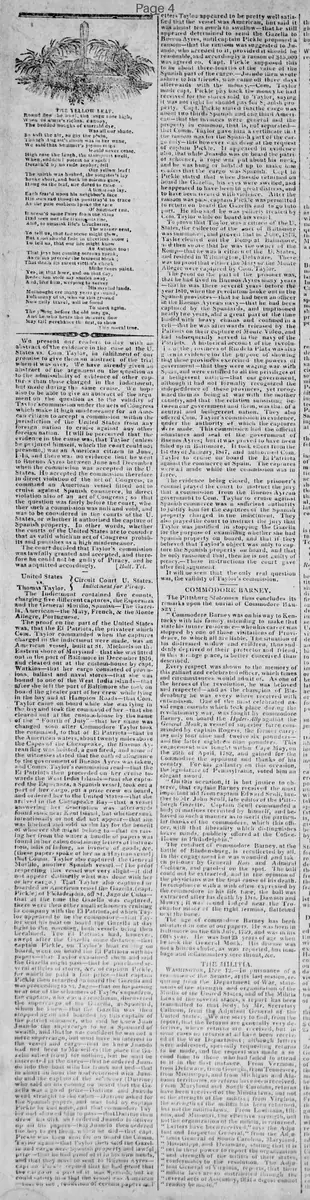
The Yellow Leaf.
Round lay the yellow leaf;
The boughs did lose their high,
When summer's richest canopy
The bedded boughs of emerald dye
Was all our shade.
So soft the air, so gay the plain,
Though August's moon was in her wane,
We said that summer's joyous reign
Would never cease.
High rose the laugh, the songsters swell,
When, sudden! potent as a spell,
Detach'd by no rude zephyr, fell
One yellow leaf.
The mirth was hush'd, the songster's lay
Broke short, and back in solemn gaze
Hung on the leaf, nor dared to raise
A timorous lay.
Each fear'd upon his neighbor's face
His own sad thoughts pourtray'd to trace,
As the pale emblem spoke the waste
Of summer run.
I deem'd some Fairy from the skies
Had seen our idle transports rise,
And, to unmask life's treacheries,
The warner sent,
To tell us, that the scene might glow,
But so 'twould fade in cheerless snow;
To tell us, that our hearts might know
An Autumn too:
That joys but coming sorrows speak,
As calms precede the tempest bleak;
That death its surest victim's cheek
Blithe roses paint.
Yes, in that hour, and on that day,
Reflection stole my smiles away.
And, like him, weeping to survey
His myriad lands.
Methought ere many years go round,
Few of us, who on this ground
Now gaily travel, will be found
To meet again.
The young before the old may go,
And he who hears this measure now
May fail perchance the first, to show
This moral tune.
We present our readers today with an abstract of the evidence in the case of the United States vs. Com. Taylor, in fulfilment of our promise to give them an abstract of the trial when it was over. We have already given an abstract of the argument on the question as to the admissibility of evidence of other captures than those charged in the indictment, but made during the same cruise. We hope also to be able to give an abstract of the argument on the question as to the validity of Taylor's commission under the acts of Congress which make it high misdemeanor for an American citizen to accept a commission within the jurisdiction of the United States from any foreign nation to cruise against any other foreign nation. It will be perceived that the evidence in the cause was, that Taylor (unless he perjured himself, which the court could not presume,) was an American citizen in June, 1816, and there was no evidence that he went to Buenos Ayres between June and December when the commission was accepted in the United States. He accepted the commission therefore in direct violation of the act of Congress, to command an American vessel fitted out to cruise against Spanish commerce. In direct violation also of an act of Congress; so that the question was fairly before the court, whether such a commission was null and void, and was to be considered in the courts of the United States, or whether it authorised the capture of Spanish property. In other words, whether the courts of the United States are to consider that as valid which an act of Congress prohibits and punishes as a high misdemeanor. The court decided that Taylor's commission was lawfully granted and accepted, and therefore he could not be guilty of Piracy. And he was acquitted accordingly.
[Balt. Tel.
Thomas Taylor.
United States
vs.
Circuit Court United States.
Indictment for Piracy.
The Indictment contained five counts, charging five different captures, the Esperanza and the General Morillo, Spanish—The Gazella, American—the Mary, French, & the Monte Allegre, Portuguese.
The proof on the part of the United States was, that the El Patriota, the privateer which Com. Taylor commanded when the captures charged in the indictment were made, was an American vessel, built at St. Michaels on the Eastern shore of Maryland—that she was fitted out in the port of Baltimore in December 1816, and cleared out at the custom-house by capt. Watkins—that her cargo consisted of provisions, ballast and naval stores—that she was bound to one of the West India islands—that after she left the port of Baltimore she took on board the greater part of her crew while lying in the bay and at Hampton Roads—that Com. Taylor came on board while she was lying in the bay and took the command of her—that she cleared out at the custom-house by the name of the "Fourth of July"—that her name was changed soon after Commodore Taylor took the command, to that of El Patriota—that in the American waters, about twenty miles above the Capes of the Chesapeake, the Buenos Ayrean flag was hoisted, a gun fired, and some of the witnesses stated that the oath of allegiance to the government of Buenos Ayres was taken, and Comm. Taylor's commission read—that the El Patriota then proceeded on her cruise towards the West India Islands—that she captured the Esperanza, a Spanish vessel, took out a part of her cargo, put a prize crew on board, and ordered her to the United States—that she arrived in the Chesapeake Bay—that a vessel answering her description was afterwards found sunk near Kent Island, but whether intentionally or not did not appear—that she was libelled and sold as she lay for the benefit of whoever she might belong to—that on raising her from the water a bundle of papers was found in her cabin containing letters of instruction, bills of lading, an invoice of goods, &c. (these papers spoke of her as a Haytian vessel)—that Comm. Taylor also captured the General Morillo, another Spanish vessel.—(The proof respecting this vessel was very slight—it did not appear distinctly what was done with her or her cargo.). That Taylor also captured or boarded an American vessel the Gazella.(capt. Pickle) of Philadelphia, off St. Jago de Cuba—that at the time the Gazella was captured, there were then other small schooners cruising in company with the El Patriota, of which Taylor appeared to be the commodore—that Taylor sent his boat on board the Gazella at daylight in the morning, both vessels being then becalmed. The El Patriota had, however, swept after the Gazella some distance that Captain Pickle, on Taylor's boat coming on board, went on board the El Patriota with his papers—that Taylor examined them and said the Gazella might pass—that he purchased several articles of stores, &c. of captain Pickle, for which he paid a fair price—that captain Pickle then returned on board the Gazella and was proceeding to St. Jago—that on his passing near one of the schooners of Taylor's squadron, the capt., who was a Frenchman, discovered the supercargo of the Gazella, a Spaniard, whom he knew—that the Gazella was then stopped again and boarded by this captain of the patriot schooner, who said he knew Juan Juando the supercargo to be a Spaniard of wealth, and that he was confident he was not a mere supercargo, but must have an interest in the vessel and cargo—that he knew Juando had not been to Marseilles (the place the Gazella sailed from) for nothing, but he must be interested in the cargo—that he ordered Juan. do into the boat with his trunk and bed—that in about an hour she had returned with Juan. do and the capt. of the schooner (Dutrine) who said on his coming on board that the Gaz: ella was a good prize—Dutrine and Juando went straight to the cabin—Dutrine asked for the Spanish papers, and was told by captain Pickle he had none, and that commodore Taylor had allowed him to pass—that Dutrine then drew his dirk and ordered Juando to deliver up all his papers—that Juando then ordered the boy to get them. when he did—that capt. Pickle was then sent for on board the Comm. Taylor again—that Taylor then said the Gazel. la and cargo were Spanish property and lawful prize—that he had proof of it in his own hands. and that they must be sent to Buenos Ayres— Capt. Pickle replied that he had proof that the cargo a part of it was British, but he could satisfy any one that the vessel was American —that on the production of certain papers letters Taylor appeared to be pretty well satisfied that the vessel was American. but said it was almost too much to swallow—that he still appeared determined to send the Gazella to Buenos Ayres, until captain Pickle proposed a ransom—that the ransom was suggested to Ju. ando, who acceded to it, provided it should be reasonable, and accordingly a ransom of $15,000 was agreed on. Capt. Pickle supposed this to be about three-fourths of the value of the Spanish part of the cargo.—Juando then wrote ashore to his friends, who came off three days afterwards with the money.—Com. Taylor made capt. Pickle pay back the money he had received for the stores sold to Taylor, saying it was not right he should pay for Spanish pro. perty. Capt. Pickle stated that the cargo was about two thirds Spanish and one third American. etc.—that the invoices were general and the property in common, that is, not separated—that Comm. Taylor gave him a certificate that the ransom was for the Spanish part of the car. go only—this however was done at the request of captain Pickle. It appeared in evidence also, that while Juando was on board the patri. ot schooner, a rope was put about his neck, and he was hung or hoisted up to make him confess that the cargo was Spanish. Capt. Pickle stated that when Juando returned on board the Gazella, his eyes were swelled, and he appeared to have been in great distress, and to have been treated with violence. After the ransom was paid. captain Pickle was permitted to return on board the Gazella and to go into port. He also said he was politely treated by Com. Taylor while on board his vessel. To prove that Taylor was a citizen of the United States, the collector of the port of Baltimore was summoned, and proved that in June, 1816, Taylor cleared out the Romp at Baltimore, and then swore that he was the owner of the Romp—that he was a citizen of the United States. and resided in Wilmington, Delaware. There was no proof that either the Mary or the Monte Allegre were captured by Com. Taylor. The proof on the part of the prisoner was, that he had lived in Buenos Ayres many years —that he was there several years before the year 1810, when the revolution broke out in the Spanish provinces—that he had been an officer in the Buenos Ayrean navy—that he had been captured by the Spaniards, and imprisoned nearly two years, and a great part of the time loaded with heavy chains and confined in a cell—that he was afterwards released by the Patriots on their capture of Monte Video, and had subsequently served in the navy of the Patriots. A historical account of the revolu. tion in the provinces of Rio de la Plata was also given in evidence for the purpose of showing that these provinces exercised the powers of government—that they were waging war with Spain, and were entitled to all the privileges of a belligerent nation—that our government, although it had not formally recognized the independence of these provinces, yet recog. nized them as being at war with the mother country, and that the relation subsisting be. tween our government and them, was that of a neutral and belligerent nation. They also offered Com. Taylor's commission in evidence, under the authority of which the captures were made. This commission had the official signatures and seal of the government of Buenos Ayres; but it was proved to have been filled up in Baltimore. It took effect from the 1st day of January, 1817, and authorised Com. Taylor to cruise on board the El Patriota against the commerce of Spain. The captures were all made while the commission was in force. The evidence being closed, the prisoner's counsel prayed the court to instruct the jury that a commission from the Buenos Ayrean government to Com. Taylor to cruise against Spanish commerce was a sufficient authority to justify him for the captures of the Spanish property charged in the indictment. They also prayed the court to instruct the jury that Taylor was justified in stopping the Gazella for the purpose of examining whether she had Spanish property on board, and that if they believed that Taylor's object was only to capture the Spanish property on board, and that he only ransomed that, then he is not guilty of piracy.—These instructions the court gave after full argument. It will be seen that the only real question was, the validity of Taylor's commission.
Round lay the yellow leaf;
The boughs did lose their high,
When summer's richest canopy
The bedded boughs of emerald dye
Was all our shade.
So soft the air, so gay the plain,
Though August's moon was in her wane,
We said that summer's joyous reign
Would never cease.
High rose the laugh, the songsters swell,
When, sudden! potent as a spell,
Detach'd by no rude zephyr, fell
One yellow leaf.
The mirth was hush'd, the songster's lay
Broke short, and back in solemn gaze
Hung on the leaf, nor dared to raise
A timorous lay.
Each fear'd upon his neighbor's face
His own sad thoughts pourtray'd to trace,
As the pale emblem spoke the waste
Of summer run.
I deem'd some Fairy from the skies
Had seen our idle transports rise,
And, to unmask life's treacheries,
The warner sent,
To tell us, that the scene might glow,
But so 'twould fade in cheerless snow;
To tell us, that our hearts might know
An Autumn too:
That joys but coming sorrows speak,
As calms precede the tempest bleak;
That death its surest victim's cheek
Blithe roses paint.
Yes, in that hour, and on that day,
Reflection stole my smiles away.
And, like him, weeping to survey
His myriad lands.
Methought ere many years go round,
Few of us, who on this ground
Now gaily travel, will be found
To meet again.
The young before the old may go,
And he who hears this measure now
May fail perchance the first, to show
This moral tune.
We present our readers today with an abstract of the evidence in the case of the United States vs. Com. Taylor, in fulfilment of our promise to give them an abstract of the trial when it was over. We have already given an abstract of the argument on the question as to the admissibility of evidence of other captures than those charged in the indictment, but made during the same cruise. We hope also to be able to give an abstract of the argument on the question as to the validity of Taylor's commission under the acts of Congress which make it high misdemeanor for an American citizen to accept a commission within the jurisdiction of the United States from any foreign nation to cruise against any other foreign nation. It will be perceived that the evidence in the cause was, that Taylor (unless he perjured himself, which the court could not presume,) was an American citizen in June, 1816, and there was no evidence that he went to Buenos Ayres between June and December when the commission was accepted in the United States. He accepted the commission therefore in direct violation of the act of Congress, to command an American vessel fitted out to cruise against Spanish commerce. In direct violation also of an act of Congress; so that the question was fairly before the court, whether such a commission was null and void, and was to be considered in the courts of the United States, or whether it authorised the capture of Spanish property. In other words, whether the courts of the United States are to consider that as valid which an act of Congress prohibits and punishes as a high misdemeanor. The court decided that Taylor's commission was lawfully granted and accepted, and therefore he could not be guilty of Piracy. And he was acquitted accordingly.
[Balt. Tel.
Thomas Taylor.
United States
vs.
Circuit Court United States.
Indictment for Piracy.
The Indictment contained five counts, charging five different captures, the Esperanza and the General Morillo, Spanish—The Gazella, American—the Mary, French, & the Monte Allegre, Portuguese.
The proof on the part of the United States was, that the El Patriota, the privateer which Com. Taylor commanded when the captures charged in the indictment were made, was an American vessel, built at St. Michaels on the Eastern shore of Maryland—that she was fitted out in the port of Baltimore in December 1816, and cleared out at the custom-house by capt. Watkins—that her cargo consisted of provisions, ballast and naval stores—that she was bound to one of the West India islands—that after she left the port of Baltimore she took on board the greater part of her crew while lying in the bay and at Hampton Roads—that Com. Taylor came on board while she was lying in the bay and took the command of her—that she cleared out at the custom-house by the name of the "Fourth of July"—that her name was changed soon after Commodore Taylor took the command, to that of El Patriota—that in the American waters, about twenty miles above the Capes of the Chesapeake, the Buenos Ayrean flag was hoisted, a gun fired, and some of the witnesses stated that the oath of allegiance to the government of Buenos Ayres was taken, and Comm. Taylor's commission read—that the El Patriota then proceeded on her cruise towards the West India Islands—that she captured the Esperanza, a Spanish vessel, took out a part of her cargo, put a prize crew on board, and ordered her to the United States—that she arrived in the Chesapeake Bay—that a vessel answering her description was afterwards found sunk near Kent Island, but whether intentionally or not did not appear—that she was libelled and sold as she lay for the benefit of whoever she might belong to—that on raising her from the water a bundle of papers was found in her cabin containing letters of instruction, bills of lading, an invoice of goods, &c. (these papers spoke of her as a Haytian vessel)—that Comm. Taylor also captured the General Morillo, another Spanish vessel.—(The proof respecting this vessel was very slight—it did not appear distinctly what was done with her or her cargo.). That Taylor also captured or boarded an American vessel the Gazella.(capt. Pickle) of Philadelphia, off St. Jago de Cuba—that at the time the Gazella was captured, there were then other small schooners cruising in company with the El Patriota, of which Taylor appeared to be the commodore—that Taylor sent his boat on board the Gazella at daylight in the morning, both vessels being then becalmed. The El Patriota had, however, swept after the Gazella some distance that Captain Pickle, on Taylor's boat coming on board, went on board the El Patriota with his papers—that Taylor examined them and said the Gazella might pass—that he purchased several articles of stores, &c. of captain Pickle, for which he paid a fair price—that captain Pickle then returned on board the Gazella and was proceeding to St. Jago—that on his passing near one of the schooners of Taylor's squadron, the capt., who was a Frenchman, discovered the supercargo of the Gazella, a Spaniard, whom he knew—that the Gazella was then stopped again and boarded by this captain of the patriot schooner, who said he knew Juan Juando the supercargo to be a Spaniard of wealth, and that he was confident he was not a mere supercargo, but must have an interest in the vessel and cargo—that he knew Juando had not been to Marseilles (the place the Gazella sailed from) for nothing, but he must be interested in the cargo—that he ordered Juan. do into the boat with his trunk and bed—that in about an hour she had returned with Juan. do and the capt. of the schooner (Dutrine) who said on his coming on board that the Gaz: ella was a good prize—Dutrine and Juando went straight to the cabin—Dutrine asked for the Spanish papers, and was told by captain Pickle he had none, and that commodore Taylor had allowed him to pass—that Dutrine then drew his dirk and ordered Juando to deliver up all his papers—that Juando then ordered the boy to get them. when he did—that capt. Pickle was then sent for on board the Comm. Taylor again—that Taylor then said the Gazel. la and cargo were Spanish property and lawful prize—that he had proof of it in his own hands. and that they must be sent to Buenos Ayres— Capt. Pickle replied that he had proof that the cargo a part of it was British, but he could satisfy any one that the vessel was American —that on the production of certain papers letters Taylor appeared to be pretty well satisfied that the vessel was American. but said it was almost too much to swallow—that he still appeared determined to send the Gazella to Buenos Ayres, until captain Pickle proposed a ransom—that the ransom was suggested to Ju. ando, who acceded to it, provided it should be reasonable, and accordingly a ransom of $15,000 was agreed on. Capt. Pickle supposed this to be about three-fourths of the value of the Spanish part of the cargo.—Juando then wrote ashore to his friends, who came off three days afterwards with the money.—Com. Taylor made capt. Pickle pay back the money he had received for the stores sold to Taylor, saying it was not right he should pay for Spanish pro. perty. Capt. Pickle stated that the cargo was about two thirds Spanish and one third American. etc.—that the invoices were general and the property in common, that is, not separated—that Comm. Taylor gave him a certificate that the ransom was for the Spanish part of the car. go only—this however was done at the request of captain Pickle. It appeared in evidence also, that while Juando was on board the patri. ot schooner, a rope was put about his neck, and he was hung or hoisted up to make him confess that the cargo was Spanish. Capt. Pickle stated that when Juando returned on board the Gazella, his eyes were swelled, and he appeared to have been in great distress, and to have been treated with violence. After the ransom was paid. captain Pickle was permitted to return on board the Gazella and to go into port. He also said he was politely treated by Com. Taylor while on board his vessel. To prove that Taylor was a citizen of the United States, the collector of the port of Baltimore was summoned, and proved that in June, 1816, Taylor cleared out the Romp at Baltimore, and then swore that he was the owner of the Romp—that he was a citizen of the United States. and resided in Wilmington, Delaware. There was no proof that either the Mary or the Monte Allegre were captured by Com. Taylor. The proof on the part of the prisoner was, that he had lived in Buenos Ayres many years —that he was there several years before the year 1810, when the revolution broke out in the Spanish provinces—that he had been an officer in the Buenos Ayrean navy—that he had been captured by the Spaniards, and imprisoned nearly two years, and a great part of the time loaded with heavy chains and confined in a cell—that he was afterwards released by the Patriots on their capture of Monte Video, and had subsequently served in the navy of the Patriots. A historical account of the revolu. tion in the provinces of Rio de la Plata was also given in evidence for the purpose of showing that these provinces exercised the powers of government—that they were waging war with Spain, and were entitled to all the privileges of a belligerent nation—that our government, although it had not formally recognized the independence of these provinces, yet recog. nized them as being at war with the mother country, and that the relation subsisting be. tween our government and them, was that of a neutral and belligerent nation. They also offered Com. Taylor's commission in evidence, under the authority of which the captures were made. This commission had the official signatures and seal of the government of Buenos Ayres; but it was proved to have been filled up in Baltimore. It took effect from the 1st day of January, 1817, and authorised Com. Taylor to cruise on board the El Patriota against the commerce of Spain. The captures were all made while the commission was in force. The evidence being closed, the prisoner's counsel prayed the court to instruct the jury that a commission from the Buenos Ayrean government to Com. Taylor to cruise against Spanish commerce was a sufficient authority to justify him for the captures of the Spanish property charged in the indictment. They also prayed the court to instruct the jury that Taylor was justified in stopping the Gazella for the purpose of examining whether she had Spanish property on board, and that if they believed that Taylor's object was only to capture the Spanish property on board, and that he only ransomed that, then he is not guilty of piracy.—These instructions the court gave after full argument. It will be seen that the only real question was, the validity of Taylor's commission.
What sub-type of article is it?
Ode
Ballad
What themes does it cover?
Nature Seasons
Death Mourning
Moral Virtue
What keywords are associated?
Yellow Leaf
Autumn Transience
Summer Joy
Life Sorrows
Mortality Reflection
Poem Details
Title
The Yellow Leaf.
Form / Style
Rhymed Stanzas
Key Lines
When, Sudden! Potent As A Spell,
Detach'd By No Rude Zephyr, Fell
One Yellow Leaf.
That Joys But Coming Sorrows Speak,
As Calms Precede The Tempest Bleak;
That Death Its Surest Victim's Cheek
Blithe Roses Paint.