Thank you for visiting SNEWPapers!
Sign up free
Editorial
August 28, 1811
Alexandria Daily Gazette, Commercial & Political
Alexandria, Virginia
What is this article about?
An editorial communication criticizes the Enquirer editor's obvious statements on Maryland elections, laments poor journalism in American papers, and shares a biography from the Baltimore Federal Republican detailing General Armstrong's sarcastic views on inept diplomatic appointees like Erving, Barlow, Warden, and Colvin, highlighting Jefferson's undue influence over President Madison in foreign appointments.
Clipping
OCR Quality
95%
Excellent
Full Text
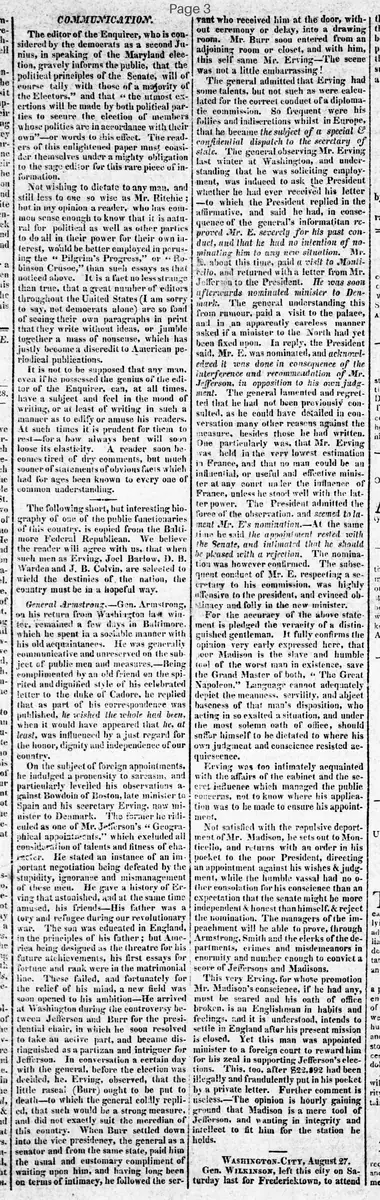
COMMUNICATION.
The editor of the Enquirer, who is considered by the democrats as a second Junius, in speaking of the Maryland election, gravely informs the public, that the political principles of the Senate, will of course tally with those of a majority of the Electors," and that "the utmost exertions will be made by both political parties to secure the election of members whose politics are in accordance with their own" or words to this effect. The readers of this enlightened paper must consider themselves under a mighty obligation to the sage editor for this rare piece of information.
Not wishing to dictate to any man, and still less to one so wise as Mr. Ritchie; but in my opinion a reader, who has common sense enough to know that it is natural for political as well as other parties to do all in their power for their own interest, would be better employed in perusing the "Pilgrim's Progress," or "Robinson Crusoe," than such essays as that noticed above. It is a fact no less strange than true, that a great number of editors throughout the United States (I am sorry to say, not democrats alone) are so fond of seeing their own paragraphs in print that they write without ideas, or jumble together a mass of nonsense, which has justly become a discredit to American periodical publications.
It is not to be supposed that any man, even if he possessed the genius of the editor of the Enquirer, can, at all times, have a subject and feel in the mood of writing, or at least of writing in such a manner as to edify or amuse his readers. At such times it is prudent for them to rest--for a bow always bent will soon lose its elasticity. A reader soon becomes tired of dry comments, but much sooner of statements of obvious facts which had for ages been known to every one of common understanding.
The following short, but interesting biography of one of the public functionaries of this country, is copied from the Baltimore Federal Republican. We believe the reader will agree with us, that when such men as Erving, Joel Barlow, D. B. Warden and J. B. Colvin, are selected to wield the destinies of the nation, the country must be in a hopeful way.
General Armstrong.--Gen. Armstrong, on his return from Washington last winter, remained a few days in Baltimore, which he spent in a sociable manner with his old acquaintances. He was generally communicative and unreserved on the subject of public men and measures.--Being complimented by an old friend on the spirited and dignified style of his celebrated letter to the duke of Cadore, he replied that as part of his correspondence was published, he wished the whole had been, when it would have appeared that he, at least, was influenced by a just regard for the honor, dignity and independence of our country.
On the subject of foreign appointments, he indulged a propensity to sarcasm, and particularly levelled his observations against Bowdoin of Boston, late minister to Spain and his secretary Erving, now minister to Denmark. The former he ridiculed as one of Mr. Jefferson's "Geographical appointments," which excluded all consideration of talents and fitness of character. He stated an instance of an important negotiation being defeated by the stupidity, ignorance and mismanagement of these men. He gave a history of Erving that astonished, and at the same time amused, his friends--His father was a tory and refugee during our revolutionary war. The son was educated in England, in the principles of his father: but America being designed as the theatre for his future achievements, his first essays for fortune and rank were in the matrimonial line. These failed, and fortunately for the relief of his mind, a new field was soon opened to his ambition--He arrived at Washington during the controversy between Jefferson and Burr for the presidential chair, in which he soon resolved to take an active part, and became distinguished as a partizan and intriguer for Jefferson. In conversation a certain day with the general, before the election was decided, he, Erving, observed, that the little rascal (Burr) ought to be put to death--to which the general coolly replied, that such would be a strong measure, and did not exactly suit the meridian of this country. When Burr settled down into the vice presidency, the general as a senator and from the same state, paid him the usual and customary compliment of waiting upon him, and having long been on terms of intimacy, he followed the servant who received him at the door, without ceremony or delay, into a drawing room. Mr. Burr soon entered from an adjoining room or closet, and with him, this self same Mr. Erving--The scene was not a little embarrassing!
The general admitted that Erving had some talents, but not such as were calculated for the correct conduct of a diplomatic commission. So frequent were his follies and indiscretions whilst in Europe, that he became the subject of a special & confidential dispatch to the secretary of state. The general observing Mr. Erving last winter at Washington, and understanding that he was soliciting employment, was induced to ask the President whether he had ever received his letter to which the President replied in the affirmative, and said he had, in consequence of the general's information reproved Mr. E. severely for his past conduct, and that he had no intention of nominating him to any new situation. Mr. W. about this time, paid a visit to Monticello, and returned with a letter from Mr. Jefferson to the President. He was soon afterwards nominated minister to Denmark. The general understanding this from rumour, paid a visit to the palace, and in an apparently careless manner asked if a minister to the North had yet been fixed upon. In reply, the President said, Mr. E. was nominated, and acknowledged it was done in consequence of the interference and recommendation of Mr. Jefferson, in opposition to his own judgment. The general lamented and regretted that he had not been previously consulted, as he could have detailed in conversation many other reasons against the measure, besides those he had written. One particularly was, that Mr. Erving was held in the very lowest estimation in France, and that no man could be an influential, or useful and effective minister at any court under the influence of France, unless he stood well with the latter power. The President admitted the force of the observation, and seemed to lament Mr. E's nomination.--At the same time he said the appointment rested with the Senate, and intimated that he should be pleased with a rejection. The nomination was however confirmed. The subsequent conduct of Mr. E. respecting a secretary to his commission, was highly offensive to the president, and evinced obstinacy and folly in the new minister.
For the accuracy of the above statement is pledged the veracity of a distinguished gentleman. It fully confirms the opinion very early expressed here, that poor Madison is the slave and humble tool of the worst man in existence, save the Grand Master of both, "The Great Napoleon." Language cannot adequately depict the meanness, servility, and abject baseness of that man's disposition, who acting in so exalted a situation, and under the most solemn oath of office, should suffer himself to be dictated to where his own judgment and conscience resisted acquiescence.
Erving was too intimately acquainted with the affairs of the cabinet and the secret influence which managed the public concerns, not to know where his application was to be made to ensure his appointment.
Not satisfied with the repulsive deportment of Mr. Madison, he sets out to Monticello, and returns with an order in his pocket to the poor President, directing an appointment against his wishes & judgment, while the humble vassal had no other consolation for his conscience than an expectation that the senate might be more independent & honest than himself, & reject the nomination. The managers of the impeachment will be able to prove, through Armstrong, Smith and the clerks of the departments, crimes and misdemeanors in enormity and number enough to convict a score of Jeffersons and Madisons.
This very Erving, for whose promotion Mr. Madison's conscience, if he had any, must be scared and his oath of office broken, is an Englishman in habits and feelings, and it is understood, intends to settle in England after his present mission is closed. Yet this man was appointed minister to a foreign court to reward him for his zeal in supporting Jefferson's election. This, too, after $22,092 had been illegally and fraudulently put in his pocket by a private letter. Further comment is useless.--The opinion is hourly gaining ground that Madison is a mere tool of Jefferson, and wanting in integrity and intellect to fit him for the station he holds.
The editor of the Enquirer, who is considered by the democrats as a second Junius, in speaking of the Maryland election, gravely informs the public, that the political principles of the Senate, will of course tally with those of a majority of the Electors," and that "the utmost exertions will be made by both political parties to secure the election of members whose politics are in accordance with their own" or words to this effect. The readers of this enlightened paper must consider themselves under a mighty obligation to the sage editor for this rare piece of information.
Not wishing to dictate to any man, and still less to one so wise as Mr. Ritchie; but in my opinion a reader, who has common sense enough to know that it is natural for political as well as other parties to do all in their power for their own interest, would be better employed in perusing the "Pilgrim's Progress," or "Robinson Crusoe," than such essays as that noticed above. It is a fact no less strange than true, that a great number of editors throughout the United States (I am sorry to say, not democrats alone) are so fond of seeing their own paragraphs in print that they write without ideas, or jumble together a mass of nonsense, which has justly become a discredit to American periodical publications.
It is not to be supposed that any man, even if he possessed the genius of the editor of the Enquirer, can, at all times, have a subject and feel in the mood of writing, or at least of writing in such a manner as to edify or amuse his readers. At such times it is prudent for them to rest--for a bow always bent will soon lose its elasticity. A reader soon becomes tired of dry comments, but much sooner of statements of obvious facts which had for ages been known to every one of common understanding.
The following short, but interesting biography of one of the public functionaries of this country, is copied from the Baltimore Federal Republican. We believe the reader will agree with us, that when such men as Erving, Joel Barlow, D. B. Warden and J. B. Colvin, are selected to wield the destinies of the nation, the country must be in a hopeful way.
General Armstrong.--Gen. Armstrong, on his return from Washington last winter, remained a few days in Baltimore, which he spent in a sociable manner with his old acquaintances. He was generally communicative and unreserved on the subject of public men and measures.--Being complimented by an old friend on the spirited and dignified style of his celebrated letter to the duke of Cadore, he replied that as part of his correspondence was published, he wished the whole had been, when it would have appeared that he, at least, was influenced by a just regard for the honor, dignity and independence of our country.
On the subject of foreign appointments, he indulged a propensity to sarcasm, and particularly levelled his observations against Bowdoin of Boston, late minister to Spain and his secretary Erving, now minister to Denmark. The former he ridiculed as one of Mr. Jefferson's "Geographical appointments," which excluded all consideration of talents and fitness of character. He stated an instance of an important negotiation being defeated by the stupidity, ignorance and mismanagement of these men. He gave a history of Erving that astonished, and at the same time amused, his friends--His father was a tory and refugee during our revolutionary war. The son was educated in England, in the principles of his father: but America being designed as the theatre for his future achievements, his first essays for fortune and rank were in the matrimonial line. These failed, and fortunately for the relief of his mind, a new field was soon opened to his ambition--He arrived at Washington during the controversy between Jefferson and Burr for the presidential chair, in which he soon resolved to take an active part, and became distinguished as a partizan and intriguer for Jefferson. In conversation a certain day with the general, before the election was decided, he, Erving, observed, that the little rascal (Burr) ought to be put to death--to which the general coolly replied, that such would be a strong measure, and did not exactly suit the meridian of this country. When Burr settled down into the vice presidency, the general as a senator and from the same state, paid him the usual and customary compliment of waiting upon him, and having long been on terms of intimacy, he followed the servant who received him at the door, without ceremony or delay, into a drawing room. Mr. Burr soon entered from an adjoining room or closet, and with him, this self same Mr. Erving--The scene was not a little embarrassing!
The general admitted that Erving had some talents, but not such as were calculated for the correct conduct of a diplomatic commission. So frequent were his follies and indiscretions whilst in Europe, that he became the subject of a special & confidential dispatch to the secretary of state. The general observing Mr. Erving last winter at Washington, and understanding that he was soliciting employment, was induced to ask the President whether he had ever received his letter to which the President replied in the affirmative, and said he had, in consequence of the general's information reproved Mr. E. severely for his past conduct, and that he had no intention of nominating him to any new situation. Mr. W. about this time, paid a visit to Monticello, and returned with a letter from Mr. Jefferson to the President. He was soon afterwards nominated minister to Denmark. The general understanding this from rumour, paid a visit to the palace, and in an apparently careless manner asked if a minister to the North had yet been fixed upon. In reply, the President said, Mr. E. was nominated, and acknowledged it was done in consequence of the interference and recommendation of Mr. Jefferson, in opposition to his own judgment. The general lamented and regretted that he had not been previously consulted, as he could have detailed in conversation many other reasons against the measure, besides those he had written. One particularly was, that Mr. Erving was held in the very lowest estimation in France, and that no man could be an influential, or useful and effective minister at any court under the influence of France, unless he stood well with the latter power. The President admitted the force of the observation, and seemed to lament Mr. E's nomination.--At the same time he said the appointment rested with the Senate, and intimated that he should be pleased with a rejection. The nomination was however confirmed. The subsequent conduct of Mr. E. respecting a secretary to his commission, was highly offensive to the president, and evinced obstinacy and folly in the new minister.
For the accuracy of the above statement is pledged the veracity of a distinguished gentleman. It fully confirms the opinion very early expressed here, that poor Madison is the slave and humble tool of the worst man in existence, save the Grand Master of both, "The Great Napoleon." Language cannot adequately depict the meanness, servility, and abject baseness of that man's disposition, who acting in so exalted a situation, and under the most solemn oath of office, should suffer himself to be dictated to where his own judgment and conscience resisted acquiescence.
Erving was too intimately acquainted with the affairs of the cabinet and the secret influence which managed the public concerns, not to know where his application was to be made to ensure his appointment.
Not satisfied with the repulsive deportment of Mr. Madison, he sets out to Monticello, and returns with an order in his pocket to the poor President, directing an appointment against his wishes & judgment, while the humble vassal had no other consolation for his conscience than an expectation that the senate might be more independent & honest than himself, & reject the nomination. The managers of the impeachment will be able to prove, through Armstrong, Smith and the clerks of the departments, crimes and misdemeanors in enormity and number enough to convict a score of Jeffersons and Madisons.
This very Erving, for whose promotion Mr. Madison's conscience, if he had any, must be scared and his oath of office broken, is an Englishman in habits and feelings, and it is understood, intends to settle in England after his present mission is closed. Yet this man was appointed minister to a foreign court to reward him for his zeal in supporting Jefferson's election. This, too, after $22,092 had been illegally and fraudulently put in his pocket by a private letter. Further comment is useless.--The opinion is hourly gaining ground that Madison is a mere tool of Jefferson, and wanting in integrity and intellect to fit him for the station he holds.
What sub-type of article is it?
Partisan Politics
Foreign Affairs
What keywords are associated?
Political Appointments
Diplomatic Failures
Jefferson Influence
Madison Weakness
Poor Journalism
Erving Biography
Foreign Ministers
What entities or persons were involved?
Mr. Ritchie
General Armstrong
Erving
Joel Barlow
D. B. Warden
J. B. Colvin
Bowdoin
Jefferson
Burr
Madison
Napoleon
Editorial Details
Primary Topic
Criticism Of Inept Diplomatic Appointments And Jefferson's Influence Over Madison
Stance / Tone
Strongly Anti Jefferson And Anti Madison, Sarcastic Towards Poor Journalism And Appointees
Key Figures
Mr. Ritchie
General Armstrong
Erving
Joel Barlow
D. B. Warden
J. B. Colvin
Bowdoin
Jefferson
Burr
Madison
Napoleon
Key Arguments
Editors Like Ritchie Publish Obvious And Uninformative Political Commentary
American Editors Often Write Nonsense To Fill Space, Discrediting Periodicals
Poor Diplomatic Appointees Like Erving, Barlow, Warden, And Colvin Endanger The Nation
Erving's Background As A Tory Son And Jefferson Intriguer Makes Him Unfit
Jefferson Overrides Madison's Judgment In Appointing Erving Despite Warnings
Madison Acts As Jefferson's Servile Tool, Breaking His Oath
Erving Received Fraudulent Payment And Plans To Settle In England