Thank you for visiting SNEWPapers!
Sign up free
The Cook County Herald
Grand Marais, Cook County, Minnesota
What is this article about?
University of Illinois experiments on Kankakee marshes near Momence, Ill., reveal soil rich in nitrogen and phosphorus but deficient in potassium, with plots showing dramatically higher corn yields when potassium is applied, educating farmers on targeted fertilization.
Merged-components note: The first four images on page 1 are spatially integrated into the right column of the soil testing story, as described in the text ('top picture', 'second picture', 'lower cut'). Note: image d1608da9 is left column, not merged.
Clipping
OCR Quality
Full Text
TESTING TO KNOW WHEN SOILS NEED POTASSIUM
Interesting Experiments Being Conducted on "Kankakee Marshes" Near Momence, Ill.
For several years the University of Illinois has been conducting field experiments throughout the state, for the purpose of determining the needs of the soil in different localities and also for the purpose of demonstrating to the farmers the needs of their soils. One of these experimental fields is near Momence and is located on what are commonly called the "Kankakee marshes."
The experiment is now in its fifth year and has proved of wonderful interest. A representative of the Farmers' Review recently visited this field in company with Prof. Hopkins, of the state university and a committee of observation from the Illinois farmers' institute.
The soil is rich in nitrogen and has a fair supply of phosphorus, but the amount of potassium contained in it is very small. But this fact has not prevented the farmers from applying dried blood to similar land in the locality. Now dried blood is a valuable fertilizer because it is rich in nitrogen, but it certainly cannot affect land that has in it more nitrogen than the crops can possibly use.
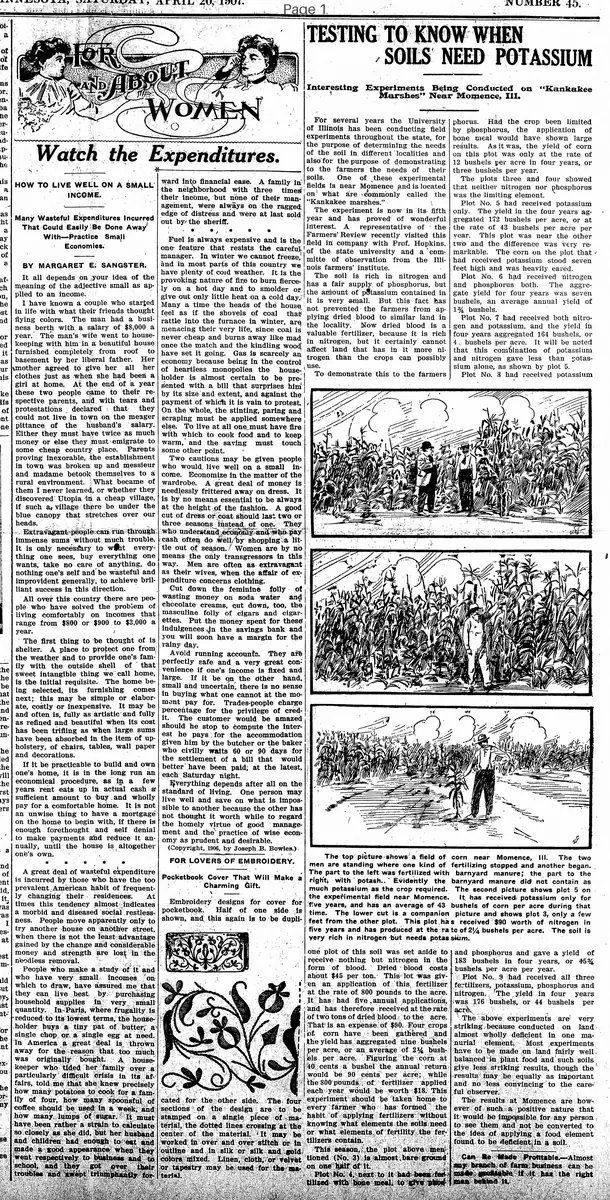
To demonstrate this to the farmers one plot of this soil was set aside to receive nothing but nitrogen in the form of blood. Dried blood costs about $45 per ton. This lot was given an application of this fertilizer at the rate of 800 pounds to the acre.
It has had five annual applications, and has therefore received at the rate of two tons of dried blood to the acre.
That is an expense of $90. Four crops of corn have been gathered and the yield has aggregated nine bushels per acre, or an average of 2¼ bushels per acre. Figuring the corn at 40 cents a bushel the annual return would be 90 cents per acre; while the 800 pounds of fertilizer applied each year would be worth $18. This experiment should be taken home to every farmer who has formed the habit of applying fertilizers without knowing what elements the soils need or what elements of fertility the fertilizers contain.
This season, the plot above mentioned (No. 3) is almost bare ground on one half of it.
Plot No. 4 next to it had been fertilized with bone meal and phosphorus and gave a yield of 12 bushels per acre in four years, or three bushels per year. Had the crop been limited by phosphorus, the application of bone meal would have shown large results. As it was, the yield of corn on this plot was only at the rate of 12 bushels per acre in four years, or three bushels per year.
The plots three and four showed that neither nitrogen nor phosphorus was the limiting element.
Plot No. 5 had received potassium only. The yield in the four years aggregated 172 bushels per acre, or at the rate of 43 bushels per acre per year. This plot was near the other two and the difference was very remarkable. The corn on the plot that had received potassium stood seven feet high and was heavily eared.
Plot No. 6 had received nitrogen and phosphorus both. The aggregate yield for four years was seventy bushels, an average annual yield of 17½ bushels.
Plot No. 7 had received both nitrogen and potassium, and the yield in four years aggregated 164 bushels, or 41 bushels per acre. It will be noted that this combination of potassium and nitrogen gave less than potassium alone, as shown by plot 5.
Plot No. 8 had received potassium and phosphorus and gave a yield of 183 bushels in four years, or 45¾ bushels per acre per year.
Plot No. 9 had received all three fertilizers, potassium, phosphorus and nitrogen. The yield in four years was 176 bushels, or 44 bushels per acre.
The above experiments are very striking because conducted on land almost wholly deficient in one manurial element. Most experiments have to be made on land fairly well balanced in plant food and such soils give less striking results, though the results may be equally as important and no less convincing to the careful observer.
The results at Momence are however of such a positive nature that it would be impossible for any person to see them and not be converted to the idea of applying a food element found to be deficient in a soil.
Can Be Made Profitable.—Almost any branch of farm business can be made profitable if it has the right management.
What sub-type of article is it?
What themes does it cover?
What keywords are associated?
What entities or persons were involved?
Where did it happen?
Story Details
Key Persons
Location
Kankakee Marshes Near Momence, Ill.
Event Date
Fifth Year Of Experiments
Story Details
University of Illinois conducts soil experiments on Kankakee marshes, demonstrating that the soil is deficient in potassium despite richness in nitrogen and phosphorus. Various plots receive different fertilizers: nitrogen alone yields low (2.25 bushels/acre/year), phosphorus low (3 bushels/acre/year), potassium alone high (43 bushels/acre/year), combinations vary but potassium key to high yields.