Thank you for visiting SNEWPapers!
Sign up free
Lynchburg Virginian
Lynchburg, Virginia
What is this article about?
Report from Boston Atlas on the trial of pirates involving the ship Panda. Court hears nautical testimony on encounter possibility, discusses evidence documents like captain's protest and depositions. Government closes case; defense calls witnesses Aranza and Aloza on African voyage routes and slave trade.
Clipping
OCR Quality
Full Text
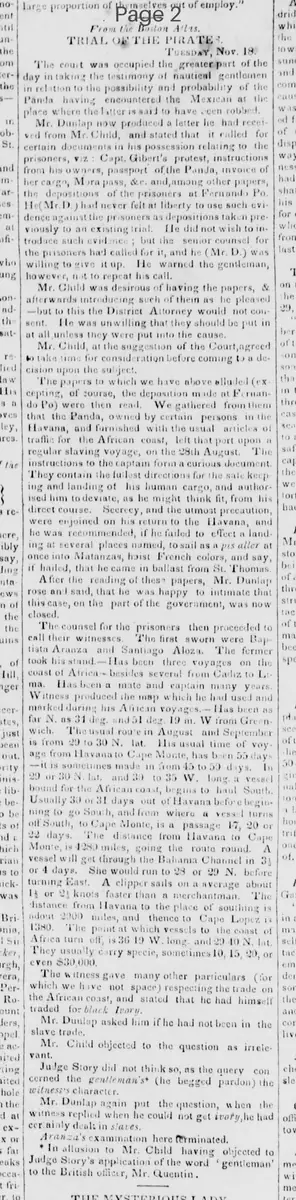
TRIAL OF THE PIRATES
Tuesday, Nov. 18.
The court was occupied the greater part of the day in taking the testimony of nautical gentlemen in relation to the possibility and probability of the Panda having encountered the Mexican at the place where the latter is said to have been robbed.
Mr. Dunlap now produced a letter he had received from Mr. Child, and stated that it called for certain documents in his possession relating to the prisoners, viz: Capt. Gilbert's protest, instructions from his owners, passport of the Panda, invoice of her cargo, Mora pass, &c. and, among other papers the depositions of the prisoners at Fernando Po. He (Mr. D.) had never felt at liberty to use such evidence against the prisoners as depositions taken previously to an existing trial. He did not wish to introduce such evidence; but the senior counsel for the prisoners had called for it, and he (Mr. D.) was willing to give it up. He warned the gentleman, however, not to repeat his call.
Mr. Child was desirous of having the papers, & afterwards introducing such of them as he pleased -but to this the District Attorney would not consent. He was unwilling that they should be put in at all unless they were put into the cause.
Mr. Child, at the suggestion of the Court, agreed to take time for consideration before coming to a decision upon the subject.
The papers to which we have above alluded (excepting, of course, the deposition made at Fernando Po) were then read. We gathered from them that the Panda, owned by certain persons in the Havana, and furnished with the usual articles of traffic for the African coast, left that port upon a regular slaving voyage, on the 28th August. 'The instructions to the captain form a curious document. They contain the fullest directions for the safe keeping and landing of his human cargo, and authorized him to deviate, as he might think fit, from his direct course. Secrecy, and the utmost precaution, were enjoined on his return to the Havana, and he was recommended, if he failed to effect a landing at several places named, to sail as a pis aller at once into Matanzas, hoist French colors, and say, if hailed, that he came in ballast from St. Thomas.
After the reading of these papers, Mr. Dunlap rose and said, that he was happy to intimate that this case, on the part of the government, was now closed.
The counsel for the prisoners then proceeded to call their witnesses. The first sworn were Baptista Aranza and Santiago Aloza. The former took his stand. Has been three voyages on the coast of Africa—besides several from Cadiz to Lima. Has been a mate and captain many years. Witness produced the map which he had used and marked during his African voyages. Has been as far N. as 31 deg. and 51 deg. 19 m. W. from Greenwich. The usual route in August and September is from 29 to 30 N. lat. His usual time of voyage from Havana to Cape Monte, has been 55 days -it is sometimes made in from 45 to 50 days. In 29 or 30 N. lat. and 30 to 35 W. long. a vessel bound for the African coast, begins to haul South. Usually 30 or 31 days out of Havana before beginning to go South, and from where a vessel turns off South, to Cape Monte, is a passage 17, 20 or 22 days. The distance from Havana to Cape Monte, is 4500 miles, going the route round. A vessel will get through the Bahama Channel in 3 or 4 days. She would run to 28 or 29 N. before turning East. A clipper sails on average about 1 or 2 knots faster than a merchantman. The distance from Havana to the place of southing is about 2000 miles, and thence to Cape Lopez is 1350. The point at which vessels to the coast of Africa turn off, is 36 19 W. long. and 29 40 N. lat. They usually carry specie, sometimes 10, 15, 20, or even $30,000.
The witness gave many other particulars (for which we have not space) respecting the trade on the African coast, and stated that he had himself traded for black ivory.
Mr. Dunlap asked him if he had not been in the slave trade.
Mr. Child objected to the question as irrelevant.
Judge Story did not think so, as the query concerned the gentleman's* (he begged pardon) the witness's character.
Mr. Dunlap again put the question, when the witness replied when he could not get ivory, he had certainly dealt in slaves.
Aranza's examination here terminated
* In allusion to Mr. Child having objected to Judge Story's application of the word 'gentleman' to the British officer, Mr. Quentin.
What sub-type of article is it?
What themes does it cover?
What keywords are associated?
What entities or persons were involved?
Where did it happen?
Story Details
Key Persons
Location
Boston
Event Date
Tuesday, Nov. 18
Story Details
Court examines nautical testimony on Panda's possible encounter with Mexican ship. Debate over introducing documents like captain's instructions revealing slaving voyage from Havana on August 28. Government closes case; defense witnesses Aranza and Aloza testify on African trade routes and admit slave trading.