Thank you for visiting SNEWPapers!
Sign up free
Editorial
September 15, 1926
Seward Daily Gateway
Seward, Seward County, Alaska
What is this article about?
Editorial defends Alaskan judges Reed, Ritchie, and DA Shoup against accusations by Dan Sutherland and allies of failing to enforce Prohibition law, claiming violations are no worse than elsewhere and enforcement is limited by resources and federal rules. Criticizes politicians' motives and urges voters to reject them on November 2nd.
Clipping
OCR Quality
95%
Excellent
Full Text
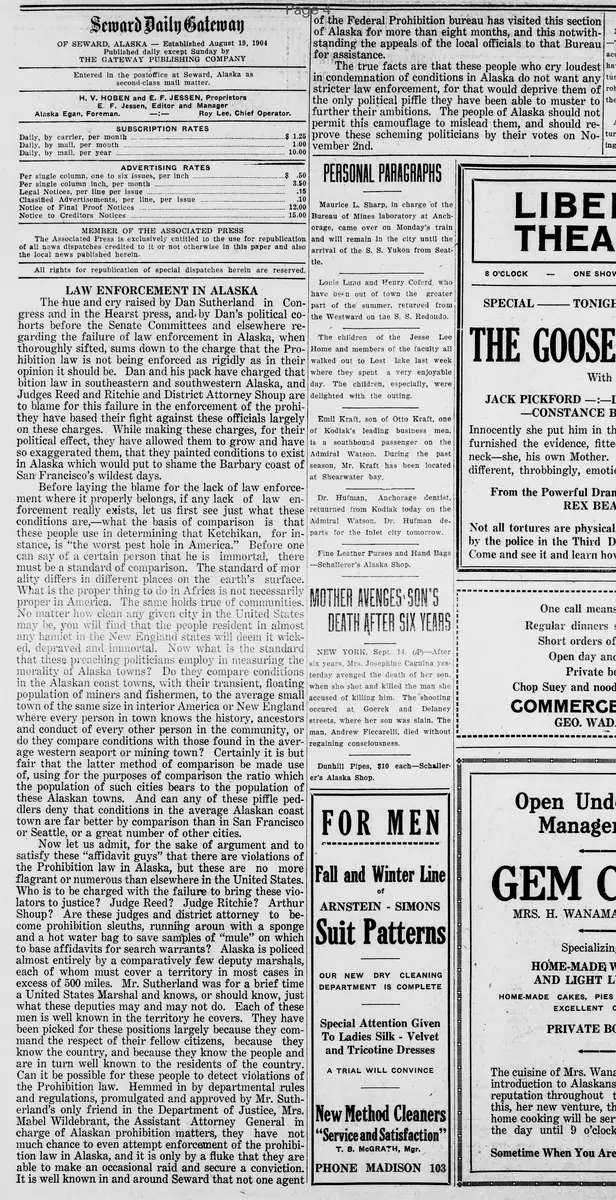
LAW ENFORCEMENT IN ALASKA
The hue and cry raised by Dan Sutherland in Congress and in the Hearst press, and by Dan's political co-horts before the Senate Committees and elsewhere regarding the failure of law enforcement in Alaska, when thoroughly sifted, sums down to the charge that the Prohibition law is not being enforced as rigidly as in their opinion it should be. Dan and his pack have charged that the Prohibition law in southeastern and southwestern Alaska, and Judges Reed and Ritchie and District Attorney Shoup are to blame for this failure in the enforcement of the prohibition they have based their fight against these officials largely on these charges. While making these charges, for their political effect, they have allowed them to grow and have so exaggerated them, that they painted conditions to exist in Alaska which would put to shame the Barbary coast of San Francisco's wildest days.
Before laying the blame for the lack of law enforcement where it properly belongs, if any lack of law enforcement really exists, let us first see just what these conditions are, -what the basis of comparison is that these people use in determining that Ketchikan, for instance, is "the worst pest hole in America." Before one can say of a certain person that he is immoral, there must be a standard of comparison. The standard of morality differs in different places on the earth's surface. What is the proper thing to do in Africa is not necessarily proper in America. The same holds true of communities. No matter how clean any given city in the United States may be, you will find that the people resident in almost any hamlet in the New England states will deem it wicked, depraved and immoral. Now what is the standard that these preaching politicians employ in measuring the morality of Alaska towns? Do they compare conditions in the Alaskan coast towns, with their transient, floating population of miners and fishermen, to the average small town of the same size in interior America or New England where every person in town knows the history, ancestors and conduct of every other person in the community, or do they compare conditions with those found in the average western seaport or mining town? Certainly it is but fair that the latter method of comparison be made use of, using for the purposes of comparison the ratio which the population of such cities bears to the population of these Alaskan towns. And can any of these piffle peddlers deny that conditions in the average Alaskan coast town are far better by comparison than in San Francisco or Seattle, or a great number of other cities.
Now let us admit, for the sake of argument and to satisfy these "affidavit guys" that there are violations of the Prohibition law in Alaska, but these are no more flagrant or numerous than elsewhere in the United States. Who is to be charged with the failure to bring these violators to justice? Judge Reed? Judge Ritchie? Arthur Shoup? Are these judges and district attorney to become prohibition sleuths, running around with a sponge and a hot water bag to save samples of "mule" on which to base affidavits for search warrants? Alaska is policed almost entirely by a comparatively few deputy marshals, each of whom must cover a territory in most cases in excess of 500 miles. Mr. Sutherland was for a brief time a United States Marshal and knows, or should know, just what these deputies may and may not do. Each of these men is well known in the territory he covers. They have been picked for these positions largely because they command the respect of their fellow citizens, because they know the country, and because they know the people and are in turn well known to the residents of the country. Can it be possible for these people to detect violations of the Prohibition law. Hemmed in by departmental rules and regulations, promulgated and approved by Mr. Sutherland's only friend in the Department of Justice, Mrs. Mabel Willebrandt, the Assistant Attorney General in charge of Alaskan prohibition matters, they have not much chance to even attempt enforcement of the prohibition law in Alaska, and it is only by a fluke that they are able to make an occasional raid and secure a conviction. It is well known in and around Seward that not one agent of the Federal Prohibition bureau has visited this section of Alaska for more than eight months, and this notwithstanding the appeals of the local officials to that Bureau for assistance.
The true facts are that these people who cry loudest in condemnation of conditions in Alaska do not want any stricter law enforcement, for that would deprive them of the only political piffle they have been able to muster to further their ambitions. The people of Alaska should not permit this camouflage to mislead them, and should reprove these scheming politicians by their votes on November 2nd.
The hue and cry raised by Dan Sutherland in Congress and in the Hearst press, and by Dan's political co-horts before the Senate Committees and elsewhere regarding the failure of law enforcement in Alaska, when thoroughly sifted, sums down to the charge that the Prohibition law is not being enforced as rigidly as in their opinion it should be. Dan and his pack have charged that the Prohibition law in southeastern and southwestern Alaska, and Judges Reed and Ritchie and District Attorney Shoup are to blame for this failure in the enforcement of the prohibition they have based their fight against these officials largely on these charges. While making these charges, for their political effect, they have allowed them to grow and have so exaggerated them, that they painted conditions to exist in Alaska which would put to shame the Barbary coast of San Francisco's wildest days.
Before laying the blame for the lack of law enforcement where it properly belongs, if any lack of law enforcement really exists, let us first see just what these conditions are, -what the basis of comparison is that these people use in determining that Ketchikan, for instance, is "the worst pest hole in America." Before one can say of a certain person that he is immoral, there must be a standard of comparison. The standard of morality differs in different places on the earth's surface. What is the proper thing to do in Africa is not necessarily proper in America. The same holds true of communities. No matter how clean any given city in the United States may be, you will find that the people resident in almost any hamlet in the New England states will deem it wicked, depraved and immoral. Now what is the standard that these preaching politicians employ in measuring the morality of Alaska towns? Do they compare conditions in the Alaskan coast towns, with their transient, floating population of miners and fishermen, to the average small town of the same size in interior America or New England where every person in town knows the history, ancestors and conduct of every other person in the community, or do they compare conditions with those found in the average western seaport or mining town? Certainly it is but fair that the latter method of comparison be made use of, using for the purposes of comparison the ratio which the population of such cities bears to the population of these Alaskan towns. And can any of these piffle peddlers deny that conditions in the average Alaskan coast town are far better by comparison than in San Francisco or Seattle, or a great number of other cities.
Now let us admit, for the sake of argument and to satisfy these "affidavit guys" that there are violations of the Prohibition law in Alaska, but these are no more flagrant or numerous than elsewhere in the United States. Who is to be charged with the failure to bring these violators to justice? Judge Reed? Judge Ritchie? Arthur Shoup? Are these judges and district attorney to become prohibition sleuths, running around with a sponge and a hot water bag to save samples of "mule" on which to base affidavits for search warrants? Alaska is policed almost entirely by a comparatively few deputy marshals, each of whom must cover a territory in most cases in excess of 500 miles. Mr. Sutherland was for a brief time a United States Marshal and knows, or should know, just what these deputies may and may not do. Each of these men is well known in the territory he covers. They have been picked for these positions largely because they command the respect of their fellow citizens, because they know the country, and because they know the people and are in turn well known to the residents of the country. Can it be possible for these people to detect violations of the Prohibition law. Hemmed in by departmental rules and regulations, promulgated and approved by Mr. Sutherland's only friend in the Department of Justice, Mrs. Mabel Willebrandt, the Assistant Attorney General in charge of Alaskan prohibition matters, they have not much chance to even attempt enforcement of the prohibition law in Alaska, and it is only by a fluke that they are able to make an occasional raid and secure a conviction. It is well known in and around Seward that not one agent of the Federal Prohibition bureau has visited this section of Alaska for more than eight months, and this notwithstanding the appeals of the local officials to that Bureau for assistance.
The true facts are that these people who cry loudest in condemnation of conditions in Alaska do not want any stricter law enforcement, for that would deprive them of the only political piffle they have been able to muster to further their ambitions. The people of Alaska should not permit this camouflage to mislead them, and should reprove these scheming politicians by their votes on November 2nd.
What sub-type of article is it?
Temperance
Partisan Politics
Crime Or Punishment
What keywords are associated?
Prohibition Enforcement
Alaska Law
Dan Sutherland
Political Criticism
Temperance Violations
Federal Neglect
What entities or persons were involved?
Dan Sutherland
Judges Reed And Ritchie
District Attorney Arthur Shoup
Mrs. Mabel Willebrandt
Hearst Press
Senate Committees
Editorial Details
Primary Topic
Defense Against Charges Of Lax Prohibition Enforcement In Alaska
Stance / Tone
Critical Of Politicians, Supportive Of Local Officials
Key Figures
Dan Sutherland
Judges Reed And Ritchie
District Attorney Arthur Shoup
Mrs. Mabel Willebrandt
Hearst Press
Senate Committees
Key Arguments
Charges Of Lax Prohibition Enforcement Are Exaggerated For Political Gain.
Conditions In Alaskan Towns Are Better Than In Comparable Western Seaports Like San Francisco Or Seattle.
Violations Are No More Flagrant Than Elsewhere In The Us.
Local Officials Cannot Effectively Enforce Due To Vast Territories And Limited Deputy Marshals.
Federal Prohibition Bureau Provides No Assistance Despite Appeals.
Politicians Like Sutherland Do Not Want Stricter Enforcement As It Aids Their Ambitions.
Voters Should Reject These Politicians On November 2nd.