Thank you for visiting SNEWPapers!
Sign up free
Story
August 22, 1836
Lynchburg Virginian
Lynchburg, Virginia
What is this article about?
General Harrison, at his North Bend farm, built a distillery to profit from surplus corn but dismantled it due to its harmful effects on society, exemplifying sacrifice of gain for moral principle, as expressed in his 5-year-old agricultural address.
Clipping
OCR Quality
98%
Excellent
Full Text
INTEREST SACRIFICED TO PRINCIPLE.
FROM THE OHIO PEOPLE'S PRESS.
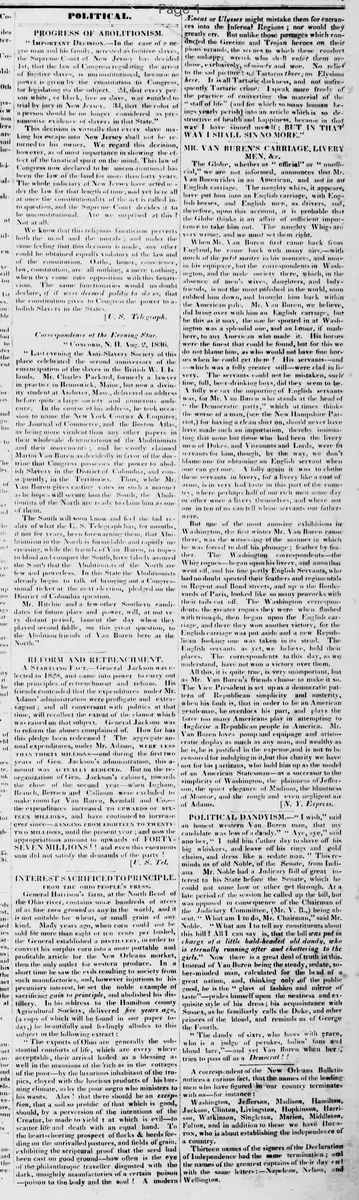
General Harrison's farm, at the North Bend of the Ohio river, contains some hundreds of acres of as fine corn ground as any in the world, and it is not suitable for wheat, or small grain of any kind. Many years ago, when corn could not be sold for more than eight or ten cents per bushel, the General established a distillery, in order to convert his surplus corn into a more portable and profitable article for the New Orleans market, then the only outlet for western produce. In a short time he saw the evils resulting to society from such manufactories, and, however injurious to his pecuniary interest, he set the noble example of sacrificing gain to principle, and abolished his distillery. In his address to the Hamilton county Agricultural Society, delivered five years ago, (a copy of which will be found in our paper to-day,) he beautifully and feelingly alludes to this subject in the following extract:
"The exports of Ohio are generally the substantial comforts of life, which are every where acceptable, their arrival hailed as a blessing as well in the mansions of the rich as in the cottages of the poor—by the luxurious inhabitant of the tropics, cloyed with the luscious products of his burning climate, as by the poor negro who ministers to his wants. Alas! that there should be an exception, that a soil so prolific of that which is good, should, by a perversion of the intentions of the Creator, be made to yield that which is evil—to scatter life and death with an equal hand. To the heart-cheering prospect of flocks & herds feeding on the unrivalled pastures, and fields of grain, exhibiting the scriptural proof that the seed had been cast on good ground—how often is the eye of the philanthropic traveller disgusted with the dark, unsightly manufactories of a certain poison—poison to the body and the soul? A modern Aeneas or Ulysses might mistake them for entrances into the Infernal Regions; nor would they greatly err. But unlike those passages which conducted the Grecian and Trojan heroes on their pious errands, the scenes to which these conduct the unhappy wretch who shall enter them are those, exclusively, of misery and woe. No relief to the sad picture: as Tartarus there; no Elysium here. It is all Tartarean darkness, and not unfrequently Tartarean crime: I speak more freely of the practice of converting the material of the "staff of life" (and for which so many human beings yearly perish) into an article which is so destructive of health and happiness, because in that way I have Sinned myself: BUT IN THAT WAY I SHALL SIN NO MORE."
FROM THE OHIO PEOPLE'S PRESS.
General Harrison's farm, at the North Bend of the Ohio river, contains some hundreds of acres of as fine corn ground as any in the world, and it is not suitable for wheat, or small grain of any kind. Many years ago, when corn could not be sold for more than eight or ten cents per bushel, the General established a distillery, in order to convert his surplus corn into a more portable and profitable article for the New Orleans market, then the only outlet for western produce. In a short time he saw the evils resulting to society from such manufactories, and, however injurious to his pecuniary interest, he set the noble example of sacrificing gain to principle, and abolished his distillery. In his address to the Hamilton county Agricultural Society, delivered five years ago, (a copy of which will be found in our paper to-day,) he beautifully and feelingly alludes to this subject in the following extract:
"The exports of Ohio are generally the substantial comforts of life, which are every where acceptable, their arrival hailed as a blessing as well in the mansions of the rich as in the cottages of the poor—by the luxurious inhabitant of the tropics, cloyed with the luscious products of his burning climate, as by the poor negro who ministers to his wants. Alas! that there should be an exception, that a soil so prolific of that which is good, should, by a perversion of the intentions of the Creator, be made to yield that which is evil—to scatter life and death with an equal hand. To the heart-cheering prospect of flocks & herds feeding on the unrivalled pastures, and fields of grain, exhibiting the scriptural proof that the seed had been cast on good ground—how often is the eye of the philanthropic traveller disgusted with the dark, unsightly manufactories of a certain poison—poison to the body and the soul? A modern Aeneas or Ulysses might mistake them for entrances into the Infernal Regions; nor would they greatly err. But unlike those passages which conducted the Grecian and Trojan heroes on their pious errands, the scenes to which these conduct the unhappy wretch who shall enter them are those, exclusively, of misery and woe. No relief to the sad picture: as Tartarus there; no Elysium here. It is all Tartarean darkness, and not unfrequently Tartarean crime: I speak more freely of the practice of converting the material of the "staff of life" (and for which so many human beings yearly perish) into an article which is so destructive of health and happiness, because in that way I have Sinned myself: BUT IN THAT WAY I SHALL SIN NO MORE."
What sub-type of article is it?
Biography
Heroic Act
What themes does it cover?
Moral Virtue
What keywords are associated?
General Harrison
Distillery Abolition
Moral Principle
Corn Farm
Ohio River
What entities or persons were involved?
General Harrison
Where did it happen?
North Bend Of The Ohio River
Story Details
Key Persons
General Harrison
Location
North Bend Of The Ohio River
Event Date
Many Years Ago
Story Details
General Harrison established a distillery on his farm to convert surplus corn into whiskey for market but later abolished it upon recognizing its societal evils, sacrificing his financial interests for principle, as detailed in his address to the Hamilton county Agricultural Society.