Thank you for visiting SNEWPapers!
Sign up free
Story
May 20, 1840
Vermont Telegraph
Brandon, Rutland County, Vermont
What is this article about?
From the New England Farmer, an essay by W.B. on ornithology for farmers, arguing birds like crows harm crops but benefit by eating pests and teach virtues; urges study and kindness toward them rather than extermination. Dated March 2, 1840 from Mount Osceola.
Clipping
OCR Quality
95%
Excellent
Full Text
Agricultural.
From the New England Farmer.
Science for Farmers--Ornithology.
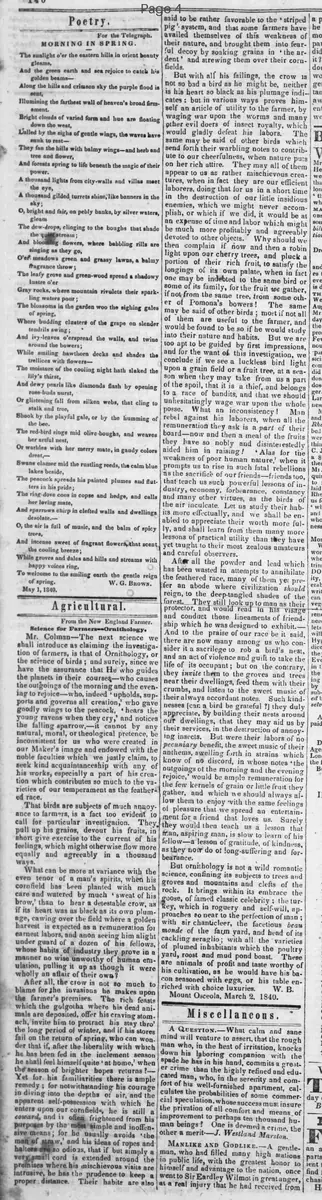
Mr. Colman--The next science we shall introduce as claiming the investigation of farmers, is that of Ornithology, or the science of birds; and surely, since we have the assurance that He who guides the planets in their courses—who causes the outgoings of the morning and the evening to rejoice—who, indeed upholds, supports and governs all creation,' who gave goodly wings to the peacock, hears the young ravens when they cry,' and notices the falling sparrow,-it cannot by any natural, moral, or theological pretence, be inconsistent for us who were created in our Maker's image and endowed with the noble faculties which we justly claim, to seek kind acquaintanceship with any, of his works, especially a part of his creation which contributes so much to the varieties of our temperament as the feathered race.
That birds are subjects of much annoyance to farmers, is a fact too evident to call for particular investigation. They pull up his grains, devour his fruits, in short give exercise to the current of his feelings, which might otherwise flow more equally and agreeably in a thousand ways.
What can be more at variance with the even tenor of a man's spirits, when his cornfield has been planted with much care and watered by much 'sweat of his brow,' than to hear a detestable crow, as if its heart was as black as its own plumage, cawing over the field where a golden harvest is expected as a remuneration for earnest labors, and anon seeing him alight under guard of a dozen of his fellows, whose habits of industry they prove in a manner no wise unworthy of human emulation, pulling it up as though it were wholly an affair of their own?
After all, the crow is not so much to blame for the invasions he makes upon the farmer's premises. The rich feasts which the golgotha where his dead animals are deposited, offer his craving stomach, invite him to protract his stay thro' the long period of winter, and if his stores fail on the return of spring, who can wonder that if, after the liberality with which he has been fed in the inclement season he shall feel himself quite 'at home,' when the season of brighter hopes returns?-
Yet for his familiarities there is ample remedy; for notwithstanding his courage in diving into the depths of air, and the apparent self-possession with which he enters upon our cornfields, he is still a coward, and is often frightened from his purposes by the most simple and inoffensive means; or he usually avoids 'the man of straw,' and his ideas of ropes and halters are so odious, that if but simply a very small cord is extended around the premises where his mischievous visits are intrusive, he has the prudence to keep a proper distance. Their habits are also said to be rather favorable to the 'striped pig' system, and that some farmers have availed themselves of this weakness of their nature, and brought them into fearful decoy by soaking grains in 'the ardent' and strewing them over their cornfields.
But with all his failings, the crow is not so bad a bird as he might be, neither is his heart so black as his plumage indicates: but in various ways proves himself an article of utility to the farmer, by waging war upon the worms and many other evil doers of insect royalty, which would gladly defeat his labors. The same may be said of other birds which send forth their warbling notes to contribute to our cheerfulness, when nature puts on her rich attire. They may all of them appear to us as rather mischievous creatures, when in fact they are our efficient laborers, doing that for us in a short time in the destruction of our little insidious enemies, which we might never accomplish, or which if we did, it would be at an expense of time and labor which might be much more profitably and agreeably devoted to other objects. 'Why should we then complain if now and then a robin light upon our cherry trees, and pluck a portion of their rich fruit, to satisfy the longings of its own palate, when in fact one may be indebted to the same bird or some of its family, for the fruit we gather, if not from the same tree, from some other of Pomona's bowers! The same may be said of other birds; most if not all of them are useful to the farmer, and would be found to be so if he would study into their nature and habits. But we are too apt to be guided by first impressions, and for the want of this investigation, we conclude if we see a luckless bird light upon a grain field or a fruit tree, at a season when they may take from us a part of the spoil, that it is a thief, and belongs to a race of bandits, and that we should unhesitatingly wage war upon the whole posse. What an inconsistency! Man rebel against his laborers, when all the remuneration they ask is a part of their board—now and then a meal of the fruits they have so nobly and disinterestedly aided him in raising! Alas for the weakness of poor human nature,' when it prompts us to rise in such fatal rebellions as the sacrifice of our friends—friends too, that teach us such powerful lessons of industry, economy, forbearance, constancy and many other virtues, as the birds of the air inculcate. Let us study their habits more effectually, and we shall be enabled to appreciate their worth more fully, and shall learn from them many more lessons of practical utility than they have yet taught to their most zealous amateurs and careful observers.
After all the powder and lead which has been wasted in attempts to annihilate the feathered race, many of them yet prefer an abode where civilization should reign, to the deep-tangled shades of the forest. They still look up to man as their protector, and would read in his visage and conduct those lineaments of friendship which he was designed to exhibit.-
And to the praise of our race be it said, there are now many among us who consider it a sacrilege to rob a bird's nest, and an act of violence and guilt to take the life of its occupant; but on the contrary, they invite them to the groves and trees near their dwellings, feed them with their crumbs, and listen to the sweet music of their always accordant notes. Such kind nesses [can a bird be grateful?] they duly appreciate, by building their nests around our dwellings, that they may aid us by their services, in the destruction of annoying insects. But were their labors of no pecuniary benefit, the sweet music of their anthems, swelling forth in strains which know of no discord, in whose notes 'the outgoings of the morning and the evening rejoice,' would be ample remuneration for the few kernels of grain or little fruit they gather, and which we should always allow them to enjoy with the same feelings of pleasure that we spread an entertainment for a friend that loves us. Surely they would then teach us a lesson that man, aspiring man, is slow to learn of his fellow—a lesson of gratitude, of kindness, as they now do of long-suffering and forbearance.
But ornithology is not a wild romantic science, confining its subjects to trees and groves and mountains and clefts of the rock. It brings within its embrace the goose, of famed classic celebrity; the turkey, which in roguery and self-will, approaches so near to the perfection of man; with sir chanticleer, the facetious beau monde of the farm yard, and head of its cackling seraglio; with all the varieties of plumed inhabitants which the poultry yard, roost and mud pond boast. These are animals of profit and taste worthy of his cultivation, as he would have his bacon seasoned with eggs, or his table enriched with choice luxuries.
W. B.
Mount Osceola, March 2, 1840.
From the New England Farmer.
Science for Farmers--Ornithology.
Mr. Colman--The next science we shall introduce as claiming the investigation of farmers, is that of Ornithology, or the science of birds; and surely, since we have the assurance that He who guides the planets in their courses—who causes the outgoings of the morning and the evening to rejoice—who, indeed upholds, supports and governs all creation,' who gave goodly wings to the peacock, hears the young ravens when they cry,' and notices the falling sparrow,-it cannot by any natural, moral, or theological pretence, be inconsistent for us who were created in our Maker's image and endowed with the noble faculties which we justly claim, to seek kind acquaintanceship with any, of his works, especially a part of his creation which contributes so much to the varieties of our temperament as the feathered race.
That birds are subjects of much annoyance to farmers, is a fact too evident to call for particular investigation. They pull up his grains, devour his fruits, in short give exercise to the current of his feelings, which might otherwise flow more equally and agreeably in a thousand ways.
What can be more at variance with the even tenor of a man's spirits, when his cornfield has been planted with much care and watered by much 'sweat of his brow,' than to hear a detestable crow, as if its heart was as black as its own plumage, cawing over the field where a golden harvest is expected as a remuneration for earnest labors, and anon seeing him alight under guard of a dozen of his fellows, whose habits of industry they prove in a manner no wise unworthy of human emulation, pulling it up as though it were wholly an affair of their own?
After all, the crow is not so much to blame for the invasions he makes upon the farmer's premises. The rich feasts which the golgotha where his dead animals are deposited, offer his craving stomach, invite him to protract his stay thro' the long period of winter, and if his stores fail on the return of spring, who can wonder that if, after the liberality with which he has been fed in the inclement season he shall feel himself quite 'at home,' when the season of brighter hopes returns?-
Yet for his familiarities there is ample remedy; for notwithstanding his courage in diving into the depths of air, and the apparent self-possession with which he enters upon our cornfields, he is still a coward, and is often frightened from his purposes by the most simple and inoffensive means; or he usually avoids 'the man of straw,' and his ideas of ropes and halters are so odious, that if but simply a very small cord is extended around the premises where his mischievous visits are intrusive, he has the prudence to keep a proper distance. Their habits are also said to be rather favorable to the 'striped pig' system, and that some farmers have availed themselves of this weakness of their nature, and brought them into fearful decoy by soaking grains in 'the ardent' and strewing them over their cornfields.
But with all his failings, the crow is not so bad a bird as he might be, neither is his heart so black as his plumage indicates: but in various ways proves himself an article of utility to the farmer, by waging war upon the worms and many other evil doers of insect royalty, which would gladly defeat his labors. The same may be said of other birds which send forth their warbling notes to contribute to our cheerfulness, when nature puts on her rich attire. They may all of them appear to us as rather mischievous creatures, when in fact they are our efficient laborers, doing that for us in a short time in the destruction of our little insidious enemies, which we might never accomplish, or which if we did, it would be at an expense of time and labor which might be much more profitably and agreeably devoted to other objects. 'Why should we then complain if now and then a robin light upon our cherry trees, and pluck a portion of their rich fruit, to satisfy the longings of its own palate, when in fact one may be indebted to the same bird or some of its family, for the fruit we gather, if not from the same tree, from some other of Pomona's bowers! The same may be said of other birds; most if not all of them are useful to the farmer, and would be found to be so if he would study into their nature and habits. But we are too apt to be guided by first impressions, and for the want of this investigation, we conclude if we see a luckless bird light upon a grain field or a fruit tree, at a season when they may take from us a part of the spoil, that it is a thief, and belongs to a race of bandits, and that we should unhesitatingly wage war upon the whole posse. What an inconsistency! Man rebel against his laborers, when all the remuneration they ask is a part of their board—now and then a meal of the fruits they have so nobly and disinterestedly aided him in raising! Alas for the weakness of poor human nature,' when it prompts us to rise in such fatal rebellions as the sacrifice of our friends—friends too, that teach us such powerful lessons of industry, economy, forbearance, constancy and many other virtues, as the birds of the air inculcate. Let us study their habits more effectually, and we shall be enabled to appreciate their worth more fully, and shall learn from them many more lessons of practical utility than they have yet taught to their most zealous amateurs and careful observers.
After all the powder and lead which has been wasted in attempts to annihilate the feathered race, many of them yet prefer an abode where civilization should reign, to the deep-tangled shades of the forest. They still look up to man as their protector, and would read in his visage and conduct those lineaments of friendship which he was designed to exhibit.-
And to the praise of our race be it said, there are now many among us who consider it a sacrilege to rob a bird's nest, and an act of violence and guilt to take the life of its occupant; but on the contrary, they invite them to the groves and trees near their dwellings, feed them with their crumbs, and listen to the sweet music of their always accordant notes. Such kind nesses [can a bird be grateful?] they duly appreciate, by building their nests around our dwellings, that they may aid us by their services, in the destruction of annoying insects. But were their labors of no pecuniary benefit, the sweet music of their anthems, swelling forth in strains which know of no discord, in whose notes 'the outgoings of the morning and the evening rejoice,' would be ample remuneration for the few kernels of grain or little fruit they gather, and which we should always allow them to enjoy with the same feelings of pleasure that we spread an entertainment for a friend that loves us. Surely they would then teach us a lesson that man, aspiring man, is slow to learn of his fellow—a lesson of gratitude, of kindness, as they now do of long-suffering and forbearance.
But ornithology is not a wild romantic science, confining its subjects to trees and groves and mountains and clefts of the rock. It brings within its embrace the goose, of famed classic celebrity; the turkey, which in roguery and self-will, approaches so near to the perfection of man; with sir chanticleer, the facetious beau monde of the farm yard, and head of its cackling seraglio; with all the varieties of plumed inhabitants which the poultry yard, roost and mud pond boast. These are animals of profit and taste worthy of his cultivation, as he would have his bacon seasoned with eggs, or his table enriched with choice luxuries.
W. B.
Mount Osceola, March 2, 1840.
What sub-type of article is it?
Curiosity
Animal Story
What themes does it cover?
Moral Virtue
Nature
Providence Divine
What keywords are associated?
Ornithology
Birds
Farmers
Crows
Agriculture
Pest Control
Moral Lessons
What entities or persons were involved?
Mr. Colman
W. B.
Where did it happen?
Mount Osceola
Story Details
Key Persons
Mr. Colman
W. B.
Location
Mount Osceola
Event Date
March 2, 1840
Story Details
An essay introducing ornithology to farmers, emphasizing birds' utility in pest control despite occasional crop damage, particularly crows, and advocating appreciation of their habits and moral lessons over destruction.