Thank you for visiting SNEWPapers!
Sign up free
The Hillsborough Recorder
Hillsboro, Orange County, North Carolina
What is this article about?
Dialogue from the Madisonian newspaper where Col. Richland discusses with Capias a 1839 congressional report on defalcations by public land office receivers totaling over $2 million since 1829, highlighting cases like Sterling, Pollock, Linn, Harris, and Boyd who were retained in office despite known defaults due to political loyalty.
Clipping
OCR Quality
Full Text
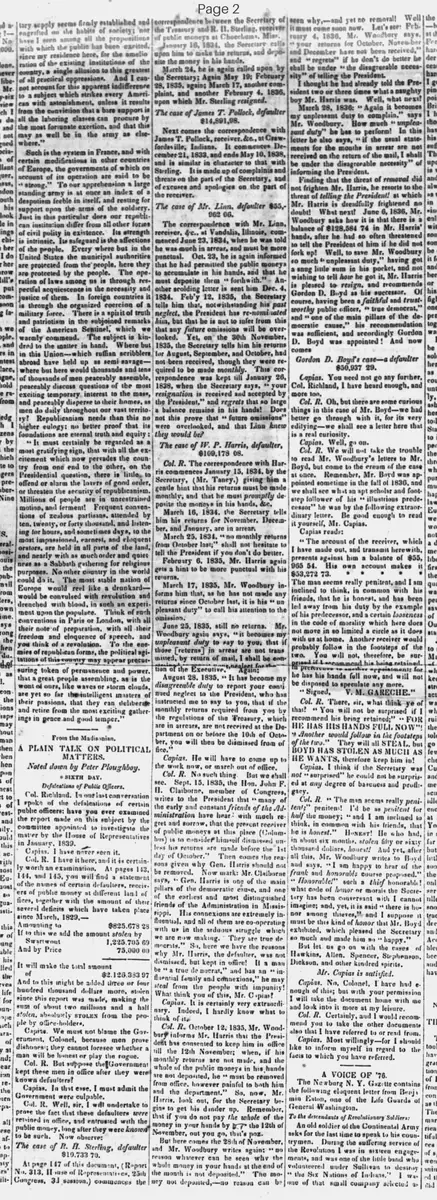
A PLAIN TALK ON POLITICAL
MATTERS.
Noted down by Peter Ploughboy.
SIXTH DAY.
Defalcations of Public Officers.
Col. Richland. In our last conversation I spoke of the defalcations of certain public officers: have you ever examined the report made on this subject by the committee appointed to investigate the matter by the House of Representatives in January, 1839?
Capias. I have never seen it.
Col. R. I have it here, and it is certainly worth an examination. At pages 143, 144, and 145, you will find a statement of the names of certain defaulters, receivers of public money at different land offices, together with the amount of their several deficits which have taken place since March, 1829,—
Amounting to
$825,678 28
If to this we add the amount stolen by Swartwout
1,225,705 69
And by Price
75,000 00
It will make the total amount of
$2,126,333 97
And to this might be added three or four hundred thousand dollars more, stolen since this report was made, making the sum of about two millions and a half stolen, absolutely stolen from the people by office-holders.
Capias. We must not blame the Government, Colonel, because men prove dishonest; they cannot foresee whether a man will be honest or play the rogue.
Col. R. But suppose the Government kept these men in office after they were known defaulters?
Capias. In that case, I must admit the Government were culpable.
Col. R. Well, sir, I will undertake to prove the fact that these defaulters were retained in office, and entrusted with the public money, long after they were known to be such. Now observe:
The case of R. H. Sterling, defaulter $10,733 70.
At page 147 of this document, (Report No. 313, House of Representatives, 25th Congress, 3d session,) commences the correspondence between the Secretary of the Treasury and R. H. Sterling, receiver of public moneys at Chocchuma, Miss. January 10, 1834, the Secretary calls upon him to make his returns, and deposit the money in his hands. March 24, he is again called upon by the Secretary; Again May 19; February 28, 1835, again; March 17, another complaint, and another February 4, 1836, upon which Mr. Sterling resigned.
The case of James T. Pollock, defaulter $14,891.98.
Next comes the correspondence with James T. Pollock, receiver, &c., at Crawfordsville, Indiana. It commences December 21, 1833, and ends May 10, 1838, and is similar in character to that with Sterling. It is made up of complaints and threats on the part of the Secretary, and of excuses and apologies on the part of the receiver.
The case of Mr. Linn, defaulter $55,962 06.
The correspondence with Mr. Linn, receiver, &c., at Vandalia, Illinois, commenced June 23, 1834, when he was told he was much in arrear, and must be more punctual. Oct. 23, he is again informed that he had permitted the public moneys to accumulate in his hands, and that he must deposit them forthwith. Another scolding letter is sent him Dec. 4, 1834. Feb'y 12, 1835, the Secretary tells him that, notwithstanding his past neglect, the President has re-nominated him, but that he is not to infer from this that any future omissions will be overlooked. Yet, on the 30th November, 1835, the Secretary tells him his returns for August, September, and October, had not been received, though they were required to be made monthly. This correspondence was kept till January 26, 1836, when the Secretary says, 'your resignation is received and accepted by the President,' and regrets that so large a balance remains in his hands! Does not this prove that 'future omissions' were overlooked, and that Linn knew they would be?
The case of W. P. Harris, defaulter $109,178 08.
Col. R. The correspondence with Harris commences January 15, 1834, by the Secretary, (Mr. Taney,) giving him a gentle hint that his returns must be made monthly, and that he must promptly deposit the moneys in his hands, &c. March 16, 1834, the Secretary tells him his returns for November, December, and January, are in arrear. March 25, 1834, 'no monthly returns from October last;' shall not hesitate to tell the President if you don't do better. February 6, 1835, Mr. Harris again gets a hint to be more punctual with his returns. March 17, 1835, Mr. Woodbury informs him that, as he has not made any returns since October last, it is his 'unpleasant duty' to call his attention to the omission. June 25, 1835, still no returns. Mr. Woodbury again says, 'it becomes my unpleasant duty to say to you, that if those returns in arrear are not transmitted, by return of mail, I shall be compelled to report your neglect for the attention of the Executive.' Again; August 28, 1835, 'It has become my disagreeable duty to report your continued neglect to the President, who has instructed me to say to you, that if the monthly returns required from you by the regulations of the Treasury, which are in arrear, are not received at the Department on or before the 10th of October, you will then be dismissed from office.' Capias. He will have to come up to the work now, or march out of office. Col. R. No such thing. But we shall see. Sept. 15, 1835, the Hon. John F. I. Claiborne, member of Congress, writes to the President that 'many of the early and constant friends of the Administration have heard with much regret and sorrow, that the present receiver of public moneys at this place (Columbus) is to consider himself dismissed unless his returns are made before the 1st day of October.' Then comes the reasons given why Gen. Harris should not be removed. Now mark: Mr. Claiborne says, 'Gen. Harris is one of the main pillars of the democratic cause, and one of the earliest and most distinguished friends of the Administration in Mississippi. His connexions are extremely influential, and all of them are co-operating with us in the arduous struggle which we are now making. They are true democrats.' So, here we have the reasons why Mr. Harris, the defaulter, was not dismissed, but kept in office! If a man be 'a true democrat,' and has an 'influential family and connexions,' he may steal from the people with impunity! What think you of this, Mr. Capias? Capias. It is certainly very extraordinary. Indeed, I hardly know what to think of it. Col. R. October 12, 1835. Mr. Woodbury informs Mr. Harris that the President has consented to keep him in office till the 12th November; when, if his monthly returns are not made, and the whole of the public moneys in his hands are not deposited, he 'must be removed from office, however painful to both him and the department.' So, now, Mr. Harris, look out, for the Secretary begins to get his dander up. Remember, that if you do not pay the whole of the money in your hands by the 12th of November, out you go, that's pos. But here comes the 28th of November and Mr. Woodbury writes again: 'no reason whatever can be seen why the whole money in your hands at the end of the month is not deposited.' The money not deposited,—no reason can be seen why, and yet no removal! Well it must come soon now. Let's see: February 4, 1836. Mr. Woodbury says, your returns for October, November and December have not been received,' and 'regrets' if he don't do better he shall be under 'the disagreeable necessity' of telling the President. I thought he had already told the President two or three times what a naughty boy Mr. Harris was. Well, what next? March 28, 1836: 'Again it becomes my unpleasant duty to complain,' says Mr. Woodbury. How much 'unpleasant duty' he has to perform! In this letter he also says, 'if the usual statements for the months in arrear are not received on the return of the mail, I shall be under the disagreeable necessity' of informing the President. Finding that the threat of removal did not frighten Mr. Harris, he resorts to the threat of telling the President! at which Mr. Harris is dreadfully frightened no doubt! What next! June 6, 1836, Mr. Woodbury asks how it is that there is balance of $128,584 74 in Mr. Harris hands, after he had so often threatened to tell the President of him if he did not fork up! Well, to save Mr. Woodbury so much 'unpleasant duty,' having got a snug little sum in his pocket, and not wishing to tell how he got it, Mr. Harris is pleased to resign, and recommends Gordon D. Boyd as his successor. Of course, having been a faithful and trustworthy public officer, 'true democrat,' and 'one of the main pillars of the democratic cause,' his recommendation was sufficient, and accordingly Gordon D. Boyd was appointed! And now comes
Gordon D. Boyd's case—a defaulter $50,937 29.
Capias. You need not go any further Col. Richland, I have heard enough, and more too. Col. R. Oh, but there are some curious things in this case of Mr. Boyd—we had better go through with it, for its very edifying—we shall see a letter here that is a real curiosity. Capias. Well, go on. Col. R. We will not take the trouble to read Mr. Woodbury's letters to Mr. Boyd, but come to the cream of the case at once. Remember, Mr. Boyd was appointed sometime in the fall of 1836, and we shall see what an apt scholar and foot-step follower of his 'illustrious predecessor' he was by the following extraordinary letter. Be good enough to read it yourself, Mr. Capias. Capias reads: 'The account of the receiver, which I have made out, and transmit herewith, presents against him a balance of $55,965 54. His own account makes it $53,272 73. The man seems really penitent, and I am inclined to think, in common with his friends, that he is honest, and has been led away from his duty by the example of his predecessor, and a certain looseness in the code of morality which here does not move in so limited a circle as it does with us at home. Another receiver would probably follow in the footsteps of the two. You will not, therefore, be surprised if I recommend his being retained in preference to a new appointment; for he has his hands full now, and will not be disposed to speculate any more. Signed, V. M. GARECHE.' Col. R. There, sir, what think ye of that? 'You will not be surprised if I recommend his being retained;' 'FOR HE HAS HIS HANDS FULL NOW'! 'Another would follow in the footsteps of the two.' They will all STEAL, but BOYD HAS STOLEN AS MUCH AS HE WANTS, therefore keep him in! Capias. I think if the Secretary was not 'surprised' he could not be surprised at any degree of baseness and profligacy. Col. R. 'The man seems really penitent;' penitent! I'd be as penitent for half the money; 'and I am inclined to think, in common with his friends, that he is honest.' Honest! He who had, in about six months, stolen fifty or sixty thousand dollars, honest! And yet, after all this, Mr. Woodbury writes to Boyd and says, 'I am happy to hear of the frank and honorable course proposed.' 'Honorable!' such a thief honorable! what code of honor or morals the Secretary has been conversant with I cannot imagine; and, yet, it is said 'there is honor among thieves,' and I suppose it must be this kind of honor that Mr. Boyd exhibited, which pleased the Secretary so much and made him so 'happy.' But let us go on with the cases of Hawkins, Allen, Spencer, Stephenson, Dickson, and other kindred spirits. Mr. Capias is satisfied. Capias. No, Colonel. I have had enough of this; but with your permission I will take the document home with me and look into it more at my leisure. Col. R. Certainly, and I would recommend you to take the other documents also that I have referred to or read from. Capias. Most willingly—for I should like to inform myself in regard to the facts to which you have referred.
What sub-type of article is it?
What themes does it cover?
What keywords are associated?
What entities or persons were involved?
Where did it happen?
Story Details
Key Persons
Location
Chocchuma, Miss.; Crawfordsville, Indiana; Vandalia, Illinois; Columbus, Mississippi
Event Date
Since March, 1829; Report January, 1839
Story Details
Col. Richland presents Capias with a 1839 House report detailing defalcations by land office receivers totaling over $2 million, including cases of R. H. Sterling, James T. Pollock, Mr. Linn, W. P. Harris, and Gordon D. Boyd, who were retained in office despite repeated warnings and defaults due to political connections and Democratic loyalty.