Thank you for visiting SNEWPapers!
Sign up free
Editorial
March 15, 1832
Litchfield Enquirer
Litchfield, Litchfield County, Connecticut
What is this article about?
The editorial reproduces and endorses the Vermont Chronicle editor's critique of 'cant terms' like 'anxious seats' and vague scriptural allusions in religious revival accounts, arguing they foster vagueness, fanaticism, and moral deterioration while harming religion's image.
Clipping
OCR Quality
95%
Excellent
Full Text
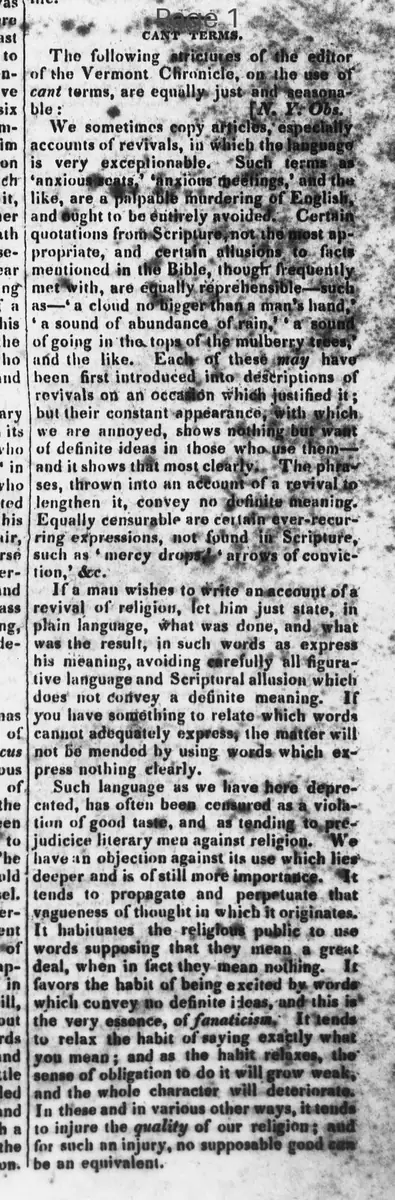
CANT TERMS.
The following strictures of the editor of the Vermont Chronicle, on the use of cant terms, are equally just and seasonable:
We sometimes copy articles, especially accounts of revivals, in which the language is very exceptionable. Such terms as 'anxious seats, anxious meetings' and the like, are a palpable murdering of English; and ought to be entirely avoided. Certain quotations from Scripture, not the most appropriate, and certain allusions to facts mentioned in the Bible, though frequently met with, are equally reprehensible such as—'a cloud no bigger than a man's hand,' 'a sound of abundance of rain,' 'a sound of going in the tops of the mulberry trees,' and the like. Each of these may have been first introduced into descriptions of revivals on an occasion which justified it: but their constant appearance, with which we are annoyed, shows nothing but want of definite ideas in those who use them and it shows that most clearly. The phrases, thrown into an account of a revival to lengthen it, convey no definite meaning. Equally censurable are certain ever-recurring expressions, not found in Scripture, such as 'mercy droppings' 'arrows of conviction,' &c.
If a man wishes to write an account of a revival of religion, let him just state, in plain language, what was done, and what was the result, in such words as express his meaning, avoiding carefully all figurative language and Scriptural allusion which does not convey a definite meaning. If you have something to relate which words cannot adequately express, the matter will not be mended by using words which express nothing clearly.
Such language as we have here deprecated, has often been censured as a violation of good taste, and as tending to prejudice literary men against religion. We have an objection against its use which lies deeper and is of still more importance. It tends to propagate and perpetuate, that vagueness of thought in which it originates. It habituates the religious public to use words supposing that they mean a great deal, when in act they mean nothing. It favors the habit of being excited by words which convey no definite ideas, and this is the very essence, of fanaticism. It tends to relax the habit of saying exactly what you mean; and as the habit relaxes, the sense of obligation to do it will grow weak, and the whole character will deteriorate. In these and in various other ways, it tends to injure the quality of our religion; and for such an injury, no supposable good can be an equivalent.
The following strictures of the editor of the Vermont Chronicle, on the use of cant terms, are equally just and seasonable:
We sometimes copy articles, especially accounts of revivals, in which the language is very exceptionable. Such terms as 'anxious seats, anxious meetings' and the like, are a palpable murdering of English; and ought to be entirely avoided. Certain quotations from Scripture, not the most appropriate, and certain allusions to facts mentioned in the Bible, though frequently met with, are equally reprehensible such as—'a cloud no bigger than a man's hand,' 'a sound of abundance of rain,' 'a sound of going in the tops of the mulberry trees,' and the like. Each of these may have been first introduced into descriptions of revivals on an occasion which justified it: but their constant appearance, with which we are annoyed, shows nothing but want of definite ideas in those who use them and it shows that most clearly. The phrases, thrown into an account of a revival to lengthen it, convey no definite meaning. Equally censurable are certain ever-recurring expressions, not found in Scripture, such as 'mercy droppings' 'arrows of conviction,' &c.
If a man wishes to write an account of a revival of religion, let him just state, in plain language, what was done, and what was the result, in such words as express his meaning, avoiding carefully all figurative language and Scriptural allusion which does not convey a definite meaning. If you have something to relate which words cannot adequately express, the matter will not be mended by using words which express nothing clearly.
Such language as we have here deprecated, has often been censured as a violation of good taste, and as tending to prejudice literary men against religion. We have an objection against its use which lies deeper and is of still more importance. It tends to propagate and perpetuate, that vagueness of thought in which it originates. It habituates the religious public to use words supposing that they mean a great deal, when in act they mean nothing. It favors the habit of being excited by words which convey no definite ideas, and this is the very essence, of fanaticism. It tends to relax the habit of saying exactly what you mean; and as the habit relaxes, the sense of obligation to do it will grow weak, and the whole character will deteriorate. In these and in various other ways, it tends to injure the quality of our religion; and for such an injury, no supposable good can be an equivalent.
What sub-type of article is it?
Moral Or Religious
What keywords are associated?
Cant Terms
Religious Revivals
Vague Language
Scriptural Allusions
Fanaticism
Plain Language
What entities or persons were involved?
Editor Of The Vermont Chronicle
Editorial Details
Primary Topic
Criticism Of Cant Terms In Religious Revival Accounts
Stance / Tone
Strongly Critical Of Vague And Figurative Religious Language
Key Figures
Editor Of The Vermont Chronicle
Key Arguments
Cant Terms Like 'Anxious Seats' Murder English And Should Be Avoided
Inappropriate Scriptural Allusions Convey No Definite Meaning And Show Lack Of Ideas
Figurative Phrases Lengthen Accounts Without Adding Clarity
Such Language Promotes Vagueness Of Thought And Fanaticism
It Habituates People To Excitement By Empty Words, Deteriorating Character And Religion