Thank you for visiting SNEWPapers!
Sign up free
Gazette Of The United States, & Philadelphia Daily Advertiser
Philadelphia, Philadelphia County, Pennsylvania
What is this article about?
A May 8, 1799, communication from York, Pennsylvania, publishes an August 1798 address from the Synod of Ulster to their Presbyterian congregations in Ireland. It condemns the recent rebellion, notes minimal clergy involvement, urges loyalty to the King and Constitution, opposes French influence, and promotes peace and religious tolerance.
Clipping
OCR Quality
Full Text
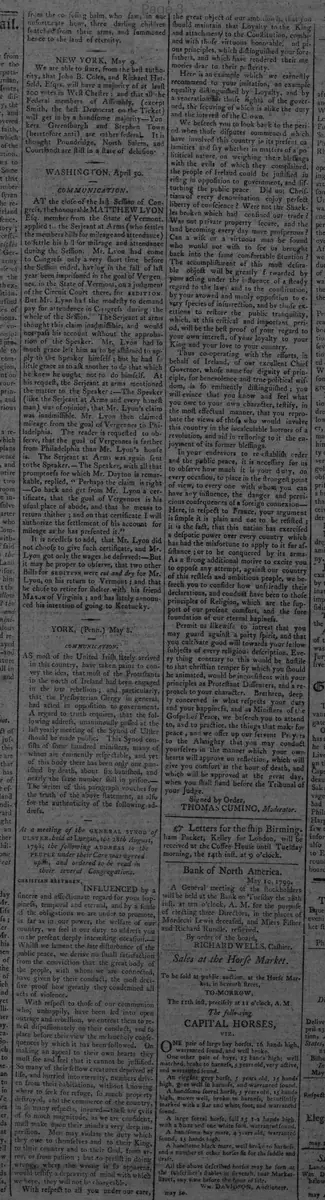
COMMUNICATION.
AS most of the United Irish lately arrived in this country, have taken pains to convey the idea, that most of the Protestants in the north of Ireland had been engaged in the late rebellion; and particularly, that the Presbyterian Clergy in general, had acted in opposition to government.
A regard to truth requires, that the following address, unanimously passed at the last yearly meeting of the Synod of Ulster should be made public. This Synod consists of some hundred ministers, many of whom are eminently respectable, and yet of this body there has been only one punished by death, about six banished, and nearly the same number still in prison.
The writer of this paragraph vouches for the truth of the above statement, as also for the authenticity of the following address.
At a meeting of the GENERAL SYNOD of ULSTER, held at Lurgan, the 28th August, 1798; the following ADDRESS to the PEOPLE under their Care was agreed upon, and ordered to be read in their several Congregations.
INFLUENCED by a sincere and affectionate regard for your happiness, temporal and eternal, and by a sense of the obligations we are under to promote, as far as in our power, the welfare of our country, we feel it our duty to address you on the present deeply interesting occasion.
Whilst we lament the late disturbance of the public peace, we derive no small satisfaction from the conviction that the great body of the people, with whom we are connected, have given by their conduct, the most decisive proof how greatly they condemned all acts of violence.
With respect to those of our communion who, unhappily, have been led into open outrage and rebellion, we entreat them to reflect dispassionately on their conduct, and to place before their view the melancholy consequences by which it has been followed. On making an appeal to their own hearts they must see and feel that it cannot be justified. So many of their fellow creatures deprived of life, and hurried into eternity, numbers driven from their habitations, without knowing where to seek for refuge, so much property destroyed, and the commerce of the country, in so many respects, injured—these are evils of so much magnitude, as we are confident, must make upon their minds a very deep impression. Men may violate the duty which they owe to themselves and to their King, to their country and to their God, from error, or from passion; but, to persist in doing wrong, where the wrong is so apparent, would testify a depravity of mind with which we hope, they will not be chargeable.
The great object of our ambition is, that you should maintain that Loyalty to the King and attachment to the Constitution, combined with those virtuous honorable and pious principles, which distinguished your forefathers, and which have rendered their memories dear to their posterity.
Here is an example which we earnestly recommend to your imitation, an example equally distinguished by Loyalty, and by a veneration for those rights of the governed, the securing of which is alike the duty and the interest of the Crown.
We beseech you to look back to the period when those disputes commenced which have involved this country in its present calamities. and say whether in matters of a political nature, on weighing their blessings with the evils of which they complained; the people of Ireland could be justified in rising in opposition to government, and disturbing the public peace. Did not Christians of every denomination enjoy perfect liberty of conscience? Were not the Shackles broken which had confined our trade? Was not private property secure, and the land becoming every day more prosperous?
Can a wise or a virtuous man be found who would not wish to see us brought back into the same comfortable situation? The accomplishment of this most desirable object will be greatly forwarded by your acting under the influence of a steady regard to the laws and to the constitution, by your avowed and manly opposition to every species of insurrection, and by those exertions to restore the public tranquility, which, at this critical and important period, will be the best proof of your regard to your own interest, of your loyalty to your King and your love to your country.
Thus co-operating with the efforts, in behalf of Ireland, of our excellent Chief Governor, whose name for dignity of principle, for benevolence and true political wisdom, is so eminently distinguished; you will evince that you know and feel what you owe to your own character, testify, in the most effectual manner, that you reprobate the views of those who would involve this country in the incalculable horrors of a revolution, and aid in restoring to it the enjoyment of its former blessings.
In your endeavors to re-establish order and the public peace, it is necessary for us to observe how much it is your duty, on every occasion, to place in the strongest point of view, to every one with whom you can have any influence, the danger and pernicious consequences of a foreign connexion—Here, in respect to France, your argument is simple it is plain and not to be resisted; it is the fact, that this nation has exercised a despotic power over every country which has had the misfortune to apply to it for assistance ;or to be conquered by its arms.
As a strong additional motive to excite you to oppose any attempt, against our country of this restless and ambitious people, we beseech you to consider how unfriendly their declarations, and conduct have been to those principles of Religion, which are the support of our present comfort, and the sure foundation of our eternal happiness.
Permit us likewise to intreat that you may guard against a party spirit, and that you cultivate good will towards your fellow subjects of every religious description. Every thing contrary to this would be hostile to that christian temper by which you should be animated, would be inconsistent with your principles as Protestant Dissenters, and a reproach to your character. Brethren, deeply concerned in what respects your duty and your happiness, and as Ministers of the Gospel of Peace, we beseech you to attend to, and to practice, the things that make for peace , and we offer up our fervent Prayers to the Almighty that you may conduct yourselves in the manner which your own hearts will approve on reflection, which will give you comfort at the hour of death, and which will be approved at the great day, when you shall stand before the Tribunal of your Judge.
Signed by Order,
THOMAS CUMING, Moderator.
What sub-type of article is it?
What themes does it cover?
What keywords are associated?
What entities or persons were involved?
Letter to Editor Details
Author
Thomas Cuming, Moderator
Recipient
The People Under Their Care
Main Argument
the synod condemns the irish rebellion of 1798, urges reflection on its consequences, promotes loyalty to the king and constitution, opposes insurrection and french influence, and calls for peace, religious tolerance, and virtuous conduct among presbyterian congregations.
Notable Details