Thank you for visiting SNEWPapers!
Sign up free
Richmond Enquirer
Richmond, Richmond County, Virginia
What is this article about?
Trials in Baltimore of mail robbers John Alexander, Lewis Hare, and Joseph T. Hare for robbing a mail coach near the Susquehanna River in March 1818. Alexander confessed fully; all convicted. Lewis Hare, aged 20, received 10 years imprisonment after pardon on capital counts. Alexander and J.T. Hare sentenced to death by hanging.
Merged-components note: These sequential components continue the same article on the trial of the mail robbers, forming a single coherent story.
Clipping
OCR Quality
Full Text
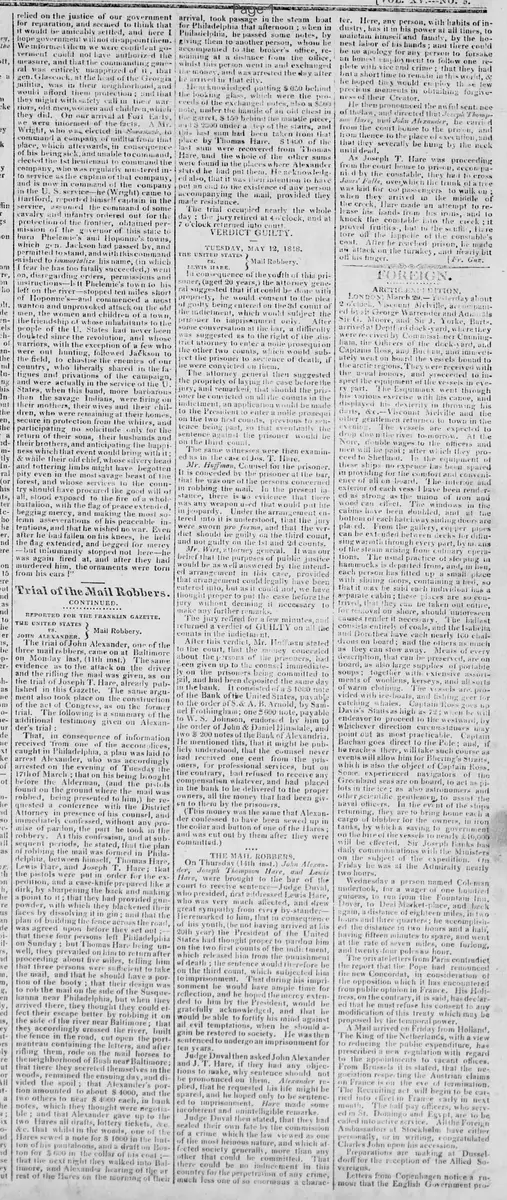
CONTINUED.
REPORTED FOR THE FRANKLIN GAZETTE.
THE UNITED STATES
vs.
Mail Robbery.
JOHN ALEXANDER.
The trial of John Alexander, one of the three mail robbers, came on at Baltimore on Monday last, (11th inst.) The same evidence as to the attack on the driver and the rifling the mail was given, as on the trial of Joseph T. Hare, already published in this Gazette. The same argument also took place on the construction of the act of Congress, as on the former trial. The following is a summary of the additional testimony given on Alexander's trial:
That, in consequence of information received from one of the accomplices, caught in Philadelphia, a plan was laid to arrest Alexander, who was accordingly arrested on the evening of Tuesday the 17th of March; that on his being brought before the Alderman, (and the pistols found on the ground where the mail was robbed, being presented to him,) he requested a conference with the District Attorney in presence of his counsel, and immediately confessed, without any promise of pardon, the part he took in the robbery. At this confession, and at subsequent periods, he stated, that the plan of robbing the mail was formed in Philadelphia, between himself, Thomas Hare, Lewis Hare, and Joseph T. Hare: that the pistols were put in order for the expedition, and a case-knife prepared like a dirk, by sharpening the back and making a point to it; that they had provided gun-powder, with which they blackened their faces by dissolving it in gin; and that the plan of building the fence across the road, was agreed upon before they set out:—that these four persons left Philadelphia on Sunday; but Thomas Hare being unwell, they prevailed on him to return after proceeding about five miles, telling him that three persons were sufficient to take the mail, and that he should have a portion of the booty; that their design was to rob the mail on the side of the Susquehanna near Philadelphia, but when they arrived there, they thought they could effect their escape better by robbing it on the side of the river near Baltimore; that they accordingly crossed the river, built the fence in the road, cut open the portmanteau containing the letters, and after rifling them, rode on the mail horses to the neighborhood of Bush near Baltimore: that there they secreted themselves in the woods, remained the ensuing day, and divided the spoil; that Alexander's portion amounted to about $4000, and the two others to near $4000 each, in bank notes, which they thought were negotiable; and that Alexander gave up to the two Hares all drafts, lottery tickets, &c. &c. that whilst in the woods, one of the Hares sewed a note for $1000 in the button of his pantaloons, and a draft on Boston for $600 in the collar of his coat;—that the next night they walked into Baltimore, and Alexander hearing of the arrest of the Hares on the morning of their arrival, took passage in the steam boat for Philadelphia that afternoon; when in Philadelphia, he passed some notes, by giving them to another person, whom he accompanied to the broker's office, remaining at a distance from the office, whilst this person went in and exchanged the money, and was arrested the day after he arrived in that city. He acknowledged putting $500 behind the looking glass, which were the proceeds of the exchanged notes, also a $500 note, under the handle of an old chest in the garret, $150 behind the mantle piece, and $2000 under a step of the stairs, and this last sum had been taken from that place by Thomas Hare, $1400 of the last sum were recovered from Thomas Hare, and the whole of the other sums were found in the places where Alexander stated he had put them. He acknowledged also, that it was their intention to have put an end to the existence of any person accompanying the mail, provided they made resistance.
The trial occupied nearly the whole day: the jury retired at 4 o'clock, and at 7 o'clock returned into court.
VERDICT GUILTY.
TUESDAY, MAY 12, 1818.
THE UNITED STATES
vs.
Mail Robbery.
LEWIS HARE.
In consequence of the youth of this prisoner, (aged 20 years,) the attorney general suggested that if it could be done with propriety, he would consent to the plea of guilty being entered on the 3d count of the indictment, which would subject the prisoner to imprisonment only. After some conversation at the bar, a difficulty was suggested as to the right of the district attorney to enter a nolle prosequi on the other two counts, which would subject the prisoner to sentence of death, if he were convicted on them.
The attorney general then suggested the propriety of laying the case before the jury, and remarked, that should the prisoner be convicted on all the counts in the indictment, an application would be made to the President to enter a nolle prosequi on the two first counts, previous to sentence being passed, so that eventually the sentence against the prisoner would be on the 3d count.
The same witnesses were then examined as in the case of Jos. T. Hare.
Mr. Hoffman, Counsel for the prisoner.
It is conceded by the prisoner at the bar, that he was one of the persons concerned in robbing the mail. In the present instance, there is no evidence that there was any weapon used that would put life in jeopardy."
Under the arrangement entered into it is understood, that the jury were sworn pro forma, and that the verdict should be guilty on the third count, and not guilty on the 1st and 2d counts.
Mr. Wirt, attorney general. It was our belief that the purposes of public justice would be as well answered by the intended arrangement in this case, provided that arrangement could legally have been entered into, but as it could not, we have thought proper to put the case before the jury without deeming it necessary to make any further remarks.
The jury retired for a few minutes, and returned a verdict of GUILTY on all the counts in the indictment.
After this verdict, Mr. Hoffman stated to the court, that the money concealed about the persons of the prisoners, had been given up to the counsel immediately on the prisoners being committed to jail, and had been deposited the same day in the bank. It consisted of a $1000 note of the Bank of the United States, payable to the order of S. & A. B. Arnold, by Samuel Trothingham; one $500 note, payable to W. S. Johnson, endorsed by him to the order of John & Daniel Hinsdale, and two $200 notes of the Bank of Alexandria. He mentioned this, that it might be publicly understood, that the counsel never had received one cent from the prisoners, for professional services, but on the contrary, had refused to receive any compensation whatever, and had placed in the bank to be delivered to the proper owners, all the money that had been given to them by the prisoners.
(This money was the same that Alexander confessed to have been sewed up in the collar and button of one of the Hares; and was cut out by them after they were committed.)
THE MAIL ROBBERS,
On Thursday (14th inst.) John Alexander, Joseph Thompson Hare, and Lewis Hare, were brought to the bar of the court to receive sentence—Judge Duval, who presided, first addressed Lewis Hare, who was very much affected, and drew great sympathy from every by-stander—He remarked to him, that in consequence of his youth, (he not having arrived at his 20th year) the President of the United States had thought proper to pardon him on the two first counts of the indictment, which released him from the punishment of death: the sentence would therefore be on the third count, which subjected him to imprisonment. That during his imprisonment he would have ample time for reflection, and he hoped the mercy extended to him by the President, would be gratefully acknowledged, and that he would be able to fortify his mind against all evil temptations, when he should again be restored to society. He was then sentenced to undergo an imprisonment for ten years.
Judge Duval then asked John Alexander and J. T. Hare, if they had any objections to make, why sentence should not be pronounced on them. Alexander replied, that he requested his life might be spared, and he hoped only to be sentenced to imprisonment. Hare made some incoherent and unintelligible remarks.
Judge Duval then stated, that they had sealed their own fate by the commission of a crime which the law viewed as one of the most heinous nature, and which affected society generally, more than any other that could be committed. That there could be no inducement in this country for the perpetration of any crime, much less one of so enormous a character.
ter. Here, any person, with habits of industry, has it in his power at all times, to maintain himself and family, by the honest labor of his hands; and there could be no apology for any person to forsake an honest employment to follow one replete with vice and crime: that they had but a short time to remain in this world, & he hoped they would employ these few precious moments in obtaining forgiveness of their Creator.
He then pronounced the awful sentence of the law, and directed that Joseph Thompson Hare, and John Alexander, be carried from the court house to the prison, and from thence to the place of execution, and that they severally be hung by the neck until dead.
As Joseph T. Hare was proceeding from the court house to prison, accompanied by the constable, they had to cross Jones' Falls, over which the trunk of a tree was laid for foot passengers to walk on: when they arrived on the middle of the creek, Hare made an attempt to release his hands from his irons, and to knock the constable into the creek; it proved fruitless, but in the struggle, Hare tore off the lappet of the constable's coat. After he reached prison, he made an attack on the turnkey, and nearly bit off his finger.
[Fr. Gaz.
What sub-type of article is it?
What themes does it cover?
What keywords are associated?
What entities or persons were involved?
Where did it happen?
Story Details
Key Persons
Location
Baltimore
Event Date
May 1818
Story Details
John Alexander confessed to planning and executing a mail robbery with the Hare brothers in March 1818 near the Susquehanna River, stealing thousands in bank notes. Tried and convicted in Baltimore; sentenced to death. Lewis Hare, aged 20, convicted but pardoned on capital counts and imprisoned for 10 years. Joseph T. Hare also sentenced to death and attempted escape en route to prison.