Thank you for visiting SNEWPapers!
Sign up free
Story
May 22, 1869
The State Rights Democrat
Albany, Linn County, Oregon
What is this article about?
Article advises on proper hind shoeing for horses pulling heavy loads uphill to prevent leg twisting, improve traction, and avoid injuries like spavins. Recommends square-toed shoes for better grip.
Clipping
OCR Quality
98%
Excellent
Full Text
SHOES.
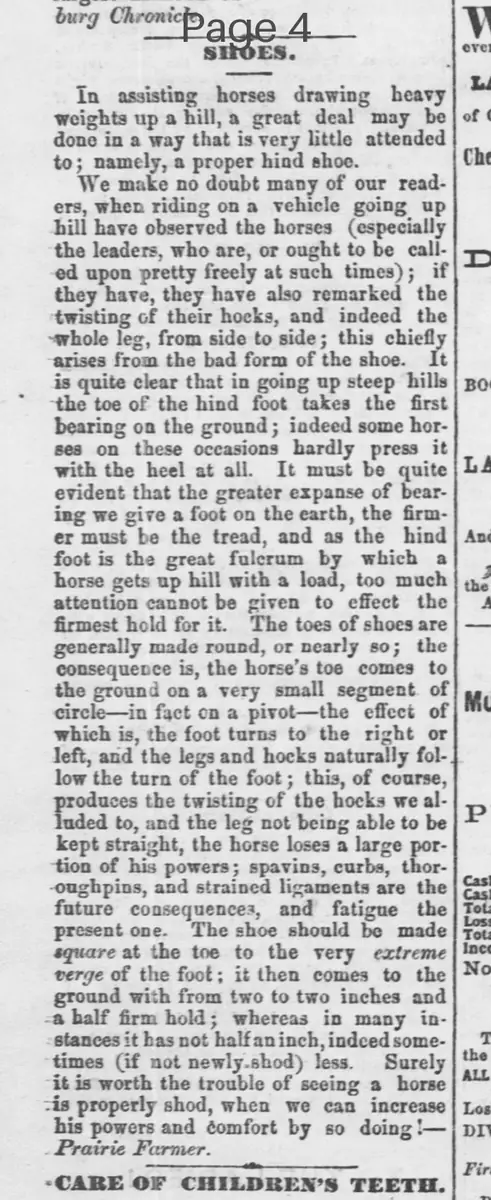
In assisting horses drawing heavy weights up a hill, a great deal may be done in a way that is very little attended to; namely, a proper hind shoe. We make no doubt many of our readers, when riding on a vehicle going up hill have observed the horses (especially the leaders, who are, or ought to be called upon pretty freely at such times); if they have, they have also remarked the twisting of their hocks, and indeed the whole leg from side to side; this chiefly arises from the bad form of the shoe. It is quite clear that in going up steep hills the toe of the hind foot takes the first bearing on the ground; indeed some horses on these occasions hardly press it with the heel at all. It must be quite evident that the greater expanse of bearing we give a foot on the earth, the firmer must be the tread, and as the hind foot is the great fulcrum by which a horse gets up hill with a load, too much attention cannot be given to effect the firmest hold for it. The toes of shoes are generally made round, or nearly so; the consequence is, the horse's toe comes to the ground on a very small segment of circle--in fact on a pivot--the effect of which is, the foot turns to the right or left, and the legs and hocks naturally follow the turn of the foot; this, of course, produces the twisting of the hocks we alluded to, and the leg not being able to be kept straight, the horse loses a large portion of his powers; spavins, curbs, thoroughpins, and strained ligaments are the future consequences, and fatigue the present one. The shoe should be made square at the toe to the very extreme verge of the foot: it then comes to the ground with from two to two inches and a half firm hold; whereas in many instances it has not half an inch, indeed some times (if not newly shod) less. Surely it is worth the trouble of seeing a horse is properly shod, when we can increase his powers and comfort by so doing!--Prairie Farmer.
In assisting horses drawing heavy weights up a hill, a great deal may be done in a way that is very little attended to; namely, a proper hind shoe. We make no doubt many of our readers, when riding on a vehicle going up hill have observed the horses (especially the leaders, who are, or ought to be called upon pretty freely at such times); if they have, they have also remarked the twisting of their hocks, and indeed the whole leg from side to side; this chiefly arises from the bad form of the shoe. It is quite clear that in going up steep hills the toe of the hind foot takes the first bearing on the ground; indeed some horses on these occasions hardly press it with the heel at all. It must be quite evident that the greater expanse of bearing we give a foot on the earth, the firmer must be the tread, and as the hind foot is the great fulcrum by which a horse gets up hill with a load, too much attention cannot be given to effect the firmest hold for it. The toes of shoes are generally made round, or nearly so; the consequence is, the horse's toe comes to the ground on a very small segment of circle--in fact on a pivot--the effect of which is, the foot turns to the right or left, and the legs and hocks naturally follow the turn of the foot; this, of course, produces the twisting of the hocks we alluded to, and the leg not being able to be kept straight, the horse loses a large portion of his powers; spavins, curbs, thoroughpins, and strained ligaments are the future consequences, and fatigue the present one. The shoe should be made square at the toe to the very extreme verge of the foot: it then comes to the ground with from two to two inches and a half firm hold; whereas in many instances it has not half an inch, indeed some times (if not newly shod) less. Surely it is worth the trouble of seeing a horse is properly shod, when we can increase his powers and comfort by so doing!--Prairie Farmer.
What sub-type of article is it?
Practical Advice
What keywords are associated?
Horse Shoeing
Hind Shoes
Uphill Traction
Animal Injuries
Proper Shoeing
Story Details
Story Details
Advises using square-toed hind shoes for horses to provide better traction when pulling loads uphill, preventing hock twisting, power loss, and injuries like spavins.