Thank you for visiting SNEWPapers!
Sign up free
Daily National Intelligencer
Washington, District Of Columbia
What is this article about?
House of Representatives committee report on February 9 analyzing US commercial intercourse with British West India Islands and North American colonies. It details trade imbalances favoring British shipping, recommends reciprocity or protective duties to safeguard US navigation interests, emphasizing essential supplies to colonies and potential circuitous trade.
Clipping
OCR Quality
Full Text
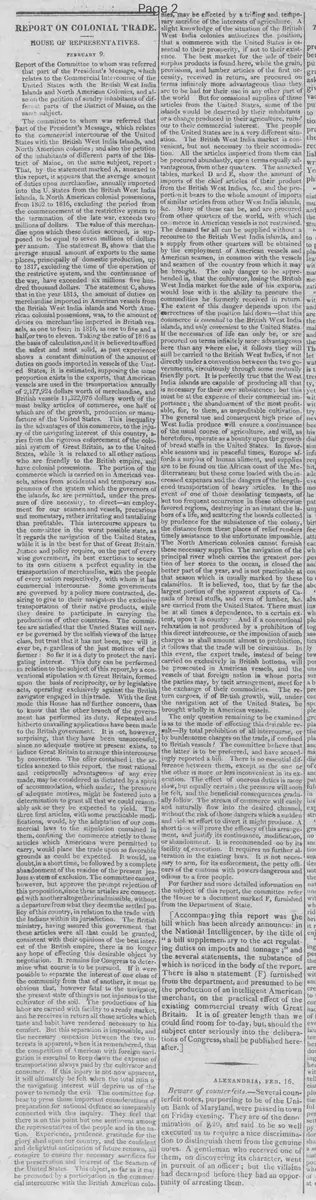
HOUSE OF REPRESENTATIVES.
FEBRUARY 9.
Report of the Committee to whom was referred that part of the President's Message, which relates to the Commercial Intercourse of the United States with the British West India Islands and North American Colonies, and also on the petition of sundry inhabitants of different parts of the District of Maine, on the same subject.
The committee to whom was referred that part of the President's Message, which relates to the commercial intercourse of the United States with the British West India Islands, and North American colonies; and also the petition of the inhabitants of different parts of the District of Maine, on the same subject, report:
That, by the statement marked A, annexed to this report, it appears that the average amount of duties upon merchandise, annually imported into the U. States from the British West India islands, & North American colonial possessions, from 1802 to 1816, excluding the period from the commencement of the restrictive system to the termination of the late war, exceeds two millions of dollars. The value of this merchandise upon which these duties accrued, is supposed to be equal to seven millions of dollars per annum. The statement B, shows that the average annual amount of exports to the same places, principally of domestic production, up to 1817, excluding the time of the operation of the restrictive system, and the continuance of the war, have exceeded six millions five hundred thousand dollars. The statement C, shows that in the year 1815, the amount of duties on merchandise imported in American vessels from the British West India islands and North American colonial possessions, was, to the amount of duties on merchandise imported in British vessels, as one to four; in 1816, as one to five and a half, or two to eleven. Taking the ratio of 1816 as the basis of calculation, and it is believed to afford the safest and most solid, as past experience shows a constant diminution of the amount of duties on goods imported in vessels of the United States, it is estimated, supposing the same proportion exists in the exports, that American vessels are used in the transportation annually of 2,177,924 dollars worth of merchandise, and British vessels 11,322,076 dollars worth of the most bulky articles of commerce, one half of which are of the growth, production or manufacture of the United States. This inequality in the advantages of this commerce, to the injury of the navigating interest of this country, arises from the rigorous enforcement of the colonial system of Great Britain, as to the United States, while it is relaxed to all other nations who are friendly to the British empire, and have colonial possessions. The portion of the commerce which is carried on in American vessels, arises from accidental and temporary suspensions of the system which the governors of the islands, &c. are permitted, under the pressure of dire necessity, to direct—an employment for our seamen and vessels, precarious and momentary, rather irritating and tantalizing than profitable. This intercourse appears to the committee in the worst possible state, as it regards the navigation of the United States, while it is in the best for that of Great Britain. Justice and policy require, on the part of every wise government, its best exertions to secure to its own citizens a perfect equality in the transportation of merchandise, with the people of every nation respectively, with whom it has commercial intercourse. Some governments are governed by a policy more contracted, desiring to give to their navigators the exclusive transportation of their native products, while they desire to participate in carrying the productions of other countries. The committee are satisfied that the United States will never be governed by the selfish views of the latter class, but trust that it has not been, nor will it ever be, regardless of the just motives of the former: So far it is a duty to protect the navigating interest. This duty can be performed in relation to the subject of this report, by a conventional stipulation with Great Britain, formed upon the basis of reciprocity, or by legislative acts, operating exclusively against the British navigator engaged in this trade. With the first mode this House has no further concern, than to know that the other branch of the government has performed its duty. Repeated and hitherto unavailing applications have been made to the British government. It is not, however, surprising, that they have been unsuccessful, since no adequate motive at present exists, to induce Great Britain to arrange this intercourse by convention. The offer contained in the articles annexed to this report, the most rational and reciprocally advantageous of any ever made, may be considered as dictated by a spirit of accommodation, which under the pressure of adequate motives, might be fostered into a determination to grant all that we could reasonably ask or they be expected to yield. The three first articles, with some practicable modifications, would, by the adaptation of our commercial laws to the stipulation contained in them, confining the commerce strictly to those articles which Americans were permitted to carry, would place the trade upon as favorable grounds as could be expected. It would, no doubt, in a short time, be followed by a complete abandonment of the residue of the present jealous system of exclusion. The committee cannot, however, but approve the prompt rejection of this proposition, since these articles are connected with another altogether inadmissible, without a departure from what they deem the settled policy of this country, in relation to the trade with the Indians within its jurisdiction. The British ministry, having assured this government that these articles were all that could be granted, consistent with their opinions of the best interest of the British empire, there is no longer any hope of effecting this desirable object by negotiation. It remains for Congress to determine what course is to be pursued. If it were possible to separate the interest of one class of the community from that of another, it must be obvious that, however fatal to the navigator, the present state of things is not injurious to the cultivator of the soil. The productions of his labor are carried with facility to a ready market, and he receives in return all those articles which taste and habit have rendered necessary to his comfort. But this separation is impossible, and the necessary connexion between the two interests is apparent, when it is remembered, that the competition of American with foreign navigation is essential to keep down the expense of transportation always paid by the cultivator and consumer. If this injury is not now apparent, it will ultimately be felt when the total ruin of the navigating interest will deprive us of the power to remedy the evil. The committee forbear to press those important considerations of preparation for national defence so inseparably connected with this inquiry. They feel that there is on this point but one sentiment among the representatives of the people and in the nation. Experience, prudence, gratitude for the glory shed upon our country, and the confident and delightful anticipation of future renown, all conspire to ensure the necessary sacrifices for the preservation and interest of the Seamen of the United States. This object, so far as it may be promoted by a participation in the commercial intercourse with the British American colonies, may be effected by a trifling and temporary sacrifice of the interests of agriculture. A slight knowledge of the situation of the British West India colonies authorizes the position, that a commerce with the United States is essential to their prosperity, if not to their existence. The best market for the sale of their surplus products is found here, while the grain, provisions, and lumber articles of the first necessity, received in return, are procured on terms infinitely more advantageous than they are to be had for their use in any other part of the world. But for occasional supplies of those articles from the United States, some of the islands would be deserted by their inhabitants or a change produced in their agriculture, ruinous to their commercial interest. The people of the United States are in a very different situation. The British West India market is convenient, but not necessary to their accommodation. All the articles imported from them can be procured abundantly, upon terms equally advantageous, from other quarters. The annexed tables, marked D and E, show the amount of imports of the chief articles of their product from the British West Indies, &c. and the proportion it bears to the whole amount of imports of similar articles from other West India islands, &c. Many of these can be, and are procured from other quarters of the world, with which commerce in American vessels is not restrained. The demand for all can be supplied without a recourse to the British West India islands, and a supply from other quarters will be obtained by the employment of American vessels and American seamen, in common with the vessels and seamen of the country from which it may be brought. The only danger to be apprehended is, that the cultivator, losing the British West India market for the sale of his exports, would lose with it the ability to procure the commodities he formerly received in return. The extent of this danger depends upon the correctness of the position laid down—that this commerce is essential to the British West India islands, and only convenient to the United States. If the necessaries of life can only be, or are procured on terms infinitely more advantageous here than any where else, it follows they will still be carried to the British West Indies, if not directly under a convention between the two governments, circuitously through some mutually friendly port. It is perfectly true that the West India islands are capable of producing all that is necessary for their own subsistence; but this must be at the expense of their commercial importance; the abandonment of the most profitable, for, to them, an unprofitable cultivation. The general use and consequent high price of West India produce will ensure a continuance of the usual course of agriculture, and will, as heretofore, operate as a bounty upon the growth of bread stuffs in the United States. In favorable seasons and in peaceful times, Europe affords a surplus of human aliment, and supplies are to be found on the African coast of the Mediterranean; but these come loaded with the increased expenses and the dangers of the lengthened transportation of heavy articles. In the event of one of those desolating tempests, of but too frequent occurrence in these otherwise favored regions, destroying in an instant the labors of a life, and scattering the hoards collected by prudence for the subsistence of the colony, the distance from these places of relief renders timely assistance to the unfortunate impossible. The North American colonies cannot furnish these necessary supplies. The navigation of the principal river which carries the greatest portion of her stores to the ocean, is closed the better part of the year, and is not practicable at that season which is usually marked by these calamities. It is believed, too, that by far the largest portion of the apparent exports of Canada of bread stuffs, and even of lumber, &c, are carried from the United States. There must be at all times a dependence, to a certain extent, upon this country. And if a conventional relaxation is not produced by a prohibition of this direct intercourse, or the imposition of such charges as shall amount almost to prohibition, it follows that the trade will be circuitous. In this event, the export trade, instead of being carried on exclusively in British bottoms, will be prosecuted in American vessels, and the vessels of that foreign nation in whose ports the parties may, by tacit arrangement, meet for the exchange of their commodities. The return cargoes, if of British growth, will, under the navigation act of the United States, be brought wholly in American vessels.
The only question remaining to be examined is as to the mode of effecting this desirable result—By total prohibition of all intercourse, or by burdensome charges on the trade, if confined to British vessels? The committee believe that the latter is to be preferred, and have accordingly reported a bill. There is no essential difference between them, except as the one or the other is more or less inconvenient in its execution. The effect of onerous duties is more slow, but equally certain; the pressure will soon be felt, and the beneficial consequences gradually follow. The stream of commerce will easily and naturally flow into the desired channel, without the risk of those dangers which a sudden and violent effort to divert it might produce. A short time will prove the efficacy of this arrangement, and justify its continuance, modification, or abandonment. It is recommended too by its facility of execution. It requires no further alteration in the existing laws. It is not necessary to arm, for its enforcement, the petty officers of the customs with powers dangerous and odious to a free people.
For further and more detailed information on the subject of this report, the committee refer the House to a document marked F, furnished from the Department of State.
Accompanying this report was the bill which has been already announced in the National Intelligencer, by the title of 'a bill supplementary to the act regulating duties on imports and tonnage;' and the several statements, the substance of which is noticed in the body of the report. There is also a statement (F) furnished from the department, and presumed to be the production of an intelligent American merchant, on the practical effect of the existing commercial treaty with Great Britain. It is of greater length than we could find room for to-day, but, should the subject enter seriously into the deliberations of Congress, shall be published hereafter.
What sub-type of article is it?
What themes does it cover?
What keywords are associated?
Where did it happen?
Story Details
Location
United States, British West India Islands, North American Colonies, District Of Maine
Event Date
February 9
Story Details
Committee report analyzes trade data from 1802-1817 showing imbalances in shipping favoring British vessels due to colonial policies. Recommends reciprocity via negotiation or protective duties on British ships to promote US navigation, arguing trade is essential to British colonies but not to US, potentially shifting to circuitous routes benefiting American vessels.