Thank you for visiting SNEWPapers!
Sign up free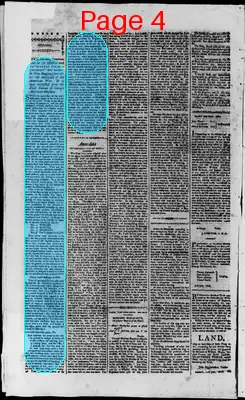
Literary
August 14, 1806
Lynchburg Star
Lynchburg, Virginia
What is this article about?
A satirical essay from post-American Revolution New England proposes a public 'Market for Matrimony' fair to revive marriage and population growth, dividing women into wards like virgins and widows, with rules for display, inspection, and enforcement to mimic commercial trade.
Clipping
OCR Quality
95%
Excellent
Full Text
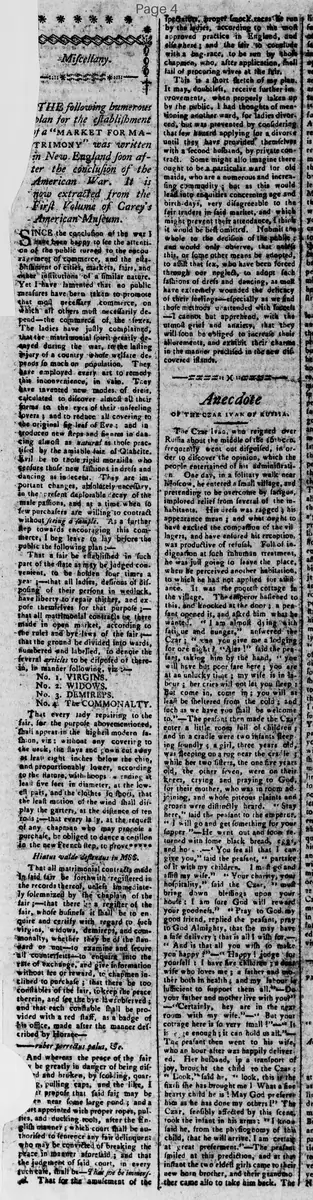
THE following humorous plan for the establishment of a "MARKET FOR MATRIMONY" was written in New England soon after the conclusion of the American War. It is now extracted from the First Volume of Carey's American Museum.
SINCE the conclusion of the war I have been happy to see the attention of the public turned to the encouragement of commerce, and the establishment of cities, markets, fairs, and other institutions of a similar nature. Yet I have lamented that no public measures have been taken to promote that most necessary commerce, on which all others must necessarily depend—the commerce of the sexes.
The ladies have justly complained that the matrimonial spirit greatly decayed during the war, to the lasting injury of a country whose welfare depends so much on population. They have employed every art to remedy this inconvenience, in vain. They have invented new modes of dress, calculated to discover almost all their forms to the eyes of their unfeeling lovers; and to reduce all covering to the original fig leaf of Eve; and have introduced new steps and figures in dancing almost as natural as those practiced by the amiable fair of Otaheite.
It will be to those rigid moralists who censure those new fashions in dress and dancing as indecent. They are important changes, absolutely necessary, in the present deplorable decay of the male patrons, and at a time when so few purchasers are willing to contract without seeing a sample. As a further step towards encouraging this commerce, I beg leave to lay before the public the following plan:
That a fair be established in such part of the state as may be judged convenient, to be holden four times a year—that all ladies, desirous of disposing of their persons in wedlock, have liberty to repair thither, and expose themselves for that purpose—that all matrimonial contracts be there made in open market, according to the rules and by-laws of the fair—that the ground be divided into wards, numbered and labelled, to denote the several articles to be disposed of therein, in manner following, viz.
No. 1. VIRGINS.
No. 2. WIDOWS.
No. 3. DEMIREPS.
No. 4. The COMMONALTY.
That every lady repairing to the fair, for the purpose aforementioned, shall appear in the highest modern fashion, viz: without any covering to the neck, the stays and gown cut away at least eight inches below the chin, and proportionably lower, according to the stature, with hoops ending at least five feet in diameter, at the lowest part, and the clothes so short, that the least motion of the wind shall display the garters, at the distance of ten rods;—that every lady, at the request of any chapman who may propose a purchase, be obliged to dance a cotillon in the new French step, to prove rectitude;
That all matrimonial contracts made in said fair be forthwith registered in the records thereof, unless immediately solemnized by the chaplain of the fair;—that there be a register of the fair, whose business it shall be to enquire and certify with regard to such Virgins, widows, demireps and commonalty, whether they be of the standard or not—to examine and secure if counterfeits—to enquire into the rate of exchange, and give information without fee or reward, to chapmen inclined to purchase; that there be two constables of the fair, to keep the peace therein, and see the bye laws observed: and that each constable shall be provided with a red staff, as a badge of his office, made after the manner described by Horace—
And whereas the peace of the fair may be greatly in danger of being disturbed and broken, by scolding, quarrelling, pulling caps, and the like, I would propose that said fair may be held near some large pond; and a court appointed with proper ropes, pulleys, and ducking stools, after the English manner; which court shall be authorised to sentence any fair delinquent who may be convicted of breaking the peace in manner aforesaid; and that the judgment of said court, in every such case, shall be—that she be immersed—
That for the amusement of the spectators, proper mock-races be run by the ladies, according to the most approved practice in England, and elsewhere: and the fair to conclude with a bag-race, to be run by those chapmen, who, after application, shall fail of procuring wives at the fair.
This is a short sketch of my plan. It may, doubtless, receive further improvements, when properly taken up by the public. I had thoughts of mentioning another ward, for ladies divorced, but was prevented by considering that few hazard applying for a divorce until they have provided themselves with a second husband, by private contract. Some might also imagine there ought to be a particular ward for old maids, who are a numerous and increasing commodity; but as this would lead into enquiries concerning age and birth-days, very disagreeable to the fair traders in said market, and which might prevent their attendance I think it would be best omitted. I submit the whole to the decision of the public, and would only observe, that unless this, or some other means be adopted, to assist that sex, who have been forced through our neglect, to adopt such fashions of dress and dancing, as must have extremely wounded the delicacy of their feelings—especially as we see those methods were unattended with success—I cannot but apprehend, with the utmost grief and anxiety that they will soon be obliged to increase their allurements, and exhibit their charms in the manner prescribed in the newly discovered islands.
SINCE the conclusion of the war I have been happy to see the attention of the public turned to the encouragement of commerce, and the establishment of cities, markets, fairs, and other institutions of a similar nature. Yet I have lamented that no public measures have been taken to promote that most necessary commerce, on which all others must necessarily depend—the commerce of the sexes.
The ladies have justly complained that the matrimonial spirit greatly decayed during the war, to the lasting injury of a country whose welfare depends so much on population. They have employed every art to remedy this inconvenience, in vain. They have invented new modes of dress, calculated to discover almost all their forms to the eyes of their unfeeling lovers; and to reduce all covering to the original fig leaf of Eve; and have introduced new steps and figures in dancing almost as natural as those practiced by the amiable fair of Otaheite.
It will be to those rigid moralists who censure those new fashions in dress and dancing as indecent. They are important changes, absolutely necessary, in the present deplorable decay of the male patrons, and at a time when so few purchasers are willing to contract without seeing a sample. As a further step towards encouraging this commerce, I beg leave to lay before the public the following plan:
That a fair be established in such part of the state as may be judged convenient, to be holden four times a year—that all ladies, desirous of disposing of their persons in wedlock, have liberty to repair thither, and expose themselves for that purpose—that all matrimonial contracts be there made in open market, according to the rules and by-laws of the fair—that the ground be divided into wards, numbered and labelled, to denote the several articles to be disposed of therein, in manner following, viz.
No. 1. VIRGINS.
No. 2. WIDOWS.
No. 3. DEMIREPS.
No. 4. The COMMONALTY.
That every lady repairing to the fair, for the purpose aforementioned, shall appear in the highest modern fashion, viz: without any covering to the neck, the stays and gown cut away at least eight inches below the chin, and proportionably lower, according to the stature, with hoops ending at least five feet in diameter, at the lowest part, and the clothes so short, that the least motion of the wind shall display the garters, at the distance of ten rods;—that every lady, at the request of any chapman who may propose a purchase, be obliged to dance a cotillon in the new French step, to prove rectitude;
That all matrimonial contracts made in said fair be forthwith registered in the records thereof, unless immediately solemnized by the chaplain of the fair;—that there be a register of the fair, whose business it shall be to enquire and certify with regard to such Virgins, widows, demireps and commonalty, whether they be of the standard or not—to examine and secure if counterfeits—to enquire into the rate of exchange, and give information without fee or reward, to chapmen inclined to purchase; that there be two constables of the fair, to keep the peace therein, and see the bye laws observed: and that each constable shall be provided with a red staff, as a badge of his office, made after the manner described by Horace—
And whereas the peace of the fair may be greatly in danger of being disturbed and broken, by scolding, quarrelling, pulling caps, and the like, I would propose that said fair may be held near some large pond; and a court appointed with proper ropes, pulleys, and ducking stools, after the English manner; which court shall be authorised to sentence any fair delinquent who may be convicted of breaking the peace in manner aforesaid; and that the judgment of said court, in every such case, shall be—that she be immersed—
That for the amusement of the spectators, proper mock-races be run by the ladies, according to the most approved practice in England, and elsewhere: and the fair to conclude with a bag-race, to be run by those chapmen, who, after application, shall fail of procuring wives at the fair.
This is a short sketch of my plan. It may, doubtless, receive further improvements, when properly taken up by the public. I had thoughts of mentioning another ward, for ladies divorced, but was prevented by considering that few hazard applying for a divorce until they have provided themselves with a second husband, by private contract. Some might also imagine there ought to be a particular ward for old maids, who are a numerous and increasing commodity; but as this would lead into enquiries concerning age and birth-days, very disagreeable to the fair traders in said market, and which might prevent their attendance I think it would be best omitted. I submit the whole to the decision of the public, and would only observe, that unless this, or some other means be adopted, to assist that sex, who have been forced through our neglect, to adopt such fashions of dress and dancing, as must have extremely wounded the delicacy of their feelings—especially as we see those methods were unattended with success—I cannot but apprehend, with the utmost grief and anxiety that they will soon be obliged to increase their allurements, and exhibit their charms in the manner prescribed in the newly discovered islands.
What sub-type of article is it?
Satire
Essay
What themes does it cover?
Commerce Trade
Social Manners
Love Romance
What keywords are associated?
Matrimony Fair
Satirical Plan
Post War Population
Marriage Market
Women's Wards
Fashion Satire
Literary Details
Title
Market For Matrimony
Subject
Plan To Promote Matrimony After The American War
Form / Style
Satirical Proposal In Prose
Key Lines
That A Fair Be Established In Such Part Of The State As May Be Judged Convenient, To Be Holden Four Times A Year—That All Ladies, Desirous Of Disposing Of Their Persons In Wedlock, Have Liberty To Repair Thither, And Expose Themselves For That Purpose—
No. 1. Virgins.
No. 2. Widows.
No. 3. Demireps.
No. 4. The Commonalty.
Unless This, Or Some Other Means Be Adopted, To Assist That Sex, Who Have Been Forced Through Our Neglect, To Adopt Such Fashions Of Dress And Dancing, As Must Have Extremely Wounded The Delicacy Of Their Feelings