Thank you for visiting SNEWPapers!
Sign up free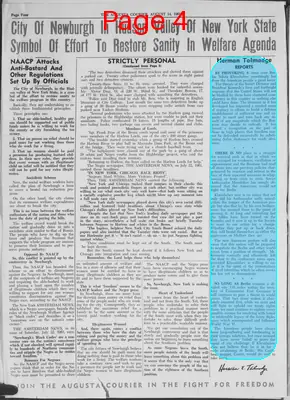
Editorial
August 14, 1961
The Augusta Courier
Augusta, Richmond County, Georgia
What is this article about?
In this editorial, Senator Herman Talmadge praises President Kennedy's firm response to Nikita Khrushchev's threats over Berlin, crediting it with shattering American complacency, bolstering defense efforts, rejecting appeasement, and enabling negotiations from strength while upholding US treaty rights amid Cold War tensions.
Clipping
OCR Quality
98%
Excellent
Full Text
Herman
Talmadge
REPORTS
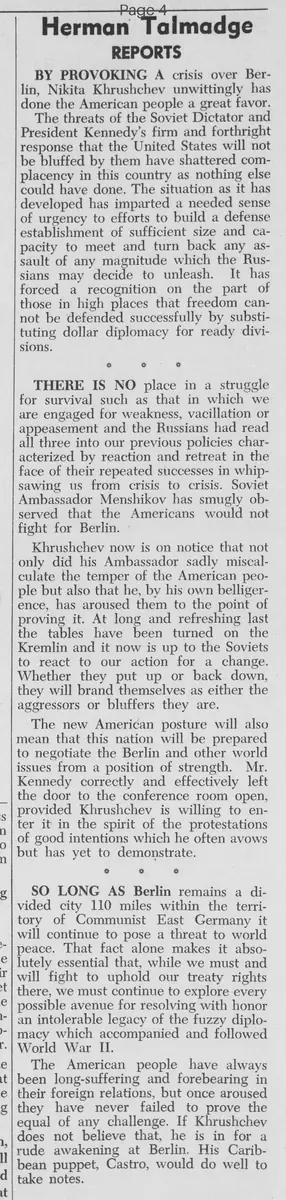
BY PROVOKING A crisis over Berlin, Nikita Khrushchev unwittingly has done the American people a great favor.
The threats of the Soviet Dictator and President Kennedy's firm and forthright response that the United States will not be bluffed by them have shattered complacency in this country as nothing else could have done. The situation as it has developed has imparted a needed sense of urgency to efforts to build a defense establishment of sufficient size and capacity to meet and turn back any assault of any magnitude which the Russians may decide to unleash. It has forced a recognition on the part of those in high places that freedom cannot be defended successfully by substituting dollar diplomacy for ready divisions.
THERE IS NO place in a struggle for survival such as that in which we are engaged for weakness, vacillation or appeasement and the Russians had read all three into our previous policies characterized by reaction and retreat in the face of their repeated successes in whipsawing us from crisis to crisis. Soviet Ambassador Menshikov has smugly observed that the Americans would not fight for Berlin.
Khrushchev now is on notice that not only did his Ambassador sadly miscalculate the temper of the American people but also that he, by his own belligerence, has aroused them to the point of proving it. At long and refreshing last the tables have been turned on the Kremlin and it now is up to the Soviets to react to our action for a change.
Whether they put up or back down, they will brand themselves as either the aggressors or bluffers they are.
The new American posture will also mean that this nation will be prepared to negotiate the Berlin and other world issues from a position of strength. Mr. Kennedy correctly and effectively left the door to the conference room open, provided Khrushchev is willing to enter it in the spirit of the protestations of good intentions which he often avows but has yet to demonstrate.
SO LONG AS Berlin remains a divided city 110 miles within the territory of Communist East Germany it will continue to pose a threat to world peace. That fact alone makes it absolutely essential that, while we must and will fight to uphold our treaty rights there, we must continue to explore every possible avenue for resolving with honor an intolerable legacy of the fuzzy diplomacy which accompanied and followed World War II.
The American people have always been long-suffering and forebearing in their foreign relations, but once aroused they have never failed to prove the equal of any challenge. If Khrushchev does not believe that, he is in for a rude awakening at Berlin. His Caribbean puppet, Castro, would do well to take notes.
Talmadge
REPORTS
BY PROVOKING A crisis over Berlin, Nikita Khrushchev unwittingly has done the American people a great favor.
The threats of the Soviet Dictator and President Kennedy's firm and forthright response that the United States will not be bluffed by them have shattered complacency in this country as nothing else could have done. The situation as it has developed has imparted a needed sense of urgency to efforts to build a defense establishment of sufficient size and capacity to meet and turn back any assault of any magnitude which the Russians may decide to unleash. It has forced a recognition on the part of those in high places that freedom cannot be defended successfully by substituting dollar diplomacy for ready divisions.
THERE IS NO place in a struggle for survival such as that in which we are engaged for weakness, vacillation or appeasement and the Russians had read all three into our previous policies characterized by reaction and retreat in the face of their repeated successes in whipsawing us from crisis to crisis. Soviet Ambassador Menshikov has smugly observed that the Americans would not fight for Berlin.
Khrushchev now is on notice that not only did his Ambassador sadly miscalculate the temper of the American people but also that he, by his own belligerence, has aroused them to the point of proving it. At long and refreshing last the tables have been turned on the Kremlin and it now is up to the Soviets to react to our action for a change.
Whether they put up or back down, they will brand themselves as either the aggressors or bluffers they are.
The new American posture will also mean that this nation will be prepared to negotiate the Berlin and other world issues from a position of strength. Mr. Kennedy correctly and effectively left the door to the conference room open, provided Khrushchev is willing to enter it in the spirit of the protestations of good intentions which he often avows but has yet to demonstrate.
SO LONG AS Berlin remains a divided city 110 miles within the territory of Communist East Germany it will continue to pose a threat to world peace. That fact alone makes it absolutely essential that, while we must and will fight to uphold our treaty rights there, we must continue to explore every possible avenue for resolving with honor an intolerable legacy of the fuzzy diplomacy which accompanied and followed World War II.
The American people have always been long-suffering and forebearing in their foreign relations, but once aroused they have never failed to prove the equal of any challenge. If Khrushchev does not believe that, he is in for a rude awakening at Berlin. His Caribbean puppet, Castro, would do well to take notes.
What sub-type of article is it?
Foreign Affairs
War Or Peace
Military Affairs
What keywords are associated?
Berlin Crisis
Khrushchev Threats
Kennedy Response
Us Defense
Cold War Tensions
Anti Appeasement
Soviet Bluff
What entities or persons were involved?
Nikita Khrushchev
President Kennedy
Soviet Ambassador Menshikov
Castro
Editorial Details
Primary Topic
Us Firm Response To Soviet Berlin Crisis
Stance / Tone
Strongly Supportive Of Kennedy's Anti Appeasement Stance
Key Figures
Nikita Khrushchev
President Kennedy
Soviet Ambassador Menshikov
Castro
Key Arguments
Khrushchev's Berlin Threats Have Awakened American Resolve Against Complacency
Kennedy's Response Emphasizes Strong Defense Over Dollar Diplomacy
Previous Us Policies Showed Weakness And Appeasement, Misread By Soviets
Us Will Not Be Bluffed And Is Prepared To Fight For Berlin
Negotiate From Strength While Keeping Conference Door Open
Berlin's Status Poses Ongoing Threat, Requiring Honorable Resolution Of Wwii Legacy
Aroused Americans Will Meet Any Challenge