Thank you for visiting SNEWPapers!
Sign up free
Literary
February 28, 1850
The Evansville Daily Journal
Evansville, Vanderburgh County, Indiana
What is this article about?
A French pedlar in Sardinia lends money to a desperate wedding guest under threat, who later repays him with interest through hospitality and family. The tale contrasts the pedlar's prudence with English merchants' folly, from Chambers' Journal.
Clipping
OCR Quality
98%
Excellent
Full Text
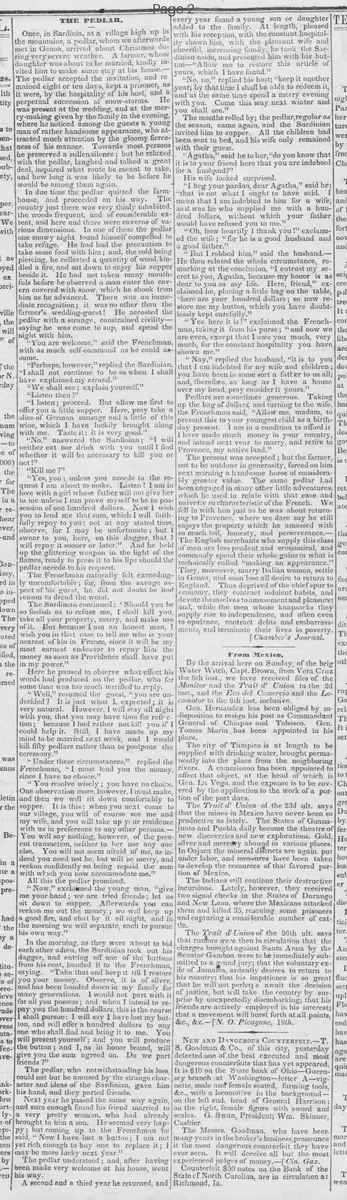
THE PEDLAR.
Once, in Sardinia, at a village high up in the mountains, a pedlar, whom we afterwards met in Genoa, arrived about Christmas during very severe weather. A farmer, whose daughter was about to be married, kindly invited him to make some stay at his house. The pedlar accepted the invitation, and remained eight or ten days, kept a prisoner, as it were, by the hospitality of his host, and a perpetual succession of snow-storms. He was present at the wedding, and at the merry-making given by the family in the evening, where he noticed among the guests a young man of rather handsome appearance, who attracted much attention by the gloomy fierceness of his manner. Towards most persons he preserved a sullen silence: but he relaxed with the pedlar, laughed and talked a great deal, inquired what route he meant to take, and how long it was likely to be before he would be among them again.
In due time the pedlar quitted the farm-house, and proceeded on his way. The country just there was very thinly inhabited, the woods frequent, and of considerable extent, and here and there were caverns of various dimensions. In one of these the pedlar one snowy night found himself compelled to take refuge. He had had the precaution to take some food with him; and, the cold being piercing, he collected a quantity of wood, kindled a fire, and sat down to enjoy his supper beside it. He had not taken many mouthfuls before he observed a man enter the cavern covered with snow, which he shook from him as he advanced. There was an immediate recognition; it was no other than the farmer's wedding-guest! He accosted the pedlar with a strange, constrained civility—saying he was come to sup, and spend the night with him.
"You are welcome," said the Frenchman with as much self-command as he could assume.
"Perhaps, however," replied the Sardinian, "I shall not continue to be so when I shall have explained my errand."
"We shall see; explain yourself."
"Listen then!"
"I listen; proceed. But allow me first to offer you a little supper. Here, pray take a slice of German sausage and a little of this wine, which I have luckily brought along with me. Taste it; it is very good."
"No," answered the Sardinian; "I will neither eat nor drink with you until I find whether it will be necessary to kill you or not!"
"Kill me?"
"Yes, you; unless you accede to the request I am about to make. Listen! I am in love with a girl whose father will not give her to me unless I can prove myself to be in possession of one hundred dollars. Now I wish you to lend me that sum, which I will faithfully repay to you: not at any stated time, observe, for I may be unfortunate; but I swear to you, here, on this dagger, that I will repay it sooner or later." And he held up the glittering weapon in the light of the flames, ready to press it to his lips should the pedlar accede to his request.
The Frenchman naturally felt exceedingly uncomfortable; for, from the savage aspect of his guest, he did not doubt he had reason to dread the worst.
The Sardinian continued: "Should you be so foolish as to refuse me, I shall kill you, take all your property, marry, and make use of it. But because I am an honest man, I wish you in that case to tell me who is your nearest of kin in France, since it will be my most earnest endeavor to repay him the money as soon as Providence shall have put it in my power."
Here he paused to observe what effect his words had produced on the pedlar, who for some time was too much terrified to reply.
"Well," resumed the guest, "you are undecided? It is just what I expected; it is very natural. However, I will stay all night with you, that you may have time for reflection; because I had rather not kill you if I could help it. Still, I have made up my mind to be married next week, and I would kill fifty pedlars rather than to postpone the ceremony."
"Under these circumstances," replied the Frenchman, "I must lend you the money, since I have no choice."
"You resolve wisely: you have no choice. One observation more, however, I must make, and then we will sit down comfortably to supper. It is this: when you next come to our village, you will of course see me and my wife, and you will take up your residence with us in preference to any other persons. You will say nothing, however, of the present transaction, neither to her nor any one else. You will not seem afraid of me, as indeed you need not be, but will be merry, and reckon confidently on being repaid the sum with which you now accommodate me."
All this the pedlar promised.
"Now," exclaimed the young man, "give me your hand; we are tried friends; let us sit down to supper. Afterwards you can reckon me out the money; we will keep up a good fire, and chat by it all night, and in the morning we will separate, each to pursue his own way."
In the morning, as they were about to bid each other adieu, the Sardinian took out his dagger, and cutting off one of the buttons from his coat, handed it to the Frenchman, saying, "Take that and keep it till I restore you your money. Observe, it is of silver, and has been handed down in my family for many generations. I would not part with it for all you possess; and when I intend to repay you the hundred dollars, this is the course I shall pursue: I will say I have lost my button, and will offer a hundred dollars to any one who shall find and bring it to me. You will present yourself; and you will produce the button; and I, as in honor bound, will give you the sum agreed on. Do we part friends?"
The pedlar, who notwithstanding his loss could not but be amused by the strange character and ideas of the Sardinian, gave him his hand, and they parted friends.
Next year he passed the same way again, and sure enough found his friend married to a very pretty woman, who had already brought to him a son. He seemed very happy; but coming up to the Frenchman he said, "Now I have lost a button; I am not yet rich enough to buy one to replace it; I may be more lucky next year."
The pedlar understood; and, after having been made very welcome at his house, went his way.
A second and a third year he returned, and every year found a young son or daughter added to the family. At length, pleased with his reception, with the constant hospitality shown him, with the pleasant wife and cheerful, increasing family, he took the Sardinian aside, and presented him with his button—"Allow me to restore this article of yours, which I have found."
"No, no," replied his host; "keep it another year; by that time I shall be able to redeem it, and at the same time spend a merry evening with you. Come this way next winter and you shall see."
The months rolled by; the pedlar, regular as the season, came again, and the Sardinian invited him to supper. All the children had been sent to bed, and his wife only remained with their guest.
"Agatha," said he to her, "do you know that it is to your friend here that you are indebted for a husband?"
His wife looked surprised.
"I beg your pardon, dear Agatha," said he; "that is not what I ought to have said. I mean that I am indebted to him for a wife, as it was he who supplied me with a hundred dollars, without which your father would have refused you to me."
"Oh, how heartily I thank you!" exclaimed the wife; "for he is a good husband and a good father."
"But I robbed him," said the husband. He then related the whole circumstance, remarking at the conclusion, "I entrust my secret to you, Agatha, because my honor is as dear to you as my life. Here, friend," exclaimed he, placing a little bag on the table, "here are your hundred dollars; so now restore me my button, which you have doubtless kept carefully."
"Yes, here it is!" exclaimed the Frenchman, taking it from his purse; "and now we are even, except that I owe you much, very much, for the constant hospitality you have shown me."
"Nay," replied the husband, "it is to you that I am indebted for my wife and children; you have been in some sort a father to us all; and, therefore, so long as I have a house over my head, pray consider it yours."
Pedlars are sometimes generous. Taking up the bag of dollars, and turning to the wife, the Frenchman said, "Allow me, madam, to present this to your youngest child as a birthday present. I am in a condition to afford it. I have made much money in your country, and intend next year to marry, and retire to Provence, my native land."
The present was accepted; but the farmer, not to be outdone in generosity, forced on him next morning a handsome horse of considerably greater value. The same pedlar had been engaged in many other little adventures, which he used to relate with that ease and naiveté so characteristic of the French. We fell in with him just as he was about returning to Provence, where we dare say he still enjoys the property which he amassed with so much toil, honesty, and perseverance.
The English merchants who supply this class of men are less prudent and economical, and commonly spend their whole gains in what is technically called "making an appearance." They, moreover, marry Italian women, settle in Genoa, and soon lose all desire to return to England. Thus deprived of the chief spur to economy, they contract indolent habits, and devote themselves to amusement and pleasure: and, while the men whose knapsacks they supply rise to independence, and often even to opulence, contract debts and embarrassments, and terminate their lives in poverty.
[Chambers' Journal.]
Once, in Sardinia, at a village high up in the mountains, a pedlar, whom we afterwards met in Genoa, arrived about Christmas during very severe weather. A farmer, whose daughter was about to be married, kindly invited him to make some stay at his house. The pedlar accepted the invitation, and remained eight or ten days, kept a prisoner, as it were, by the hospitality of his host, and a perpetual succession of snow-storms. He was present at the wedding, and at the merry-making given by the family in the evening, where he noticed among the guests a young man of rather handsome appearance, who attracted much attention by the gloomy fierceness of his manner. Towards most persons he preserved a sullen silence: but he relaxed with the pedlar, laughed and talked a great deal, inquired what route he meant to take, and how long it was likely to be before he would be among them again.
In due time the pedlar quitted the farm-house, and proceeded on his way. The country just there was very thinly inhabited, the woods frequent, and of considerable extent, and here and there were caverns of various dimensions. In one of these the pedlar one snowy night found himself compelled to take refuge. He had had the precaution to take some food with him; and, the cold being piercing, he collected a quantity of wood, kindled a fire, and sat down to enjoy his supper beside it. He had not taken many mouthfuls before he observed a man enter the cavern covered with snow, which he shook from him as he advanced. There was an immediate recognition; it was no other than the farmer's wedding-guest! He accosted the pedlar with a strange, constrained civility—saying he was come to sup, and spend the night with him.
"You are welcome," said the Frenchman with as much self-command as he could assume.
"Perhaps, however," replied the Sardinian, "I shall not continue to be so when I shall have explained my errand."
"We shall see; explain yourself."
"Listen then!"
"I listen; proceed. But allow me first to offer you a little supper. Here, pray take a slice of German sausage and a little of this wine, which I have luckily brought along with me. Taste it; it is very good."
"No," answered the Sardinian; "I will neither eat nor drink with you until I find whether it will be necessary to kill you or not!"
"Kill me?"
"Yes, you; unless you accede to the request I am about to make. Listen! I am in love with a girl whose father will not give her to me unless I can prove myself to be in possession of one hundred dollars. Now I wish you to lend me that sum, which I will faithfully repay to you: not at any stated time, observe, for I may be unfortunate; but I swear to you, here, on this dagger, that I will repay it sooner or later." And he held up the glittering weapon in the light of the flames, ready to press it to his lips should the pedlar accede to his request.
The Frenchman naturally felt exceedingly uncomfortable; for, from the savage aspect of his guest, he did not doubt he had reason to dread the worst.
The Sardinian continued: "Should you be so foolish as to refuse me, I shall kill you, take all your property, marry, and make use of it. But because I am an honest man, I wish you in that case to tell me who is your nearest of kin in France, since it will be my most earnest endeavor to repay him the money as soon as Providence shall have put it in my power."
Here he paused to observe what effect his words had produced on the pedlar, who for some time was too much terrified to reply.
"Well," resumed the guest, "you are undecided? It is just what I expected; it is very natural. However, I will stay all night with you, that you may have time for reflection; because I had rather not kill you if I could help it. Still, I have made up my mind to be married next week, and I would kill fifty pedlars rather than to postpone the ceremony."
"Under these circumstances," replied the Frenchman, "I must lend you the money, since I have no choice."
"You resolve wisely: you have no choice. One observation more, however, I must make, and then we will sit down comfortably to supper. It is this: when you next come to our village, you will of course see me and my wife, and you will take up your residence with us in preference to any other persons. You will say nothing, however, of the present transaction, neither to her nor any one else. You will not seem afraid of me, as indeed you need not be, but will be merry, and reckon confidently on being repaid the sum with which you now accommodate me."
All this the pedlar promised.
"Now," exclaimed the young man, "give me your hand; we are tried friends; let us sit down to supper. Afterwards you can reckon me out the money; we will keep up a good fire, and chat by it all night, and in the morning we will separate, each to pursue his own way."
In the morning, as they were about to bid each other adieu, the Sardinian took out his dagger, and cutting off one of the buttons from his coat, handed it to the Frenchman, saying, "Take that and keep it till I restore you your money. Observe, it is of silver, and has been handed down in my family for many generations. I would not part with it for all you possess; and when I intend to repay you the hundred dollars, this is the course I shall pursue: I will say I have lost my button, and will offer a hundred dollars to any one who shall find and bring it to me. You will present yourself; and you will produce the button; and I, as in honor bound, will give you the sum agreed on. Do we part friends?"
The pedlar, who notwithstanding his loss could not but be amused by the strange character and ideas of the Sardinian, gave him his hand, and they parted friends.
Next year he passed the same way again, and sure enough found his friend married to a very pretty woman, who had already brought to him a son. He seemed very happy; but coming up to the Frenchman he said, "Now I have lost a button; I am not yet rich enough to buy one to replace it; I may be more lucky next year."
The pedlar understood; and, after having been made very welcome at his house, went his way.
A second and a third year he returned, and every year found a young son or daughter added to the family. At length, pleased with his reception, with the constant hospitality shown him, with the pleasant wife and cheerful, increasing family, he took the Sardinian aside, and presented him with his button—"Allow me to restore this article of yours, which I have found."
"No, no," replied his host; "keep it another year; by that time I shall be able to redeem it, and at the same time spend a merry evening with you. Come this way next winter and you shall see."
The months rolled by; the pedlar, regular as the season, came again, and the Sardinian invited him to supper. All the children had been sent to bed, and his wife only remained with their guest.
"Agatha," said he to her, "do you know that it is to your friend here that you are indebted for a husband?"
His wife looked surprised.
"I beg your pardon, dear Agatha," said he; "that is not what I ought to have said. I mean that I am indebted to him for a wife, as it was he who supplied me with a hundred dollars, without which your father would have refused you to me."
"Oh, how heartily I thank you!" exclaimed the wife; "for he is a good husband and a good father."
"But I robbed him," said the husband. He then related the whole circumstance, remarking at the conclusion, "I entrust my secret to you, Agatha, because my honor is as dear to you as my life. Here, friend," exclaimed he, placing a little bag on the table, "here are your hundred dollars; so now restore me my button, which you have doubtless kept carefully."
"Yes, here it is!" exclaimed the Frenchman, taking it from his purse; "and now we are even, except that I owe you much, very much, for the constant hospitality you have shown me."
"Nay," replied the husband, "it is to you that I am indebted for my wife and children; you have been in some sort a father to us all; and, therefore, so long as I have a house over my head, pray consider it yours."
Pedlars are sometimes generous. Taking up the bag of dollars, and turning to the wife, the Frenchman said, "Allow me, madam, to present this to your youngest child as a birthday present. I am in a condition to afford it. I have made much money in your country, and intend next year to marry, and retire to Provence, my native land."
The present was accepted; but the farmer, not to be outdone in generosity, forced on him next morning a handsome horse of considerably greater value. The same pedlar had been engaged in many other little adventures, which he used to relate with that ease and naiveté so characteristic of the French. We fell in with him just as he was about returning to Provence, where we dare say he still enjoys the property which he amassed with so much toil, honesty, and perseverance.
The English merchants who supply this class of men are less prudent and economical, and commonly spend their whole gains in what is technically called "making an appearance." They, moreover, marry Italian women, settle in Genoa, and soon lose all desire to return to England. Thus deprived of the chief spur to economy, they contract indolent habits, and devote themselves to amusement and pleasure: and, while the men whose knapsacks they supply rise to independence, and often even to opulence, contract debts and embarrassments, and terminate their lives in poverty.
[Chambers' Journal.]
What sub-type of article is it?
Prose Fiction
What themes does it cover?
Moral Virtue
Friendship
What keywords are associated?
Pedlar
Sardinia
Hospitality
Honesty
Repayment
Marriage
Dagger
Button
Frenchman
Sardinian
Literary Details
Title
The Pedlar.
Key Lines
"No," Answered The Sardinian; "I Will Neither Eat Nor Drink With You Until I Find Whether It Will Be Necessary To Kill You Or Not!"
"Should You Be So Foolish As To Refuse Me, I Shall Kill You, Take All Your Property, Marry, And Make Use Of It. But Because I Am An Honest Man, I Wish You In That Case To Tell Me Who Is Your Nearest Of Kin In France..."
"Take That And Keep It Till I Restore You Your Money. Observe, It Is Of Silver, And Has Been Handed Down In My Family For Many Generations..."
"But I Robbed Him," Said The Husband. He Then Related The Whole Circumstance...
Pedlars Are Sometimes Generous. Taking Up The Bag Of Dollars...