Thank you for visiting SNEWPapers!
Sign up free
Gazette Of The United States
New York, New York County, New York
What is this article about?
Extract of a letter from Paris dated February 25, 1790, detailing the National Assembly's progress on constitutional reforms, territorial divisions into 83 departments, voting rights for active citizens, military reorganization, and the popularity of Marquis de Lafayette amid the French Revolution.
Clipping
OCR Quality
Full Text
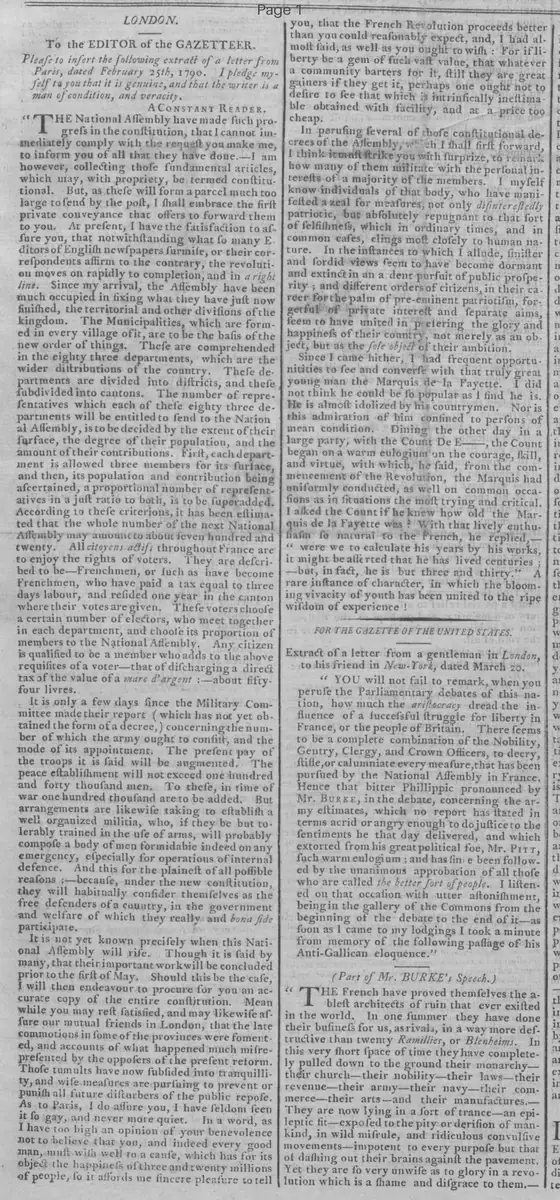
To the EDITOR of the GAZETTEER.
Please to insert the following extract of a letter from Paris, dated February 25th, 1790. I pledge myself to you that it is genuine, and that the writer is a man of condition, and veracity.
A CONSTANT READER.
"The National Assembly have made such progress in the great work of reformation, that I can immediately comply with the request you make me, to inform you of all that they have done. I am however, collecting those fundamental articles, which may, with propriety, be termed constitutional. But, as these will form a parcel much too large to send by the post, I shall embrace the first private conveyance that offers to forward them to you. At present, I have the satisfaction to assure you, that notwithstanding what so many Editors of English newspapers surmise, or their correspondents affirm to the contrary, the revolution moves on rapidly to completion, and in a right line. Since my arrival, the Assembly have been much occupied in fixing what they have just now finished, the territorial and other divisions of the kingdom. The Municipalities, which are formed in every village of it, are to be the basis of the new order of things. These are comprehended in the eighty three departments, which are the wider distributions of the country. These departments are divided into districts, and these subdivided into cantons. The number of representatives which each of these eighty three departments will be entitled to send to the National Assembly, is to be decided by the extent of their surface, the degree of their population, and the amount of their contributions. First, each department is allowed three members for its surface, and then, its population and contribution being ascertained, a proportional number of representatives in a just ratio to both, is to be superadded. According to these criterions, it has been estimated that the whole number of the next National Assembly may amount to about seven hundred and twenty. All citoyens actifs throughout France are to enjoy the rights of voters. They are described to be Frenchmen, or such as have become Frenchmen, who have paid a tax equal to three days labour, and resided one year in the canton where their votes are given. These voters choose a certain number of electors, who meet together in each department, and choose its proportion of members to the National Assembly. Any citizen is qualified to be a member who adds to the above requisites of a voter that of discharging a direct tax of the value of a marc d'argent:—about fifty-four livres.
It is only a few days since the Military Committee made their report (which has not yet obtained the form of a decree,) concerning the number of which the army ought to consist, and the mode of its appointment. The present pay of the troops it is said will be augmented. The peace establishment will not exceed one hundred and forty thousand men. To these, in time of war one hundred thousand are to be added. But arrangements are likewise taking to establish a well organized militia, who, if they be but tolerably trained in the use of arms, will probably compose a body of men formidable indeed on any emergency, especially for operations of internal defence. And this for the plainest of all possible reasons;—because, under the new constitution, they will habitually consider themselves as the free defenders of a country, in the government and welfare of which they really and bona fide participate.
It is not yet known precisely when this National Assembly will rise. Though it is said by many, that their important work will be concluded prior to the first of May. Should this be the case, I will then endeavour to procure for you an accurate copy of the entire constitution. Mean while you may rest satisfied, and may likewise assure our mutual friends in London, that the late commotions in some of the provinces were fomented, and accounts of what happened much misrepresented by the opposers of the present reform. Those tumults have now subsided into tranquillity, and wise measures are pursuing to prevent or punish all future disturbers of the public repose. As to Paris, I do assure you, I have seldom seen it so gay, and never more quiet. In a word, as I have too high an opinion of your benevolence not to believe that you, and indeed every good man, must wish well to a cause, which has for its object the happiness of three and twenty millions of people, so it affords me sincere pleasure to tell you, that the French Revolution proceeds better than you could reasonably expect, and I had almost said, as well as you ought to wish: For if liberty be a gem of such vast value, that whatever a community barters for it, till they are great gainers if they get it, perhaps one ought not to desire to see that which is intrinsically inestimable obtained with facility, and at a price too cheap.
In perusing several of those constitutional decrees of the Assembly, which I shall first forward. I think it must strike you with surprise, to remark how many of them militate with the personal interests of a majority of the members. I myself know individuals of that body, who have manifested a zeal for measures, not only disinterestedly patriotic, but absolutely repugnant to that sort of selfishness, which in ordinary times, and in common cases, clings most closely to human nature. In the instances to which I allude, sinister and sordid views seem to have become dormant and extinct in an ardent pursuit of public prosperity; and different orders of citizens, in their career for the palm of pre-eminent patriotism, forgetful of private interest and separate aims, seem to have united in preferring the glory and happiness of their country, not merely as an object, but as the sole object of their ambition.
Since I came hither, I had frequent opportunities to see and converse with that truly great young man the Marquis de la Fayette. I did not think he could be so popular as I find he is. He is almost idolized by his countrymen. Nor is this admiration of him confined to persons of mean condition. Dining the other day in a large party, with the Count De E—, the Count began on a warm eulogium on the courage, skill, and virtue, with which, he said, from the commencement of the Revolution, the Marquis had uniformly conducted, as well on common occasions as in situations the most trying and critical. I asked the Count if he knew how old the Marquis de la Fayette was? With that lively enthusiasm so natural to the French, he replied,— 'were we to calculate his years by his works, it might be asserted that he has lived centuries; —but, in fact, he is but three and thirty.' A rare instance of character, in which the blooming vivacity of youth has been united to the ripe wisdom of experience!"
What sub-type of article is it?
What keywords are associated?
What entities or persons were involved?
Where did it happen?
Foreign News Details
Primary Location
Paris
Event Date
February 25th, 1790
Key Persons
Outcome
revolution proceeding rapidly; territorial divisions into 83 departments, districts, cantons; voting rights for active citizens; military peace establishment of 140,000 men plus 100,000 in war; militia formation; provincial commotions subsided; constitution expected by may 1st.
Event Details
The National Assembly has advanced reforms, dividing France into 83 departments based on municipalities, with representation proportional to surface, population, and contributions, estimating 720 members next assembly. Active citizens (tax-paying residents) vote for electors who choose assembly members. Military report proposes augmented pay, 140,000 peace troops, 100,000 war additions, and organized militia. Assembly may conclude by May 1st. Provincial tumults subsided; Paris quiet and gay. Members show patriotic zeal. Marquis de la Fayette, aged 33, highly popular.