Thank you for visiting SNEWPapers!
Sign up free
The National Intelligencer And Washington Advertiser
Washington, District Of Columbia
What is this article about?
Account of Abbé Sicard's return to his Paris school for the deaf and dumb after 28 months of proscription during the French Revolution. Hidden by a friend, he wrote his Universal Grammar. Student Jean Massieu, aided by playwright Bouilly and Joseph Bonaparte, petitioned Napoleon for his reinstatement on February 14, 1800, leading to an emotional reunion.
Clipping
OCR Quality
Full Text
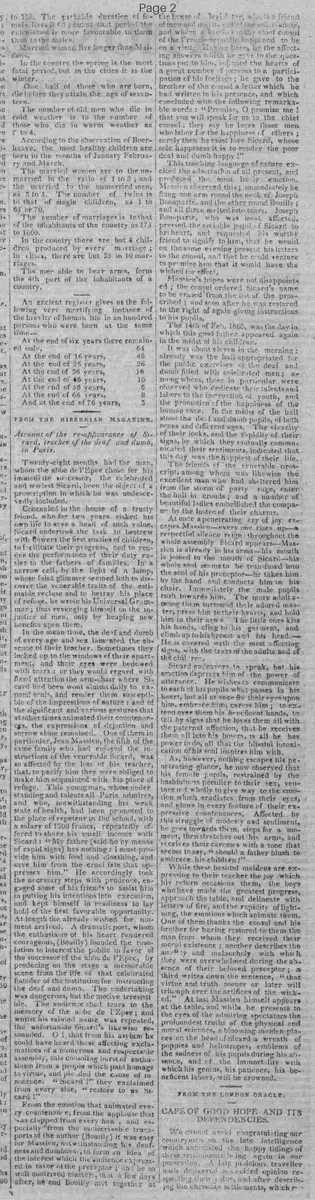
Account of the re-appearance of Sicard, teacher of the deaf and dumb, in Paris.
Twenty-eight months had the man, whom the abbe de l'Epee chose for his immediate successor, the celebrated and honest Sicard, been the object of a proscription in which he was undeservedly included,
Concealed in the house of a trusty friend, who for two years risked his own life to save a head of such value, Sicard undertook the task to bestrew with flowers the first studies of children, to facilitate their progress, and to render the performance of their duty easier to the fathers of families. In a narrow cell, by the light of a lamp, whose faint glimmer seemed loth to discover the venerable traits of the estimable recluse and to betray his place of refuge, he wrote his Universal Grammar; thus revenging himself on the injustice of men, only by heaping new benefits upon them.
In the mean time, the deaf and dumb of every age and sex lamented the absence of their teacher. Sometimes they looked up to the windows of their apartment, and their eyes were bedewed with tears: or they would regard with fixed attention the arm-chair where Sicard had been wont almost daily to expand souls, and render them susceptible of the impressions of nature: and of the significant and various gestures that at other times animated their countenances, the expressions of dejection and sorrow alone remained. One of them in particular, Jean Massieu, the fifth of the same family who had enjoyed the instructions of the venerable Sicard, was so affected by the loss of his teacher, that, to pacify him they were obliged to make him acquainted with his place of refuge. This young man, whose understanding and talents all Paris admires, and who, notwithstanding his weak state of health, had been promoted to the place of repetiteur in the school, with a salary of 1200 francs, repeatedly offered to share his small income with Sicard: "My father (said he by means of rapid signs) has nothing: I must provide him with food and cloathing, and save him from the cruel fate that oppresses him." He accordingly took the necessary steps with prudence, engaged some of his friends to assist him in putting his intentions into execution, and kept himself in readiness to lay hold of the first favorable opportunity.
At length the already wished for moment arrived. A dramatic poet, whom the enthusiasm of his heart rendered courageous, (Bouilly) founded the resolution to interest the public in favor of the successor of the abbe de l'Epee, by producing on the stage a memorable scene from the life of that celebrated founder of the institution for instructing the deaf and dumb. The undertaking was dangerous, but the motive irresistible. The audience shed tears to the memory of the abbe de l'Epee; and whilst his sainted name was repeated, the unfortunate Sicard's likewise resounded. O! that from his asylum he could have heard these affecting exclamations of a numerous and respectable assembly, this consoling burst of enthusiasm from a people which paid homage to virtue, and pleaded the Cause of innocence. "Sicard!" they exclaimed from every side, "restore to us Sicard!"
From the emotion that animated every countenance, from the applause that was clapped from every hand, and especially from the indescribable transports of the author (Bouilly) it was easy for Massieu, notwithstanding his deafness and dumbness, to form an idea of the interest which the audience expressed in favor of the preceptor; and he so well contrived matter, that a few days after, he and Bouilly met together at the house of Legi J. tor, who is a friend of men and merit, and of the unfortunate, and where a brother of the chief consul of the French republic happened to be on a visit. Having here, by the affecting answers which he gave to the questions put to him, softened the hearts of a great number of persons to a participation of his feelings; he gave to the brother of the consul a letter which he had written in his presence, and which concluded with the following remarkable words: "Promise, O promise me! that you will speak for us to the chief consul: they say he loves those men who labor for the happiness of others; surely then he must love Sicard, whose sole happiness it is to render the poor deaf and dumb happy."
This touching language of nature excited the admiration of all present, and produced the most lively emotion. Massieu observed this; immediately he flung one arm round the neck of Joseph Bonaparte, and the other round Bouilly; and all three melted into tears. Joseph Bonaparte, who was most affected, pressed the amiable pupil of Sicard to his heart, and requested his worthy friend to signify to him, that he would on the same evening present his letters to the consul, and that he could venture to promise him that it would have the wished for effect.
Massieu's hopes were not disappointed; the consul ordered Sicard's name to be erased from the list of the proscribed; and soon after he was restored to the right of again giving instructions to his pupils.
The 14th of Feb. 1800, was the day in which this good father appeared again in the midst of his children.
It was about eleven in the morning: already was the hall appropriated for the public exercises of the deaf and dumb filled with celebrated men; among whom, those in particular were observed who dedicate their talents and labors to the instruction of youth, and the promotion of the happiness of the human race. In the midst of the hall stood the deaf and dumb pupils, of both sexes and different ages. The vivacity of their looks, and the rapidity of their signs, by which they mutually communicated their sentiments, indicated that this day was the happiest of their life. The friends of the venerable proscript, among whom was likewise the excellent man who had sheltered him from the storm of party rage, enter the hall in crowds: and a number of beautiful ladies embellished the company by the lustre of their charms. Once a penetrating cry of joy escapes Massieu—every one rises up—a respectful silence reigns throughout the whole assembly Sicard appears—Massieu is already in his arms— his mouth is joined to the mouth of Sicard—his whole soul seems to be transfused into the soul of his preceptor—he takes him by the hand and conducts him to his chair. Immediately the male pupils rush towards him. The more adult among them surround their adored master, press him to their hearts, and hold him in their arms The little ones kiss his hands, cling to his garment, and climb up to his breast and his head.— He is covered with the most affecting signs, with the tears of the adults and of the children.
Sicard endeavors to speak, but his emotion deprives him of the power of utterance. He wishes to communicate to each of his pupils what passes in his heart, but all at once fix their eyes upon him, embrace him, caress him; to extend over them his beneficent hands, to tell by signs that he loves them all with the paternal affection, that he receives them all into his bosom, is all he has power to do, all that the blissful intoxication of his soul inspires him with.
As, however, nothing escapes his penetrating glance, he now observed that his female pupils, restrained by the bashfulness peculiar to their sex, venture not wholly to give way to the emotion which radiates from their eyes, and glows in every feature of their expressive countenances. Affected by this struggle of modesty and sentiment, he goes towards them, stops for a moment, then stretches out his arms, and receives their caresses with a tone that seems to say, "should a father blush to embrace his children?"
While these bashful maidens are expressing to their teacher the joy which his return occasions them, the boys who have made the greatest progress, approach the table, and delineate with letters of fire, and the rapidity of lightning, the emotions which animate them. One of them thanks the consul and his brother for having restored to them the man from whom they received their moral existence: another describes the anxiety and melancholy with which they were overwhelmed during the absence of their beloved preceptor; a third writes down the sentence, "that virtue and truth sooner or later will triumph over the artifices of the wicked." At last Massieu himself appears at the table, and while he presents to the eyes of the admiring spectators the profoundest truths of the physical and moral sciences, a blooming maiden places on the head of Sicard a wreath of poppies and heliotropes, emblems of the sadness of his pupils during his absence, and of the immortality with which his genius, his patience, his beneficent labors, will be crowned.
What sub-type of article is it?
What themes does it cover?
What keywords are associated?
What entities or persons were involved?
Where did it happen?
Story Details
Key Persons
Location
Paris
Event Date
1800 02 14
Story Details
After 28 months in hiding due to undeserved proscription, Sicard returns to his deaf and dumb pupils in Paris, reinstated by the Chief Consul through efforts of student Massieu, playwright Bouilly, and Joseph Bonaparte, culminating in an emotional reunion at the school.