Thank you for visiting SNEWPapers!
Sign up free
Story
October 27, 1887
The Saline County Journal
Salina, Saline County, Kansas
What is this article about?
Educational article on ocean facts: sea as global water reservoir with annual evaporation, salt deposits, uniform deep temperatures, wave mechanics, increasing pressure, sounding methods, and hypothetical sea level drops revealing land connections.
Clipping
OCR Quality
65%
Fair
Full Text
FACTS ABOUT THE SEA.
Some Interesting Considerations Presented by the Depths of the Ocean.
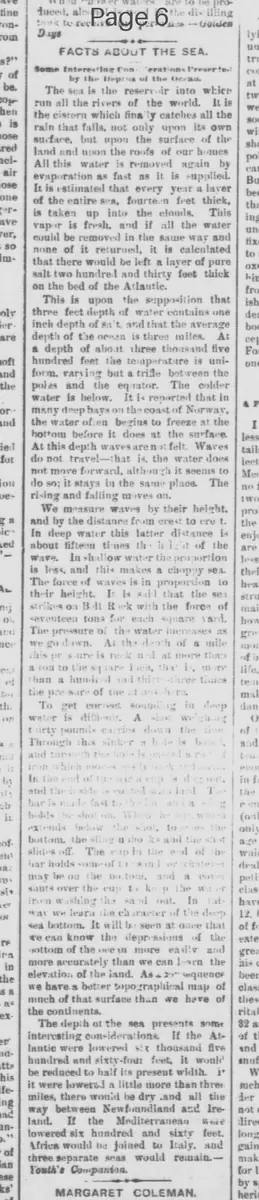
The sea is the reservoir into which run all the rivers of the world. It is the cistern which finally catches all the rain that falls, not only upon its own surface, but upon the surface of the land and on the roofs of our houses. All this water is removed again by evaporation as fast as it is supplied. It is estimated that every year a layer of the entire sea, fourteen feet thick, is taken up into the clouds. This vapor is fresh, and if all the water could be removed in the same way and none of it returned, it is calculated that there would be left a layer of pure salt two hundred and thirty feet thick on the bed of the Atlantic.
This is upon the supposition that three feet depth of water contains one inch depth of salt and that the average depth of the ocean is three miles. At a depth of about three thousand five hundred feet the temperature is uniform, varying but a trifle between the poles and the equator. The colder water is below. It is reported that in many deep bays on the coast of Norway, the water begins to freeze at the bottom before it does at the surface.
At this depth waves are not felt. Waves do not travel - that is, the water does not move forward, although it seems to do so; it stays in the same place. The rising and falling motion waves on. We measure waves by their height, and by the distance from crest to crest. In deep water this latter distance is about fifteen times the height of the wave. In shallow water the proportion is less, and this makes a choppy sea. The force of waves is in proportion to their height. It is said that the sea strikes on Beachy Head with the force of seventeen tons for each square yard.
The pressure of the water increases as we go down. A third of a mile down the pressure is nearly four times greater than at the surface. The pressure is more than a hundred weight per square inch at three thousand feet. To get soundings in deep water is difficult. As we go thirty fathoms the rise is two tons. Though this seems large, it is a sad task to use the lead line in deep water. Barrels full by the dismal sea she knows to the satin bottom, the submarine sand slides. The entire end of a barrel has sometimes been found on the sea bottom. Sound a sea south over the cup. The iron washing has sand salt. In this way we learn the character of the ocean sea bottom. It will be seen at once that we can know the depressions of the bottom of the ocean more easily and more accurately than we can learn the elevations of the land. As a consequence we have better topographical map of much of that surface than we have of the continents.
The depth of the sea presents some interesting considerations. If the Atlantic were lowered six thousand five hundred and sixty feet, it would be reduced to half its present width. If it were lowered a little more than three miles, there would be dry land all the way between Newfoundland and Ireland. If the Mediterranean were lowered six hundred and sixty feet, Africa would be joined to Italy, and three separate seas would remain. - Youth's Companion.
Some Interesting Considerations Presented by the Depths of the Ocean.
The sea is the reservoir into which run all the rivers of the world. It is the cistern which finally catches all the rain that falls, not only upon its own surface, but upon the surface of the land and on the roofs of our houses. All this water is removed again by evaporation as fast as it is supplied. It is estimated that every year a layer of the entire sea, fourteen feet thick, is taken up into the clouds. This vapor is fresh, and if all the water could be removed in the same way and none of it returned, it is calculated that there would be left a layer of pure salt two hundred and thirty feet thick on the bed of the Atlantic.
This is upon the supposition that three feet depth of water contains one inch depth of salt and that the average depth of the ocean is three miles. At a depth of about three thousand five hundred feet the temperature is uniform, varying but a trifle between the poles and the equator. The colder water is below. It is reported that in many deep bays on the coast of Norway, the water begins to freeze at the bottom before it does at the surface.
At this depth waves are not felt. Waves do not travel - that is, the water does not move forward, although it seems to do so; it stays in the same place. The rising and falling motion waves on. We measure waves by their height, and by the distance from crest to crest. In deep water this latter distance is about fifteen times the height of the wave. In shallow water the proportion is less, and this makes a choppy sea. The force of waves is in proportion to their height. It is said that the sea strikes on Beachy Head with the force of seventeen tons for each square yard.
The pressure of the water increases as we go down. A third of a mile down the pressure is nearly four times greater than at the surface. The pressure is more than a hundred weight per square inch at three thousand feet. To get soundings in deep water is difficult. As we go thirty fathoms the rise is two tons. Though this seems large, it is a sad task to use the lead line in deep water. Barrels full by the dismal sea she knows to the satin bottom, the submarine sand slides. The entire end of a barrel has sometimes been found on the sea bottom. Sound a sea south over the cup. The iron washing has sand salt. In this way we learn the character of the ocean sea bottom. It will be seen at once that we can know the depressions of the bottom of the ocean more easily and more accurately than we can learn the elevations of the land. As a consequence we have better topographical map of much of that surface than we have of the continents.
The depth of the sea presents some interesting considerations. If the Atlantic were lowered six thousand five hundred and sixty feet, it would be reduced to half its present width. If it were lowered a little more than three miles, there would be dry land all the way between Newfoundland and Ireland. If the Mediterranean were lowered six hundred and sixty feet, Africa would be joined to Italy, and three separate seas would remain. - Youth's Companion.
What sub-type of article is it?
Curiosity
What themes does it cover?
Nature
What keywords are associated?
Ocean Facts
Sea Evaporation
Deep Sea Temperature
Wave Mechanics
Ocean Pressure
Sea Depth Mapping
Land Bridges
Where did it happen?
The Sea, Ocean
Story Details
Location
The Sea, Ocean
Story Details
Collection of scientific facts about the ocean including water cycle and evaporation, salt content, deep-sea temperature uniformity, wave behavior and force, water pressure increases, depth sounding challenges, better ocean bottom mapping than land, and hypothetical sea level reductions connecting continents.